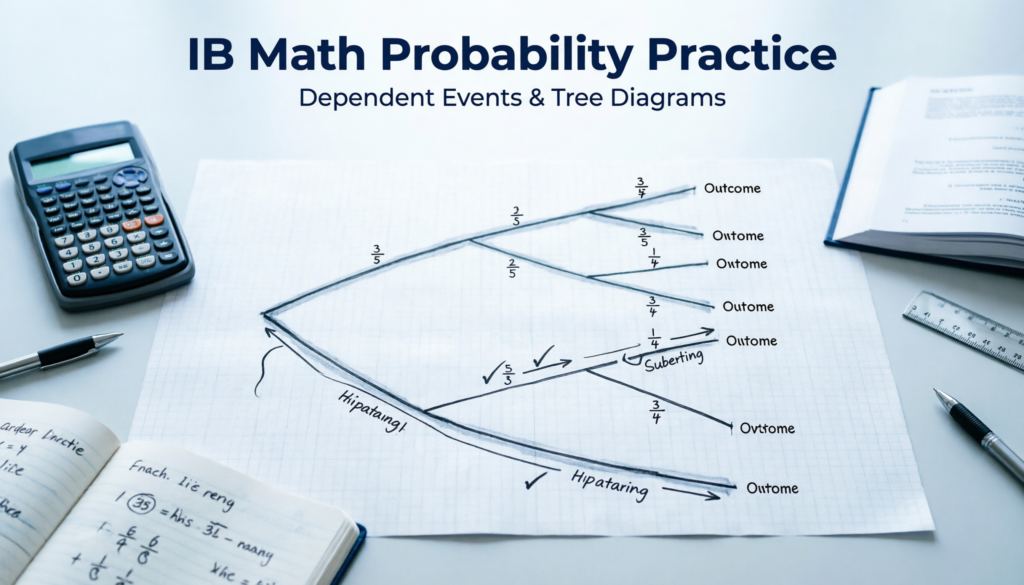
This IB math probability practice question focuses on conditional probability with dependent events — a topic that looks straightforward until the question asks you to work backwards from a result, and suddenly the tree diagram becomes your best friend. Conditional probability appears on both Paper 1 and Paper 2, and the students who score full marks are the ones who draw a careful diagram before writing a single calculation. Before you open any hints, read the question slowly, draw your tree, and label every branch with a fraction. That one habit is worth more than any shortcut.
📋 Jump To
This Week’s IB Math Probability Practice Question
📝 Question of the Week
A bag contains \( 5 \) red marbles and \( 3 \) blue marbles. Two marbles are selected at random from the bag, one after the other, without replacement.
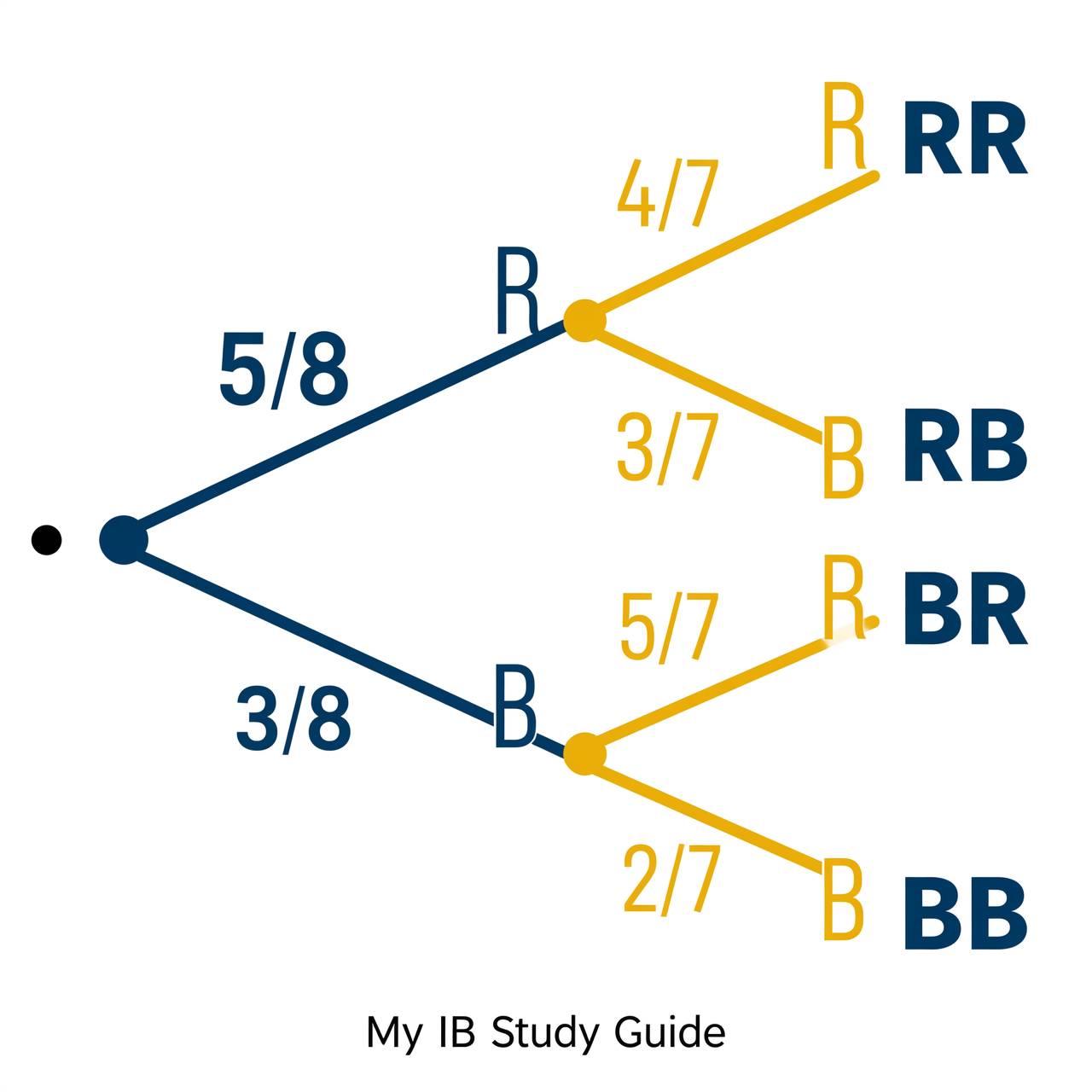
(a) Complete the tree diagram below to show all possible outcomes and their probabilities for the two selections.
[3 marks](b) Find the probability that both marbles selected are the same colour.
[3 marks](c) Given that the second marble selected is red, find the probability that the first marble selected was also red.
[3 marks]Total: [9 marks]
What You Need to Know
📖 Key Information
Topic: Probability — Conditional probability and dependent events (AA SL 4.5–4.6, AA HL 4.5–4.6)
Paper style: Paper 1 (no calculator) — all probabilities are exact fractions
Estimated time: 9–12 minutes
Key formulas from the data booklet:
Multiplication rule for dependent events:
Conditional probability formula:
Key concepts:
- Without replacement: After the first marble is drawn, the total changes from 8 to 7, and the count of the relevant colour also changes. This is what makes the events dependent.
- Tree diagram branches multiply: The probability at each terminal node is the product of all branch probabilities along that path.
- Total probability: To find \( P(\text{second marble is red}) \), add the probabilities of all paths ending in red on the second draw.
If you want to strengthen your understanding of how probability connects to statistics topics like distributions, visit our post on Question of the Week 3: Statistics Challenge for more exam-style practice. You can also review the official syllabus outcomes on the IB Mathematics curriculum page.
Hints
💡 Hint 1 — Getting Started
Begin by drawing the tree diagram carefully. For the first draw, there are 8 marbles total: 5 red and 3 blue. So the first-level branch probabilities are \( \frac{5}{8} \) for red and \( \frac{3}{8} \) for blue. Now think about what happens to the totals for the second draw — you have one fewer marble, and one fewer of whichever colour was drawn first. There are four possible paths: RR, RB, BR, BB.
⏸ Try working with this hint before opening Hint 2.
💡 Hint 2 — Second-Level Branches and Part (b)
For the second draw, the denominators all become 7 (one marble has been removed). If the first marble was red, there are now 4 red and 3 blue left. If the first was blue, there are 5 red and 2 blue left. For part (b), “both the same colour” means either RR or BB. Calculate the probability of each path by multiplying along the branches, then add:
⏸ Try completing parts (a) and (b) before opening Hint 3.
💡 Hint 3 — Conditional Probability in Part (c)
Part (c) asks: given that the second marble is red, what is the probability the first was red? This is Bayes-style conditional probability. Use the formula:
You already know \( P(RR) \) from part (b). For the denominator, find \( P(\text{second R}) \) by adding all paths where the second marble is red: that is \( P(RR) + P(BR) \).
⏸ Now try finishing the solution on your own.
Full Worked Solution
✍️ Step-by-Step Solution
Part (a) Step 1: Set Up the Tree Diagram
For this IB math probability practice question, we begin with 5 red (R) and 3 blue (B) marbles — 8 total. The first-level branches are:
After the first draw (without replacement), 7 marbles remain. The second-level conditional probabilities are:
Part (a) Step 2: Calculate All Four Path Probabilities
Multiply along each branch path to find the probability of each outcome:
Verification: \( \frac{20}{56} + \frac{15}{56} + \frac{15}{56} + \frac{6}{56} = \frac{56}{56} = 1 \checkmark \)
Part (b): Probability That Both Marbles Are the Same Colour
“Same colour” means either both red (RR) or both blue (BB). These are mutually exclusive outcomes, so we add their probabilities:
Part (c) Method 1: Using the Conditional Probability Formula
We need \( P(\text{1st R} \mid \text{2nd R}) \). First, find the total probability that the second marble is red by summing all paths ending in R on the second draw:
Now apply the conditional probability formula:
Part (c) Method 2: Intuitive Check Using Symmetry
As a sense-check: of the 35 equally weighted “units” where the second marble is red, 20 of them come from the RR path (first marble was red) and 15 come from the BR path (first was blue). So the probability is \( \frac{20}{35} = \frac{4}{7} \) — confirming our answer.
(a) Tree diagram completed with first-level branches \( \frac{5}{8} \) (R) and \( \frac{3}{8} \) (B); second-level conditional branches as shown above; all four path probabilities correctly calculated.
(b) \( P(\text{same colour}) = \frac{13}{28} \)
(c) \( P(\text{1st R} \mid \text{2nd R}) = \frac{4}{7} \)
(a) [A1] Correct first-level probabilities \( \frac{5}{8} \) and \( \frac{3}{8} \); [A1] Correct second-level probabilities from R branch; [A1] Correct second-level probabilities from B branch — 3 marks
(b) [M1] Identifying correct paths RR and BB; [A1] Correct unsimplified sum \( \frac{20}{56} + \frac{6}{56} \); [A1] Simplified answer \( \frac{13}{28} \) — 3 marks
(c) [M1] Correct identification of conditional probability structure; [M1] Correct denominator \( P(\text{2nd R}) = \frac{35}{56} \); [A1] Correct answer \( \frac{4}{7} \) — 3 marks
Total: 9 marks
Examiner Notes
🎓 What the Examiner Wants to See
- Label every branch with a fraction, not a decimal. On Paper 1, exact fractions are required. Writing \( 0.625 \) instead of \( \frac{5}{8} \) will not earn accuracy marks. The IB expects exact values throughout a no-calculator probability question.
- Show the multiplication for each path explicitly. Write \( P(RR) = \frac{5}{8} \times \frac{4}{7} \) before simplifying. This secures the method mark even if you simplify incorrectly.
- Verify your tree sums to 1. Add all four terminal probabilities before moving on. If they do not sum to 1, you have an error in your branches — catching it now saves you from carrying mistakes into parts (b) and (c).
- In part (c), clearly state the conditional probability formula. Write \( P(A \mid B) = \frac{P(A \cap B)}{P(B)} \) and identify what \( A \) and \( B \) are in context. This demonstrates structured mathematical reasoning and earns the method mark.
- Follow-through marks apply. If your branch probabilities in part (a) are wrong but you correctly apply the conditional probability method in part (c) using your own values, you can still earn the method marks.
Common Mistakes
❌ Common Mistakes to Avoid
1. Treating the events as independent (forgetting “without replacement”)
The most common error is keeping the denominator at 8 for the second draw, giving second-level probabilities of \( \frac{5}{8} \) and \( \frac{3}{8} \) regardless of what was drawn first. This treats the draws as independent — which they are not. Without replacement means the total drops to 7 and the remaining colour counts change. This error corrupts every subsequent calculation and can cost all 9 marks.
2. Confusing P(first R | second R) with P(second R | first R)
Part (c) asks for the probability the first was red given the second is red — a backward conditional. Many students instead calculate the much simpler \( P(\text{2nd R} \mid \text{1st R}) = \frac{4}{7} \), which is already on the tree. The two probabilities happen to be equal in this question, but this is a coincidence — always write out the formula and substitute correctly to avoid confusion in other contexts.
3. Forgetting to include all paths when finding P(second R)
In part (c), some students use only \( P(RR) \) as the denominator, giving \( \frac{20/56}{20/56} = 1 \) — which is clearly wrong. The denominator must be the total probability that the second marble is red, which includes both paths ending in R on the second draw: \( P(RR) + P(BR) = \frac{35}{56} \). Drawing and labelling the tree first makes this error almost impossible to make.
HL Extension: If you are studying AA HL, notice that \( P(\text{2nd R}) = \frac{5}{8} \), which equals \( P(\text{1st R}) \). This is not a coincidence — for sampling without replacement from a finite population, the marginal probability of drawing a particular colour on any given draw is always the same as the initial proportion. Can you prove this result for the general case of \( r \) red and \( b \) blue marbles?
📚 Want More Practice?
Statistics and Probability Workbook (Coming Soon)
Probability practice from conditional probability to distributions — covering tree diagrams, Venn diagrams, and all calculation methods with full solutions and examiner notes for every question.
$10.45
Get the Statistics Workbook on SamzHub →Every time you work through an IB math probability practice question like this one, you are training yourself to read dependent-event problems carefully, draw before calculating, and apply conditional probability with confidence — three habits that will serve you in every exam you sit. Come back next week for another challenge and keep building that momentum.