
βœ“

Free forever

β€’

βœ“

No credit card required

Free Template: IB Exam Study Schedule

An optimized revision timetable designed specifically for the intense IB Diploma exam period.

What's Included

βœ“

Customizable Timeline:Β A spreadsheet template you can tailor to your subjects and exam dates.

βœ“

Spaced Repetition:Β A schedule that automatically plans review sessions at optimal intervals.

βœ“

Burnout Prevention:Β Scheduled breaks and flexible days to keep your mental health intact.

βœ“

Subject Prioritization:Β A formula to calculate how much time to dedicate to HLs vs SLs.

πŸ“š

Created by IB educators

πŸ‘₯

Used by 500+ students

πŸ”„

Regularly updated

Get Your Free Copy

πŸ“§ Sent instantly to your inbox

πŸ”’ No spam. Unsubscribe anytime.

Study Tool

IB Revision Schedule & Planner

Why You Need This Resource

Don't Miss Easy Points

Rubric requirements can be confusing. We translated examiner-speak into simple concepts.

Gain Confidence

Knowing your format, structure, and math are exactly what’s required relieves massive stress.

Save Revision Time

Use these resources throughout your learning process, not just at the end.

Read Related Articles

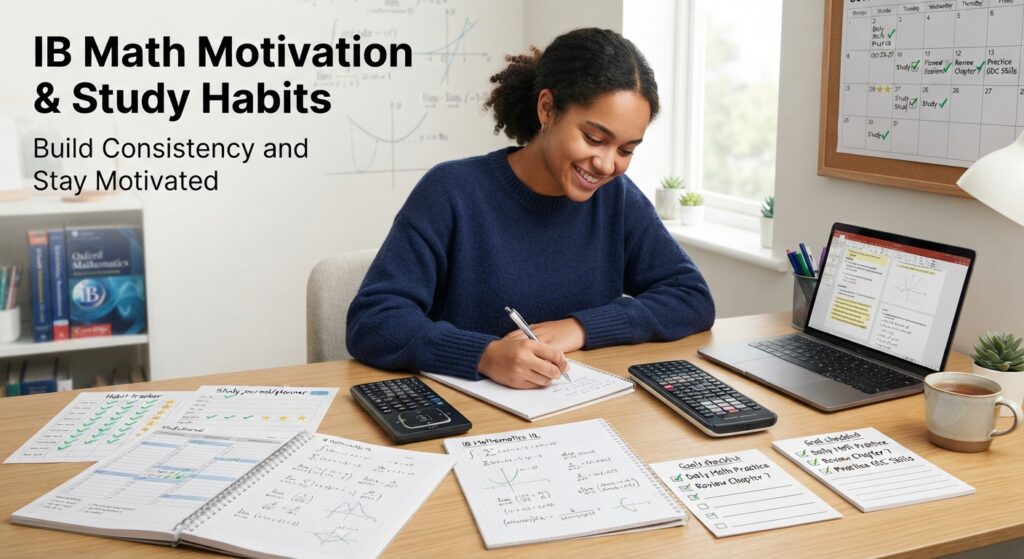
Student using IB math motivation study tips to overcome low energy and build consistent study habits

IB Math Motivation Study Tips: Proven Guide to Keep Going

If you’re searching for IB math motivation study tips, chances are you’re sitting in front of your textbook right now feeling absolutely nothing β€” and that’s more common than you think. πŸ“‹ In This Guide Why Motivation Disappears The Difference Between Motivation and Discipline What to Do on Low-Motivation Days The 10-Minute Start Method How to Build Momentum Again Key Takeaways Frequently Asked Questions Let’s skip the pep talk. You already know IB Math is important. You know your grade matters. The problem isn’t awareness β€” it’s that knowing something matters and actually feeling motivated to do it are two completely different things. Maybe you’ve been grinding for weeks and you’re burnt out. Maybe the topic you’re on feels pointless. Maybe you got a bad test score and now everything feels hopeless. Whatever the reason, your IB math motivation has flatlined β€” and no amount of “just try harder” advice is going to fix that. This guide takes a different approach. Instead of trying to pump you full of temporary inspiration, we’ll focus on practical IB math motivation study tips that work even when you feel nothing. These strategies are designed for real students in real slumps β€” not motivational poster clichΓ©s. If you’re also looking to build a study structure that requires less willpower, check out our ultimate IB Math study schedule guide. Why Motivation Disappears Before you can fix the problem, it helps to understand why it’s happening. Motivation isn’t a personality trait β€” it’s a temporary emotional state that fluctuates constantly. And several things specific to IB Math make it especially fragile: The difficulty curve: IB Math gets harder as the course progresses. What felt manageable in September can feel crushing by February. Delayed results: Unlike some subjects where effort translates quickly to better grades, math improvement is often slow and invisible β€” until it suddenly clicks. Comparison: Seeing classmates who seem to “get it” effortlessly can make you feel like something is wrong with you. It isn’t. Cumulative pressure: IB Math doesn’t exist in isolation. You’re also managing five other subjects, TOK, CAS, your Extended Essay, and your Internal Assessment (IA). Burnout: If you’ve been pushing hard without real breaks, your brain eventually shuts down the motivation system to protect itself. Notice that none of these causes are about you being lazy or incapable. They’re natural responses to a genuinely demanding programme. Understanding this is the first step in rebuilding your IB math motivation. πŸ’‘ Pro Tip If your motivation has been gone for more than two weeks and you’re also feeling persistently sad, exhausted, or withdrawn, please talk to a trusted adult, your school counsellor, or your IB coordinator. Burnout and mental health struggles are real, and getting support is a sign of strength β€” not weakness. The Difference Between Motivation and Discipline Here’s the most important mindset shift in this entire post: you don’t need motivation to study β€” you need a system. Motivation is an emotion. It comes and goes like any other feeling. Some days you’ll feel excited about math. Most days you won’t. If you only study when you feel motivated, you’ll study about 20% of the time you actually need to. Discipline is different. Discipline is showing up because you’ve decided in advance that this is what you do at this time, regardless of how you feel. It sounds less exciting β€” but it’s far more reliable. πŸ“Œ Important Discipline doesn’t mean forcing yourself through two-hour sessions when you’re exhausted. It means doing something β€” even something small β€” on the days you’ve committed to. The size of the session can vary. The consistency of showing up cannot. The good news? Discipline gets easier over time. The first week of showing up without motivation is hard. By week three, it starts to feel automatic. And here’s the irony β€” motivation often returns once you start seeing progress, and progress only comes from consistent action. What to Do on Low-Motivation Days Not every study session needs to be a full-intensity, deep-focus marathon. On days when your IB math motivation is at rock bottom, your goal shifts from “learn new things” to “don’t break the chain.” Here’s what that looks like in practice: Low-Energy Study Options Review your formula sheet β€” spend 10 minutes reading through formulas for the current topic. No problem solving required. Redo a problem you’ve already solved β€” repetition builds fluency without requiring new cognitive effort. Organise your notes β€” clean up your binder, label sections, or create a topic summary page. Watch one short explanation video β€” sometimes a different voice explaining a concept can reignite interest. Do exactly 3 problems β€” not 10, not 20. Just 3. Choose ones from a topic you’re relatively comfortable with. The point isn’t to make massive progress on these days. The point is to maintain your connection to the subject so that when your energy returns, you’re not starting from zero. ⚠️ Watch Out Don’t let “low-motivation days” become every day. These reduced sessions are a bridge to get you through tough patches β€” not a permanent study strategy. If every day feels like a low-motivation day for more than two weeks, something deeper needs to change. Revisit your schedule, your sleep, and your overall workload. The 10-Minute Start Method β€” The Most Effective IB Math Motivation Study Tip This is the single most powerful technique for overcoming motivation blocks, and it works because it exploits how your brain actually functions. How It Works Commit to exactly 10 minutes. Not 30. Not an hour. Tell yourself: “I will do 10 minutes of math, and then I can stop.” Set a timer. Use your phone, a kitchen timer, or any app. The timer makes it concrete. Start with something easy. Open your textbook to a section you’ve already covered. Do one or two straightforward problems. When the timer goes off, decide. You have full permission to stop. But ask yourself: “Do I want to keep going for 10 more minutes?”

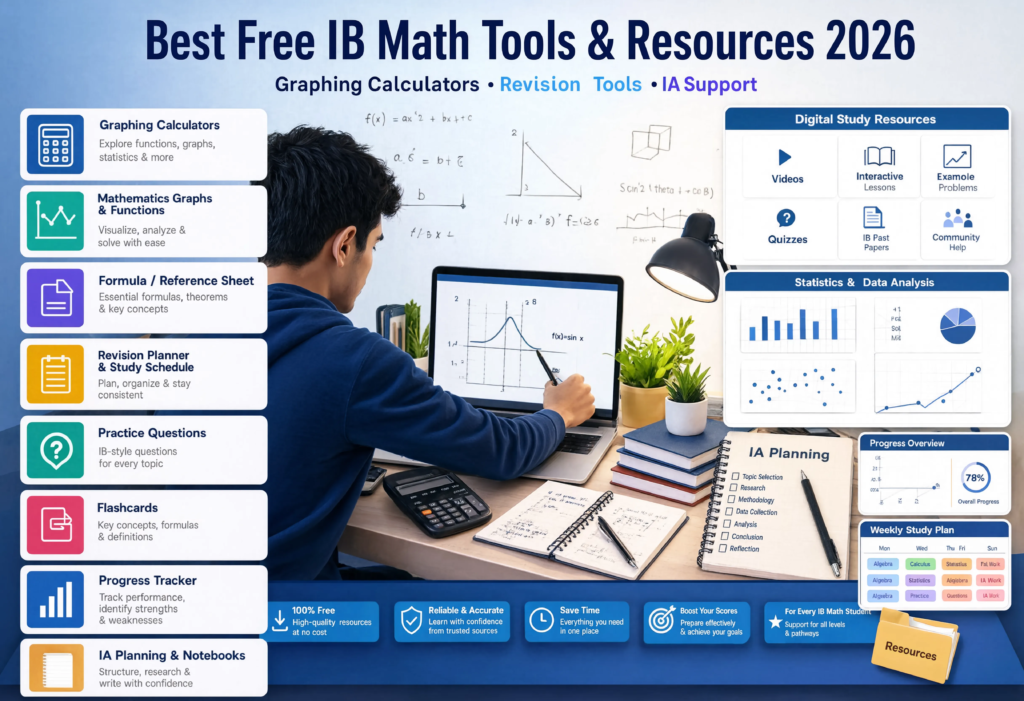
Collection of the best IB math free tools resources 2026 including graphing calculators revision apps and IA support

IB Math Free Tools Resources 2026: Essential Top Picks

The best IB math free tools resources 2026 can transform how you study, practice, and prepare β€” without costing you a single dollar. πŸ“‹ In This Guide Why Free Tools Matter Best Graphing and Visualisation Tools Best Calculator and Formula Resources Best Productivity Tools Best IA Support Tools Best Revision Tools Key Takeaways IB Math students have access to more free resources today than any previous generation β€” but the sheer number of options makes it hard to know which ones are actually worth your time. You don’t need twenty apps. You need the right five or six tools that cover your core needs: graphing, practice, formula reference, organisation, and IA support. This guide rounds up the most useful IB math free tools and resources for 2026, tested and recommended specifically for Diploma Programme students taking Analysis and Approaches (AA) or Applications and Interpretation (AI) at Standard Level (SL) or Higher Level (HL). Every tool listed here is genuinely free β€” no hidden paywalls, no “free for 7 days” tricks. If you’re looking for ways to structure your study time around these tools, our ultimate IB Math study schedule guide is a great companion to this post. Why Free Tools Matter for IB Math in 2026 Let’s be clear: free doesn’t mean low quality. Some of the most powerful tools used by IB Math students worldwide β€” including ones recommended by teachers and examiners β€” cost absolutely nothing. Here’s why leveraging them matters: They level the playing field: Not every student can afford private tutoring or premium subscriptions. Free tools ensure everyone has access to quality resources. They build technology skills: Both AA and AI courses expect you to use technology confidently. Practising with free graphing and calculation tools develops this fluency. They support independent learning: The best free resources let you explore concepts at your own pace, revisit difficult topics, and test yourself without waiting for class. They complement your textbook: Your textbook covers the syllabus, but interactive tools help you understand it in ways static pages can’t. The key is choosing tools that align with what IB Math actually requires β€” not just generic math apps. Every tool below has been selected because it directly supports IB Math coursework, revision, or your Internal Assessment (IA). Best Graphing and Visualisation Tools Graphing tools are non-negotiable for IB Math. Whether you’re exploring functions, checking your work, or building visuals for your IA, these are the tools you should know: Desmos What it does: Free online graphing calculator with an incredibly intuitive interface. Plot functions, add sliders for parameters, explore transformations, and create beautiful graphs. Why IB students love it: It’s fast, works in any browser, and handles nearly everything the IB syllabus throws at it β€” from trigonometric functions to regression models. It’s also allowed in many classrooms as a support tool. For a full walkthrough, check out our guide on how to use Desmos for IB Math. GeoGebra What it does: A more comprehensive platform that combines graphing, geometry, algebra, calculus, and statistics tools in one place. Why IB students love it: GeoGebra is particularly strong for geometry explorations and IA projects. Its 3D graphing feature is excellent for HL students exploring surfaces and volumes. It also has a huge library of shared resources created by other teachers and students. πŸ’‘ Pro Tip Learn both Desmos and GeoGebra. Use Desmos for quick daily graphing and homework checks. Use GeoGebra for deeper explorations, geometry, and IA visualisations. Together, they cover virtually every graphing need you’ll have in IB Math. Best Calculator and Formula Resources Knowing your calculator and your formula booklet inside out is one of the highest-return investments you can make. These free resources help: The IB Mathematics Formula Booklet (Official) What it is: The official formula booklet provided during exams, available as a free PDF from the IBO Mathematics curriculum page. How to use it: Don’t just read it β€” practise finding formulas quickly under time pressure. Know which formulas are in the booklet and which ones you need to memorise. Our guide on how to use the IB Math formula booklet like a pro covers this in detail. Wolfram Alpha (Free Version) What it does: Solves equations, computes integrals, runs statistical calculations, and shows step-by-step solutions (limited in free version but still highly useful). Best for: Checking your work on homework and IA calculations. Use it to verify answers β€” never as a replacement for learning the process yourself. ⚠️ Watch Out Using Wolfram Alpha to check answers is smart studying. Using it to skip the solving process is not. If you can’t solve the problem without the tool, you won’t be able to solve it on the exam either. Always attempt problems independently first. Best Productivity Tools The right productivity tools help you stay organised and consistent β€” both critical for IB math free tools resources in 2026 that go beyond just content. Google Calendar / Apple Calendar How to use it for IB Math: Block out your math study sessions as recurring events. Set reminders 15 minutes before each session. Colour-code math differently from your other subjects so you can instantly see whether your week has enough math time. Notion or Google Sheets How to use it for IB Math: Build a simple topic tracker β€” list every syllabus topic, rate your confidence (1–5), and update it weekly. This gives you a visual map of what you know and what still needs work. Both tools are free and flexible enough to customise to your needs. πŸ“š Recommended Resource AA SL Mock Exam Pack Includes realistic exam practice designed to complement the free tools and resources you’re already using. Build exam confidence with papers that mirror real IB conditions β€” plus exposure to the question types that appear most frequently. $12 Get the AA SL Mock Exam Pack on SamzHub β†’ Best IA Support Tools Your Internal Assessment requires research, data collection, mathematical analysis, and professional presentation. These free tools cover each stage: Google Scholar

Student using IB math time management subjects strategies to balance workload across all IB Diploma subjects

How to Balance IB Math With Your Other Subjects

Effective IB math time management subjects balancing is one of the biggest challenges Diploma Programme students face β€” and the students who figure it out early are the ones who thrive. πŸ“‹ In This Guide Why Math Feels Harder to Balance Than Other Subjects How Much Time Math Really Needs The Weekly Time-Block Method What to Do During Heavy Assessment Weeks The 80/20 Rule for IB Math Key Takeaways Frequently Asked Questions You’re not imagining it β€” the IB Diploma is genuinely a lot. Six subjects, Theory of Knowledge, CAS, your Extended Essay, and Internal Assessments for almost everything. Add in extracurriculars and a social life, and it’s no wonder that IB math time management across all your subjects feels impossible some weeks. The problem isn’t that you’re lazy or disorganized. The problem is that most students never learn how to distribute their time across subjects strategically. They default to working on whatever deadline is closest, which means IB Math β€” a subject that requires consistent daily practice β€” keeps getting pushed to the bottom of the list. This guide gives you practical, tested strategies for managing your IB math workload alongside everything else on your plate. Whether you’re taking Analysis and Approaches (AA) or Applications and Interpretation (AI), at Standard Level (SL) or Higher Level (HL), these methods will help you stay on top of math without sacrificing your other subjects. For a deep dive into structuring your math study time specifically, check out our guide on the ultimate IB Math study schedule. Why Math Feels Harder to Balance Than Other Subjects Not all IB subjects are equal when it comes to time management. Math has some unique characteristics that make it harder to balance: It’s cumulative: Unlike subjects where each unit is somewhat self-contained, IB Math builds directly on previous topics. Miss a week and you’re playing catch-up for months. It requires active practice: You can’t learn math by reading β€” you have to solve problems. That takes time and focused energy. It’s mentally demanding: Math uses a different kind of cognitive effort than essay writing or language practice. You need to be alert, not just awake. Homework alone isn’t enough: Unlike some subjects where completing assignments keeps you on track, math requires additional practice beyond what’s assigned. This is why so many students find that math is the first subject to slip when things get busy. It’s not that they don’t care β€” it’s that math is the easiest subject to fall behind in and the hardest to catch up on. πŸ’‘ Pro Tip Think of IB Math like a sport. You can’t skip practice for three weeks and expect to perform well in the match. Small, frequent sessions are far more valuable than occasional long ones. This mindset shift is the foundation of effective IB math time management across subjects. How Much Time Math Really Needs Before you can balance math with your other subjects, you need to know how much time it actually requires. Here are realistic weekly guidelines for study time outside of class: Weekly Time Guidelines by Level and Year SL Year 1: 3–4 hours (including homework + review) SL Year 2: 4–6 hours (increasing as exams approach) HL Year 1: 5–7 hours (including homework + extra practice) HL Year 2: 6–9 hours (including revision and past papers) Now here’s the important context: you have six subjects, plus TOK, CAS, and your Extended Essay. If each subject needed 5–7 hours outside class, that would be 30–42 hours on top of school. That’s clearly not sustainable. πŸ“Œ Important The reality is that not every subject needs the same amount of outside time every week. Some weeks your English IA will dominate. Other weeks, math revision will take priority. The skill is knowing how to flex your schedule without dropping any subject completely β€” and always keeping math at a minimum baseline. That minimum baseline? At least 30 minutes of math practice on 4–5 days per week, no matter what else is going on. This is non-negotiable if you want to avoid falling behind. Everything beyond that baseline can flex based on deadlines and assessment schedules. The Weekly Time-Block Method for IB Math Time Management Subjects Time-blocking is one of the most effective strategies for balancing IB subjects, and it works especially well for protecting your math study time. Here’s how to set it up: Step-by-Step Setup Map your fixed commitments: School hours, sports, extracurriculars, meals, and sleep. These are non-negotiable. Identify your open blocks: These are your available study windows β€” typically after school, evenings, and weekends. Assign math first: Block your math study sessions before filling in other subjects. This ensures math always has protected time. Distribute remaining subjects: Assign your other IB subjects to the remaining open blocks, prioritizing based on upcoming deadlines. Leave buffer blocks: Keep 2–3 blocks per week unassigned. These are your overflow blocks for unexpected assignments or catch-up. Sample Weekly Distribution Math: 5 blocks (Mon–Fri, 35–45 min each) β€” protected, non-negotiable HL Subject 2: 4 blocks β€” adjust based on workload HL Subject 3: 4 blocks β€” adjust based on workload SL Subjects: 2–3 blocks each β€” lower baseline, increase around deadlines TOK/EE/CAS: 1–2 blocks β€” schedule these or they’ll never happen Buffer blocks: 2–3 unassigned β€” for overflow and flexibility πŸ’‘ Pro Tip Place your math blocks at the same time each day if possible. Building a habit around a consistent time removes the daily decision of “when should I study math?” and makes it much easier to stay consistent. For a detailed routine-building approach, read our guide on how to create a weekly study routine that sticks. What to Do During Heavy Assessment Weeks Every IB student knows the feeling: three assignments due on Friday, an in-class essay on Thursday, and a math test on Monday. Heavy assessment weeks are when subject balance collapses β€” unless you have a plan. Your Heavy Week Protocol Triage your deadlines: List everything due this week and next. Rank