

Effective IB math time management subjects balancing is one of the biggest challenges Diploma Programme students face — and the students who figure it out early are the ones who thrive.
📋 In This Guide
You’re not imagining it — the IB Diploma is genuinely a lot. Six subjects, Theory of Knowledge, CAS, your Extended Essay, and Internal Assessments for almost everything. Add in extracurriculars and a social life, and it’s no wonder that IB math time management across all your subjects feels impossible some weeks.
The problem isn’t that you’re lazy or disorganized. The problem is that most students never learn how to distribute their time across subjects strategically. They default to working on whatever deadline is closest, which means IB Math — a subject that requires consistent daily practice — keeps getting pushed to the bottom of the list.
This guide gives you practical, tested strategies for managing your IB math workload alongside everything else on your plate. Whether you’re taking Analysis and Approaches (AA) or Applications and Interpretation (AI), at Standard Level (SL) or Higher Level (HL), these methods will help you stay on top of math without sacrificing your other subjects. For a deep dive into structuring your math study time specifically, check out our guide on the ultimate IB Math study schedule.
Why Math Feels Harder to Balance Than Other Subjects
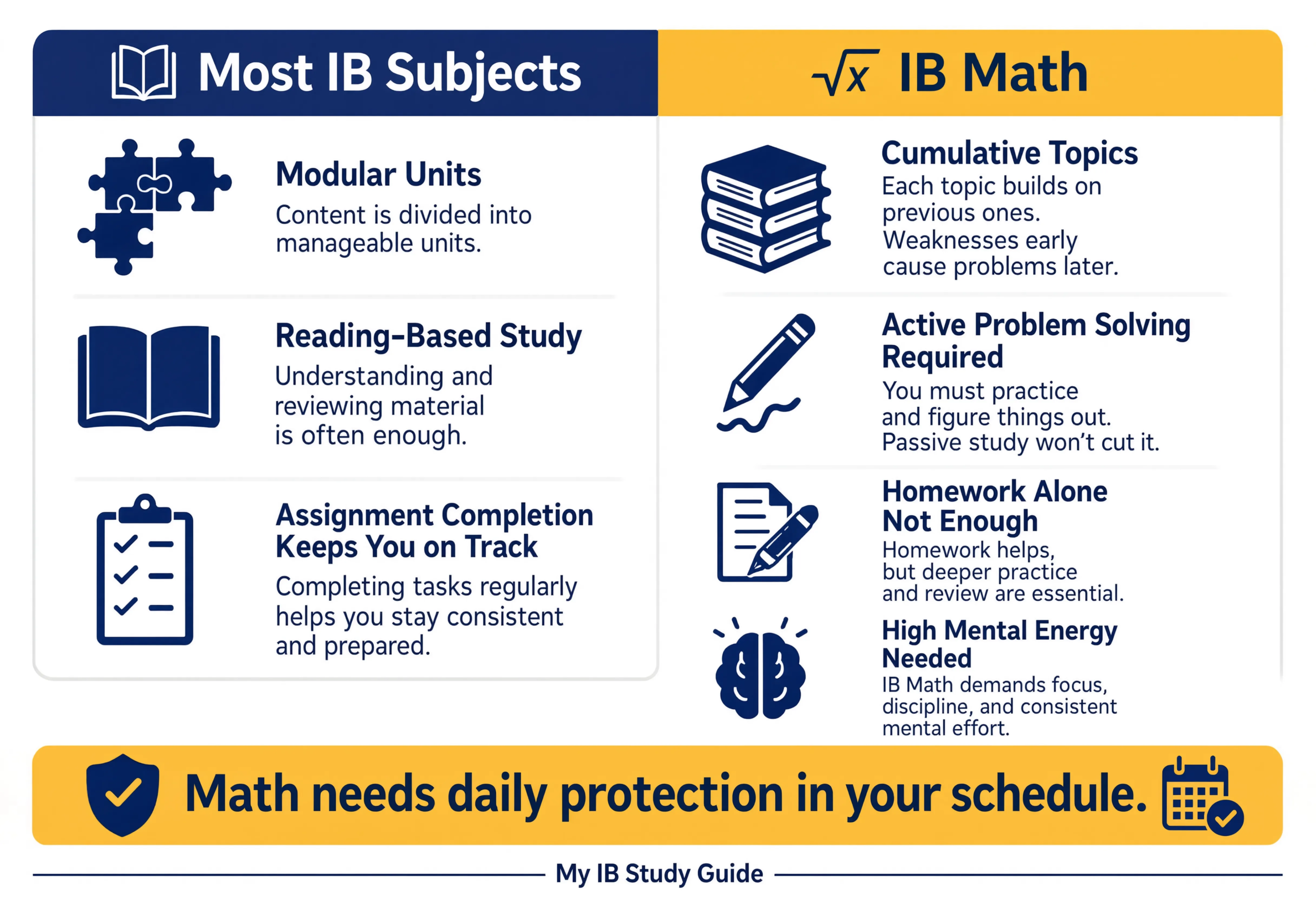
Not all IB subjects are equal when it comes to time management. Math has some unique characteristics that make it harder to balance:
- It’s cumulative: Unlike subjects where each unit is somewhat self-contained, IB Math builds directly on previous topics. Miss a week and you’re playing catch-up for months.
- It requires active practice: You can’t learn math by reading — you have to solve problems. That takes time and focused energy.
- It’s mentally demanding: Math uses a different kind of cognitive effort than essay writing or language practice. You need to be alert, not just awake.
- Homework alone isn’t enough: Unlike some subjects where completing assignments keeps you on track, math requires additional practice beyond what’s assigned.
This is why so many students find that math is the first subject to slip when things get busy. It’s not that they don’t care — it’s that math is the easiest subject to fall behind in and the hardest to catch up on.
💡 Pro Tip
Think of IB Math like a sport. You can’t skip practice for three weeks and expect to perform well in the match. Small, frequent sessions are far more valuable than occasional long ones. This mindset shift is the foundation of effective IB math time management across subjects.
How Much Time Math Really Needs
Before you can balance math with your other subjects, you need to know how much time it actually requires. Here are realistic weekly guidelines for study time outside of class:
Weekly Time Guidelines by Level and Year
- SL Year 1: 3–4 hours (including homework + review)
- SL Year 2: 4–6 hours (increasing as exams approach)
- HL Year 1: 5–7 hours (including homework + extra practice)
- HL Year 2: 6–9 hours (including revision and past papers)
Now here’s the important context: you have six subjects, plus TOK, CAS, and your Extended Essay. If each subject needed 5–7 hours outside class, that would be 30–42 hours on top of school. That’s clearly not sustainable.
📌 Important
The reality is that not every subject needs the same amount of outside time every week. Some weeks your English IA will dominate. Other weeks, math revision will take priority. The skill is knowing how to flex your schedule without dropping any subject completely — and always keeping math at a minimum baseline.
That minimum baseline? At least 30 minutes of math practice on 4–5 days per week, no matter what else is going on. This is non-negotiable if you want to avoid falling behind. Everything beyond that baseline can flex based on deadlines and assessment schedules.
The Weekly Time-Block Method for IB Math Time Management Subjects
Time-blocking is one of the most effective strategies for balancing IB subjects, and it works especially well for protecting your math study time. Here’s how to set it up:
Step-by-Step Setup
- Map your fixed commitments: School hours, sports, extracurriculars, meals, and sleep. These are non-negotiable.
- Identify your open blocks: These are your available study windows — typically after school, evenings, and weekends.
- Assign math first: Block your math study sessions before filling in other subjects. This ensures math always has protected time.
- Distribute remaining subjects: Assign your other IB subjects to the remaining open blocks, prioritizing based on upcoming deadlines.
- Leave buffer blocks: Keep 2–3 blocks per week unassigned. These are your overflow blocks for unexpected assignments or catch-up.
Sample Weekly Distribution
- Math: 5 blocks (Mon–Fri, 35–45 min each) — protected, non-negotiable
- HL Subject 2: 4 blocks — adjust based on workload
- HL Subject 3: 4 blocks — adjust based on workload
- SL Subjects: 2–3 blocks each — lower baseline, increase around deadlines
- TOK/EE/CAS: 1–2 blocks — schedule these or they’ll never happen
- Buffer blocks: 2–3 unassigned — for overflow and flexibility
💡 Pro Tip
Place your math blocks at the same time each day if possible. Building a habit around a consistent time removes the daily decision of “when should I study math?” and makes it much easier to stay consistent. For a detailed routine-building approach, read our guide on how to create a weekly study routine that sticks.
What to Do During Heavy Assessment Weeks
Every IB student knows the feeling: three assignments due on Friday, an in-class essay on Thursday, and a math test on Monday. Heavy assessment weeks are when subject balance collapses — unless you have a plan.
Your Heavy Week Protocol
- Triage your deadlines: List everything due this week and next. Rank by importance and urgency.
- Reduce math to baseline: Drop to your minimum 30 minutes per day, focused only on maintaining current knowledge.
- Use buffer blocks: This is exactly what they’re for — absorbing the overflow from heavy weeks.
- Borrow from next week, not from sleep: If you need extra time, shift a weekend block to this week. Never sacrifice sleep — it destroys your ability to think mathematically.
- Recover the following week: After the heavy week passes, add one extra math session to catch up on any missed practice.
⚠️ Watch Out
The biggest mistake during heavy assessment weeks is dropping math entirely. Even 15 minutes of formula review or 5 practice problems keeps the neural pathways active. Going from daily practice to zero for a full week creates a gap that takes much longer than a week to recover from.
📚 Recommended Service
IB Math Custom IA Plan
You have a topic idea. Now you need a plan that actually works. Get a custom IA outline built specifically for your topic — with a structured mathematical approach, suggested data sources, key formulas, and a clear path from start to submission. Delivered in 3–5 business days. Rush delivery available.
$59
Order your IA Custom Plan on SamzHub →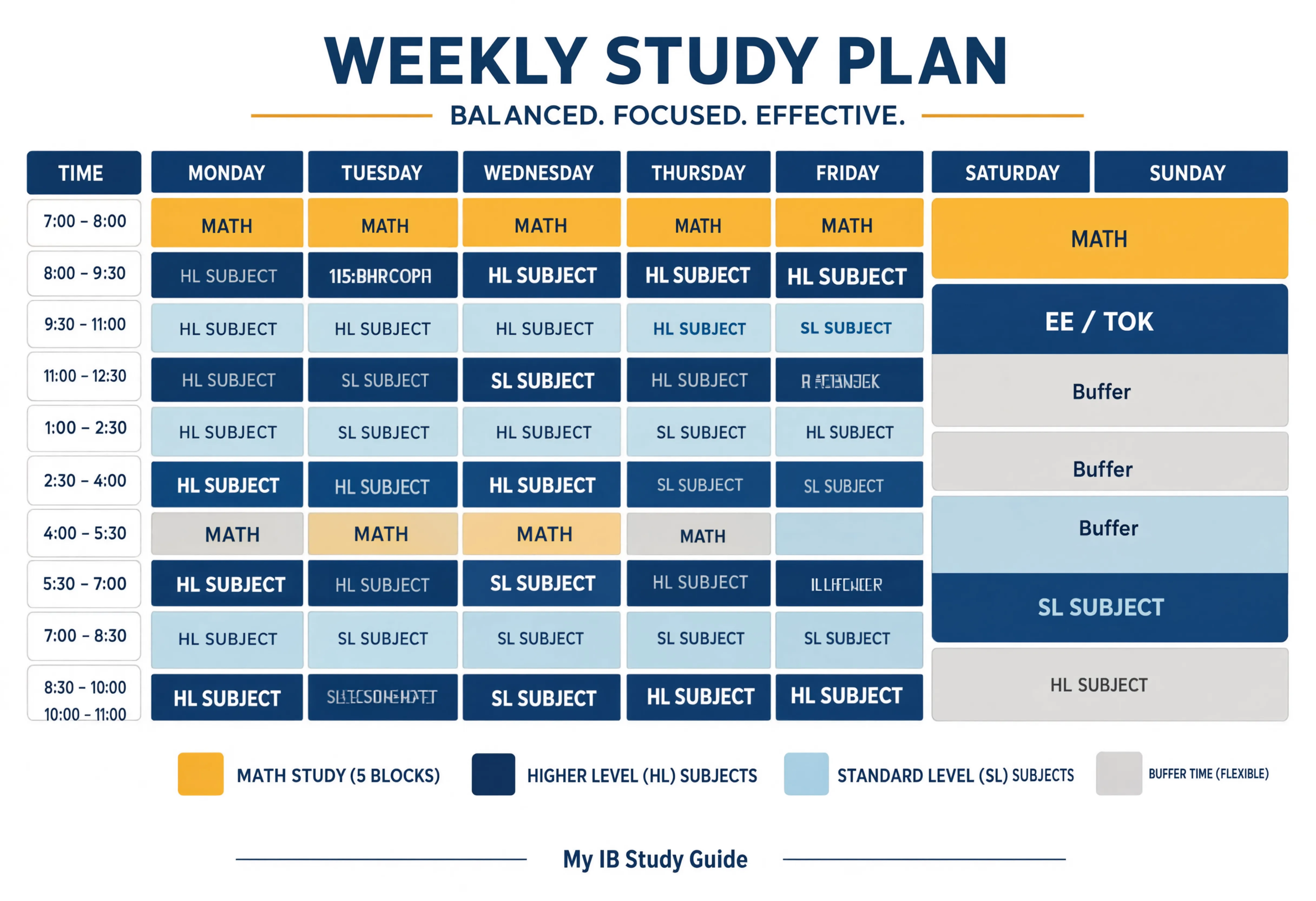
The 80/20 Rule for IB Math
The Pareto Principle — often called the 80/20 rule — states that roughly 80% of results come from 20% of efforts. This applies powerfully to IB Math study and helps you manage your IB math workload more efficiently.
Here’s how to apply it:
- Focus on high-weight topics: Some syllabus topics appear far more frequently on exams than others. Prioritize those in your limited study time.
- Master the common question types: Instead of trying to prepare for every possible question, focus on the types that appear in nearly every exam paper.
- Perfect your formula recall: Knowing your formulas cold saves time on every single problem, giving you more time for the harder questions.
- Review your mistakes, not your strengths: Spending 30 minutes on problems you got wrong is worth more than 2 hours reviewing topics you already understand.
When you’re balancing IB subjects, you can’t afford to study inefficiently. The 80/20 rule ensures that whatever time you give to math produces maximum results. This is the core principle behind effective IB subject management.
📌 Important
The 80/20 rule doesn’t mean ignoring 80% of the syllabus. It means being strategic about where you invest your deepest focus. Cover everything, but go deep on the topics that matter most. Check the official IB Mathematics curriculum guide to understand topic weightings for your course.
✅ Key Takeaways
- IB Math requires consistent daily practice — it’s the first subject to suffer when your schedule breaks down, making IB math time management across subjects essential.
- Set a non-negotiable math baseline of 30 minutes on 4–5 days per week, regardless of what else is happening.
- Use the time-block method to protect math sessions and distribute remaining subjects across your open blocks.
- During heavy assessment weeks, reduce math to baseline but never drop it to zero.
- Apply the 80/20 rule to focus your limited math time on high-impact topics and question types.
Frequently Asked Questions
Balancing IB Math with five other subjects, TOK, CAS, and your Extended Essay isn’t easy — but it’s entirely doable when you have the right system. The key to IB math time management across subjects isn’t working more hours. It’s protecting your math baseline, staying flexible during heavy weeks, and focusing your limited time on what matters most. Start building your schedule this week, and you’ll feel the difference within days.