
Knowing how to choose your IB Math IA topic is one of the most important decisions you’ll make in the Diploma Programme — and most students get it wrong before they’ve written a single word.
📋 In This Guide
If you’re staring at a blank page wondering how to choose your IB Math IA topic, you’re not alone. It’s the question almost every DP1 student gets stuck on — and it matters far more than most people realise. Your topic sets the ceiling for your entire exploration. A strong topic makes every section easier to write. A weak one creates problems that follow you all the way to submission.
The IA is worth 20% of your final IB Math grade. That’s significant. And yet many students rush the topic decision, pick something that sounds impressive without thinking it through, or spend so long deliberating that they run out of time to write well.
This guide gives you a clear, practical process for choosing your IB Math IA topic with confidence. We’ll look at what makes a topic genuinely strong, how to evaluate your ideas against the IB criteria, and the most common mistakes to avoid. This post is written primarily for Analysis and Approaches (AA) students at SL and HL, with notes for Applications and Interpretation (AI) students where relevant.
If you want to understand how your topic will be scored once you start writing, our post on the IB Math IA rubric and how to score 18+ is a great companion to this guide.
What Makes a Good IB Math IA Topic?
Before you start searching for IB Math IA ideas, you need a clear picture of what “good” actually means. A good topic isn’t necessarily the most complex or the most original. It’s one that gives you the best possible conditions to score well across all five criteria.
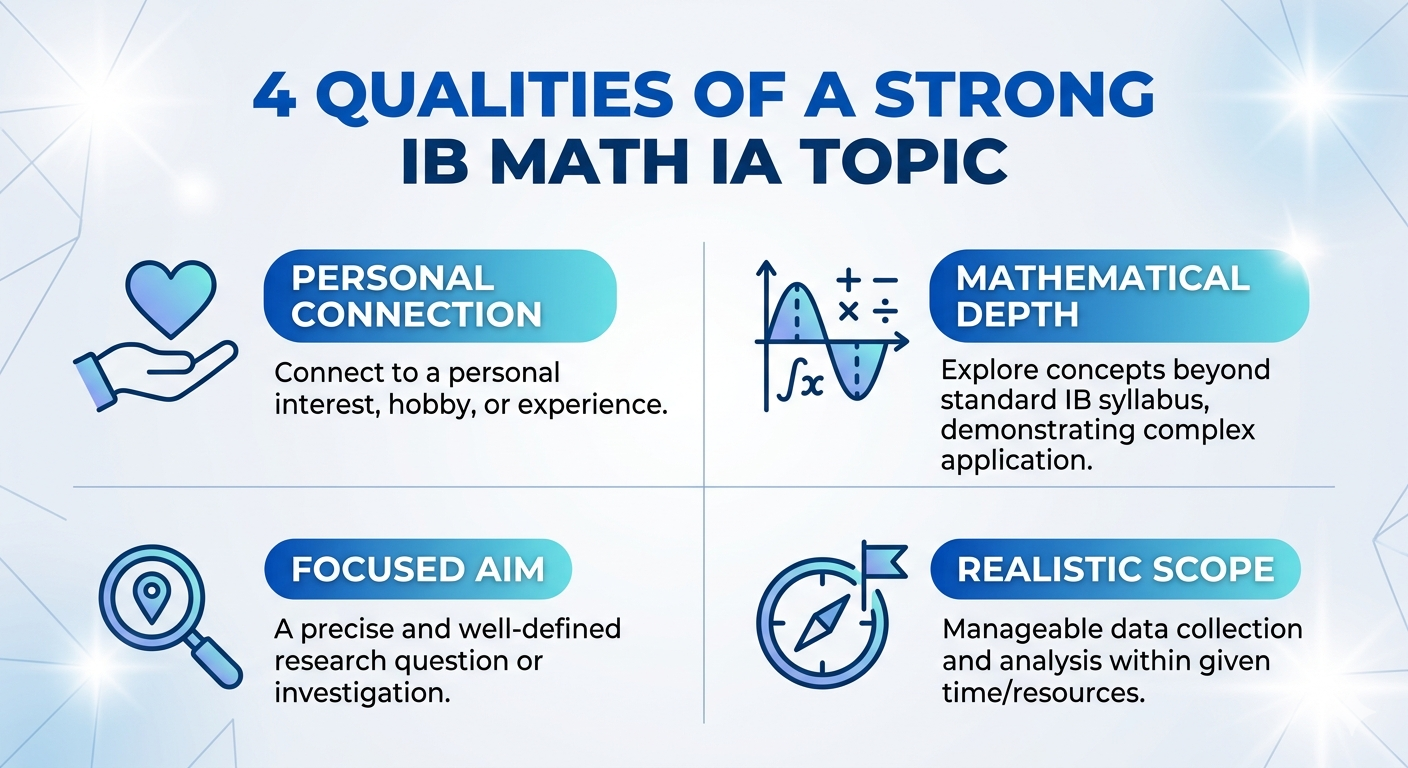
When you’re thinking about how to choose your IB Math IA topic, look for ideas that satisfy all four of these qualities:
- Personal connection — You can explain authentically why this topic interests you
- Mathematical depth — The topic uses mathematics at or above your course level
- Focused aim — You can state your research question clearly in one or two sentences
- Realistic scope — The exploration fits comfortably within 12–20 pages
For AA students, mathematical depth usually means working with concepts like calculus, proof, sequences, or modelling — applied in a way that goes beyond routine textbook exercises. For AI students, depth often comes through meaningful application of statistical tools, regression models, or mathematical modelling to real-world data.
The single most common error students make at this stage is choosing a topic based on how it sounds rather than what it allows them to do. An exploration titled “The Mathematics of Black Holes” might sound impressive, but if the actual maths is surface-level, it won’t score well on Criterion E.
💡 Pro Tip
Test your topic idea with this quick check: can you write a one-sentence aim that includes both the mathematical method and the real-world or abstract context? If you can’t, your topic is either too vague or too broad. Keep narrowing it down.
Practical takeaway: Before you commit to any idea, measure it against these four qualities. If it fails on even one, refine it first.
The 5 Criteria to Evaluate Any IB Math IA Topic Idea
The IB marks your IA on five criteria. Most students only think about these when they’re writing. The smartest approach is to use them as a filter at the topic selection stage — before you’ve invested any real time.
Here’s how each criterion should shape the way you evaluate your IB Math IA topics:
Criterion A — Presentation
Ask yourself: can this topic be structured logically from introduction to conclusion? Topics that are too scattered or too sprawling make clean organisation nearly impossible. A focused aim naturally leads to better presentation.
Criterion B — Mathematical Communication
Will this topic give you enough mathematics to write about? You need opportunities to use proper notation, define variables, draw and label graphs, and show clear working. If your idea is mostly descriptive with only a calculation or two, Criterion B will suffer.
Criterion C — Personal Engagement
This criterion rewards authentic curiosity. Examiners can tell immediately when a student has a genuine connection to their topic versus when they’ve chosen something just to appear capable. Your personal voice — why you care, what you wondered, what surprised you — must come through naturally.
Criterion D — Reflection
Does this topic allow you to reflect meaningfully? Good reflection requires limitations to discuss, unexpected results to consider, and connections to broader mathematical ideas. Topics with a single predictable outcome leave no room for real reflection.
Criterion E — Use of Mathematics
For AA SL, you need mathematics commensurate with the course. For AA HL, the bar is higher — examiners expect sophistication and precision. For AI students, appropriate use of tools like hypothesis testing, regression, or modelling with real data is what drives this criterion.
📌 Important
You don’t need university-level mathematics to score full marks on Criterion E. What you need is correct, relevant, and well-understood use of course-level maths. Choosing a topic that forces you to use mathematics you don’t genuinely understand will hurt you far more than it helps.
Practical takeaway: Write one sentence per criterion explaining how your potential topic addresses it. If you can’t complete all five, that topic needs work — or a replacement.
Topic Selection Process Step by Step
Understanding what makes a strong topic is the theory. Here’s the practical process to actually find yours. Follow these steps in order and you’ll avoid the spiral of indecision that costs students weeks of valuable time.
- Brainstorm freely for 20 minutes. Write down anything you’re genuinely interested in — sports, music, architecture, finance, gaming, nature, design, medicine. Don’t filter at this stage. Volume is the goal.
- Find the mathematical question inside each interest. For each item on your list, ask: “What mathematical question could I explore here?” For example, if you’re interested in cycling, you might explore the mathematics of gear ratios and optimising cadence using modelling and calculus.
- Filter with the 5-criteria check. Take your top three to five ideas and run each one through the five-criterion evaluation above. Remove anything that fails on two or more criteria.
- Write a one-sentence aim for each survivor. If you can’t define a clear aim, the idea is still too vague. Keep narrowing until you can.
- Run a feasibility check. Can you access the data or information you need? Can you execute the mathematics with your current knowledge plus some independent learning? Does the scope fit 12–20 pages?
- Choose one and commit. Perfectionism kills more IAs than imperfect topics do. Once you’ve completed this process, make the decision and move forward.
⚠️ Watch Out
Don’t ask your teacher to pick your topic for you. They can help you evaluate whether a topic is viable — but the choice must come from you. Criterion C specifically rewards your personal engagement, and that starts with your own decision to pursue this particular question.
For more on what the IA structure looks like once you’ve chosen your topic, read our guide on what examiners actually want from your IB Math IA structure.
Practical takeaway: Block out one focused session — not a week of passive thinking — to brainstorm, filter, and define your aim. A single structured sitting is far more productive than weeks of background anxiety.
Common Mistakes When Choosing Topics
Knowing what to avoid is just as useful as knowing what to aim for. These are the mistakes that most consistently damage students at the topic selection stage.
Choosing a Topic That’s Too Broad
“The mathematics of music” is a subject area, not a topic. You need a specific, answerable question. Something like “Modelling the frequency ratios in musical intervals using logarithmic functions” gives you a clear direction, a defined mathematical method, and a realistic scope.
Picking a Topic to Sound Impressive
A topic involving topology or advanced number theory might look ambitious, but if you don’t understand the underlying mathematics deeply, the exploration will be shallow. Examiners reward genuine understanding — not the appearance of sophistication.
Using a Topic From an Online List Without Adapting It
Examiners have reviewed thousands of IAs on the Golden Ratio in art, the Monty Hall problem, and Fibonacci in nature. If you choose a widely used topic, you need a genuinely original angle — and most students who copy the framing don’t deliver one. Use lists for inspiration only, never as your final answer.
Neglecting Personal Engagement From the Start
Some students pick a mathematically solid topic they have no real interest in. By the midpoint, the writing feels forced, the reflection is hollow, and Criterion C produces a low score. Personal engagement isn’t a box you tick at the end — it starts with the topic you choose.
Delaying the Decision
Every week you spend in indecision is a week you’re not writing, not gathering data, and not learning the mathematics you need. Set a firm deadline for your topic decision and hold yourself to it.
💡 Pro Tip
A focused, well-executed exploration on a straightforward topic will consistently outscore a vague, ambitious exploration on a complex one. Depth and clarity beat breadth and complexity every time in IB marking.
Practical takeaway: If you recognise yourself in any of these mistakes, stop and course-correct now. It’s far less costly to fix at the topic stage than after you’ve written ten pages in the wrong direction.
Topic Categories to Consider
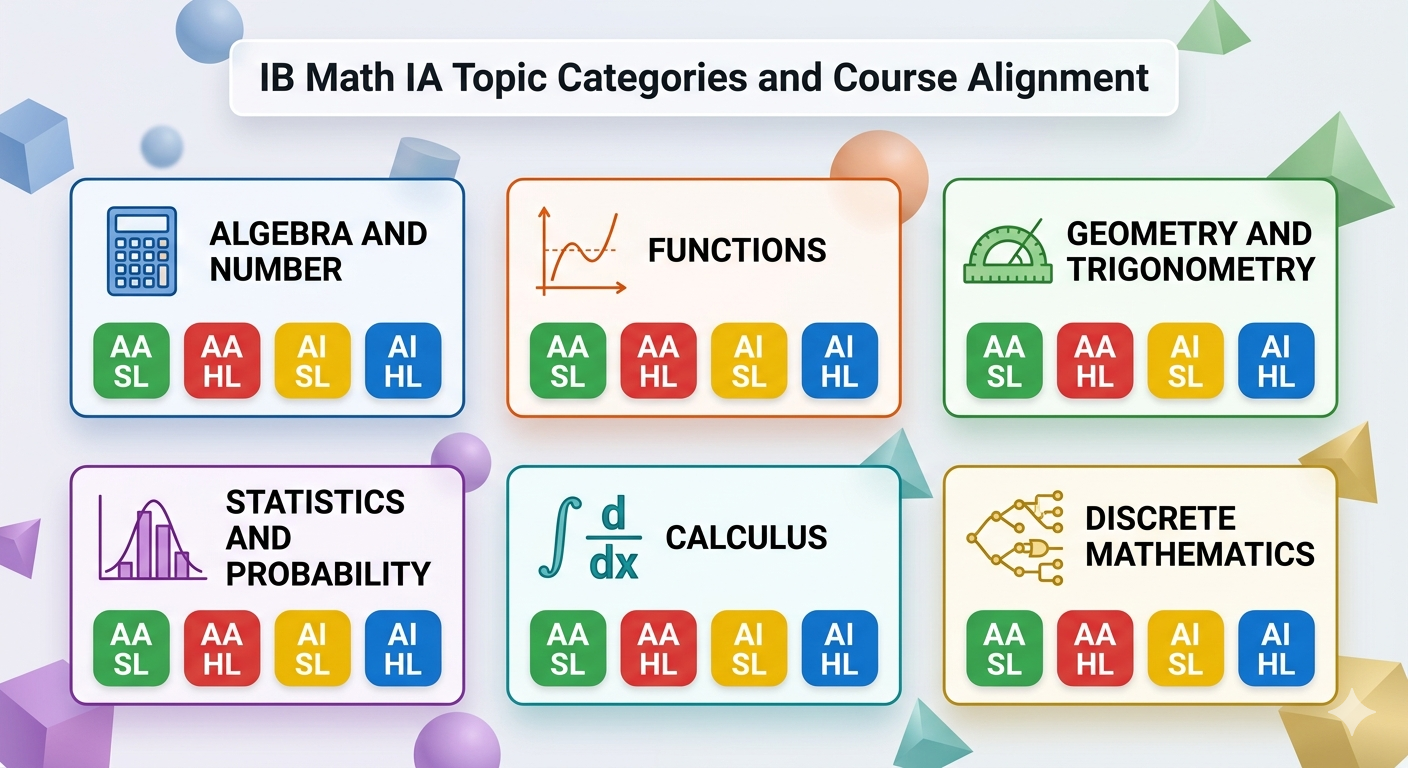
If you’re still searching for IB Math exploration ideas, it helps to think in categories rather than individual topics. Here are the main areas where strong IAs consistently emerge — along with guidance on which course and level each suits best.
Calculus-Based Explorations
Optimisation problems, modelling rates of change, related rates, area and volume investigations. These are natural fits for AA SL and HL students because they draw directly on core syllabus content while allowing genuinely original applications in physics, engineering, biology, or design.
Statistics and Probability
Hypothesis testing with real data, probability modelling in games or sports, expected value analysis, regression investigations. This is an especially strong category for AI students who want to work with authentic, self-collected or publicly available data sets.
Mathematical Modelling and Functions
Using regression curves, trigonometric models, or exponential and logarithmic functions to model real-world phenomena — population dynamics, temperature patterns, sound waves, epidemic spread. Both AA and AI students can produce strong work here when the modelling is genuinely investigative.
Geometry and Trigonometry
Investigating geometric properties, exploring non-Euclidean geometry, optimising shapes, or applying trigonometry to architecture and design. AA HL students often find rich and original material in this space.
Number Theory and Pure Mathematics
Prime distributions, continued fractions, Diophantine equations, proof-based explorations. These topics work best for AA HL students who have a genuine fascination with pure mathematics and the technical toolkit to sustain a rigorous exploration.
Applied and Interdisciplinary Topics
Mathematics in economics, medicine, music, sport, or environmental science. These shine when the mathematics genuinely drives the investigation. The risk here is letting the context overshadow the maths — your exploration must be mathematical first, applied second.
- Does my chosen category suit my course — AA or AI?
- Does it allow maths at or above my level — SL or HL?
- Can I identify at least two specific topics within this category?
- Is my interest in this area genuine, not just strategic?
- Can I access what I need — data, tools, or background knowledge?
Practical takeaway: Use these categories as starting points. Once you’ve identified your category, narrow down to the most specific, focused question you can find within it. The more specific your aim, the stronger your exploration.
✅ Key Takeaways
- Knowing how to choose your IB Math IA topic is as important as knowing how to write it — the right topic makes everything easier.
- A strong topic balances personal connection, mathematical depth, a focused aim, and realistic scope.
- Use the five IB criteria as a filter at the topic selection stage — not just when you’re writing.
- Follow a structured six-step process: brainstorm, find the maths, filter, define your aim, check feasibility, then commit.
- Avoid the most common mistakes: being too broad, too ambitious, too generic, or too indecisive.
- Think in topic categories first, then narrow to a specific, focused research question within your course and level.
Frequently Asked Questions
Choosing your IB Math IA topic doesn’t need to feel overwhelming. With a clear process, a solid understanding of what the IB is looking for, and the confidence to make a decision and commit, you can find a topic that you’re genuinely excited about and that gives you every chance of scoring well. Start with your curiosity, filter with the criteria, and trust the steps. And remember — once you’ve chosen well, the rest of the exploration becomes so much easier to write. You’ve got this.