Getting your IB Math IA structure right is one of the fastest ways to improve your score — because poor structure costs marks across multiple criteria simultaneously, not just one.
📋 In This Guide
You’ve chosen your topic. You know roughly what mathematics you want to explore. But now you’re staring at a blank document wondering: how do I actually structure this thing? Getting your IB Math IA structure right isn’t just about organisation — it directly affects your marks on Criterion A, Criterion B, Criterion D, and sometimes Criterion C as well.
The IB doesn’t publish a single rigid template for the IA structure, which is part of what makes it confusing. But experienced examiners are looking for a clear, logical flow that moves purposefully from a defined aim through to a reflective conclusion. When that flow is missing, marks disappear — even when the mathematics itself is strong.
This guide gives you a practical, examiner-focused breakdown of the ideal IB Math IA structure: what goes in each section, how long each section should be, and how your structural choices ripple across the five marking criteria. This applies to all IB Math students — Analysis and Approaches (AA) and Applications and Interpretation (AI), at both SL and HL.
If you haven’t read our breakdown of the IB Math IA rubric and how each criterion is marked, do that first — it’ll make everything in this post land more clearly.
The Ideal IB Math IA Structure Section by Section
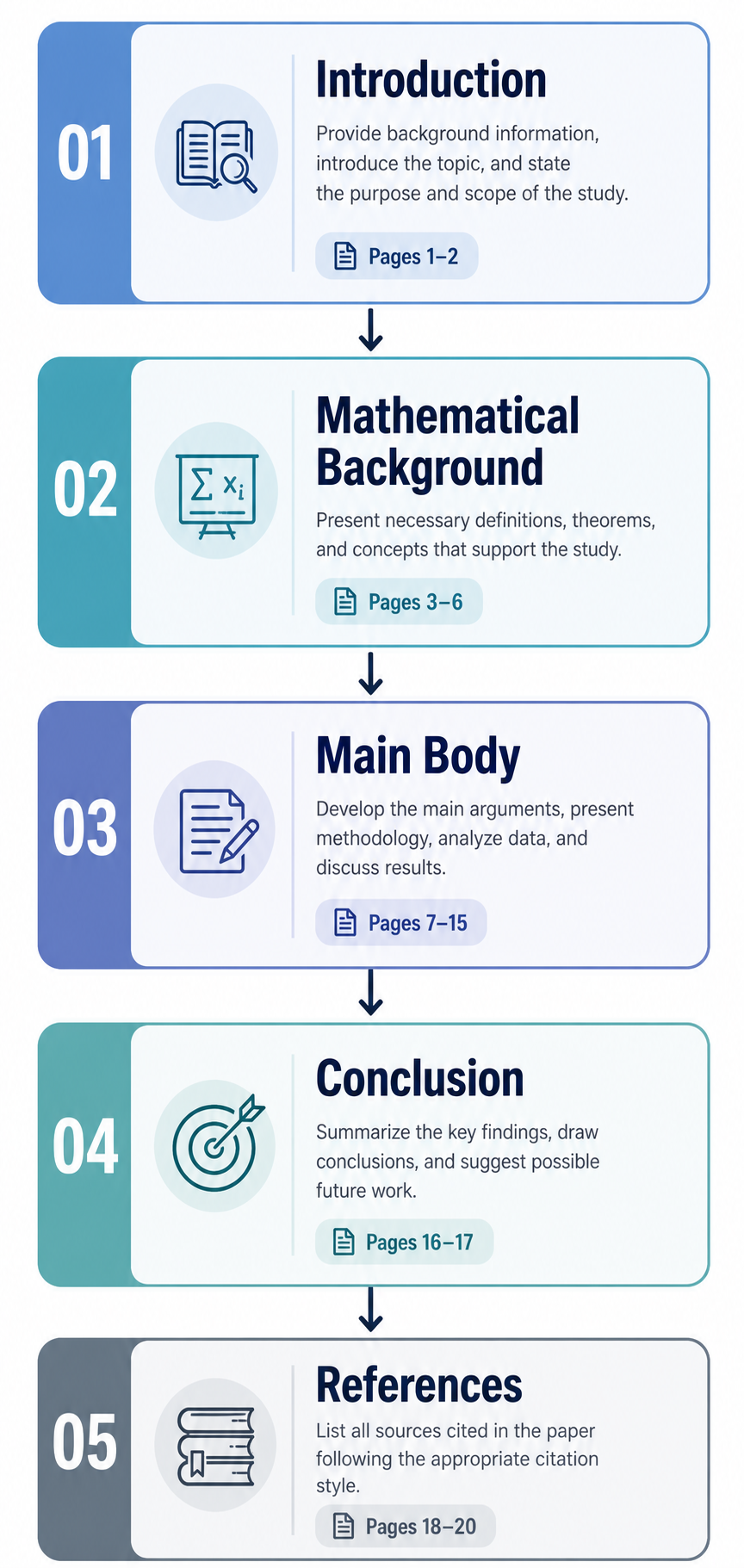
Think of your IB Math IA structure as having five core components. Each one has a specific job, and when all five work together, your exploration reads as a coherent, purposeful piece of mathematical writing — not a collection of calculations stapled together.
1. Introduction
Your introduction does three things: it establishes your aim, provides brief context for why this topic is worth exploring, and signals your personal connection to the question. Keep it focused. This is not the place for lengthy background history or general statements about mathematics. Examiners want to know what you’re exploring and why — clearly, quickly, and in your own voice.
Your aim should appear as a specific, clearly worded sentence or question. Something like: “This exploration investigates how calculus can be used to optimise the dimensions of a cylindrical container to minimise material cost for a fixed volume.” That’s precise, mathematical, and immediately tells the examiner what to expect.
💡 Pro Tip
Write your aim statement first, before anything else in your exploration. Pin it at the top of your document and refer back to it every time you start a new section. Every section should exist because it serves that aim — if it doesn’t, it probably shouldn’t be there.
2. Mathematical Background and Definitions
This section is where you define the key terms, concepts, and mathematical tools you’ll be using in your exploration. Don’t assume the examiner knows what you mean — define your variables, introduce your notation, and briefly explain any theory that underpins your approach.
Keep this section concise. Its job is to equip the reader to follow your working — not to demonstrate how much you know about the topic in general. A focused half-page to one page is usually appropriate.
3. Main Body — The Exploration Itself
This is the heart of your IA and where the majority of your marks are earned. Your main body should present your mathematical investigation in a logical sequence, with clear working, well-labelled graphs and diagrams, and enough explanation that a reader can follow your reasoning at every step.
Don’t just show calculations — narrate them. Explain what you’re doing, why you’re doing it, and what the result tells you. This is where Criterion B (Mathematical Communication) and Criterion E (Use of Mathematics) are primarily assessed. It’s also where moments of genuine personal engagement — unexpected results, independent choices, self-directed extensions — should appear naturally.
4. Conclusion
Your conclusion should directly answer the aim you set out in your introduction. Summarise what you found, state clearly what the mathematics showed, and reflect on what it means. Avoid introducing new mathematics here. The conclusion is for synthesis and reflection — not new content.
This is also where you discuss the limitations of your approach and suggest specific, mathematically grounded extensions. Vague statements like “further research could be done” won’t score well on Criterion D. Specific statements — identifying exactly what the model doesn’t account for and how a different method could address it — will.
5. References and Bibliography
Any data source, formula, theorem, or idea that isn’t your own original work needs to be cited. Use a consistent referencing style throughout. This isn’t heavily weighted in the rubric itself, but failing to include references raises academic integrity concerns and undermines the professionalism of your exploration.
Practical takeaway: Before you write a single word of your exploration, map out these five sections as headings in your document. Then fill in bullet points of what belongs under each one. Writing into a structure is dramatically easier than writing and hoping structure emerges.
How Long Should Each Section Be?
The IB recommends a total length of approximately 12–20 pages for the exploration, excluding appendices. That range gives you genuine flexibility, but it doesn’t mean all lengths within that range are equally effective. Most well-structured IAs land between 14 and 18 pages.
Here’s a practical guide to section lengths based on what works well:
- Introduction: 1–2 pages — focused, specific, personal
- Mathematical Background and Definitions: 0.5–1.5 pages — concise, relevant only
- Main Body: 8–12 pages — the bulk of your exploration with working, graphs, and narration
- Conclusion: 1.5–2.5 pages — direct, reflective, specific on limitations and extensions
- References: 0.5–1 page — consistent format, all sources cited
⚠️ Watch Out
Going over 20 pages is not a sign of depth — it’s usually a sign of poor focus. Examiners are not required to read beyond 20 pages, and a bloated exploration often signals that the student hasn’t been selective enough about what to include. If your draft is too long, cut sections that don’t directly serve your aim — not sections that do.
Similarly, an exploration under 12 pages almost always lacks sufficient mathematical development. If you’re significantly under the lower limit, you need to either deepen your mathematical analysis or extend your investigation in a meaningful direction — not add padding.
Practical takeaway: Use these length guidelines as a planning tool, not a word-count target. The goal is to give each section exactly the space it needs to do its job — no more, no less.
How IB Math IA Structure Affects Each Criterion
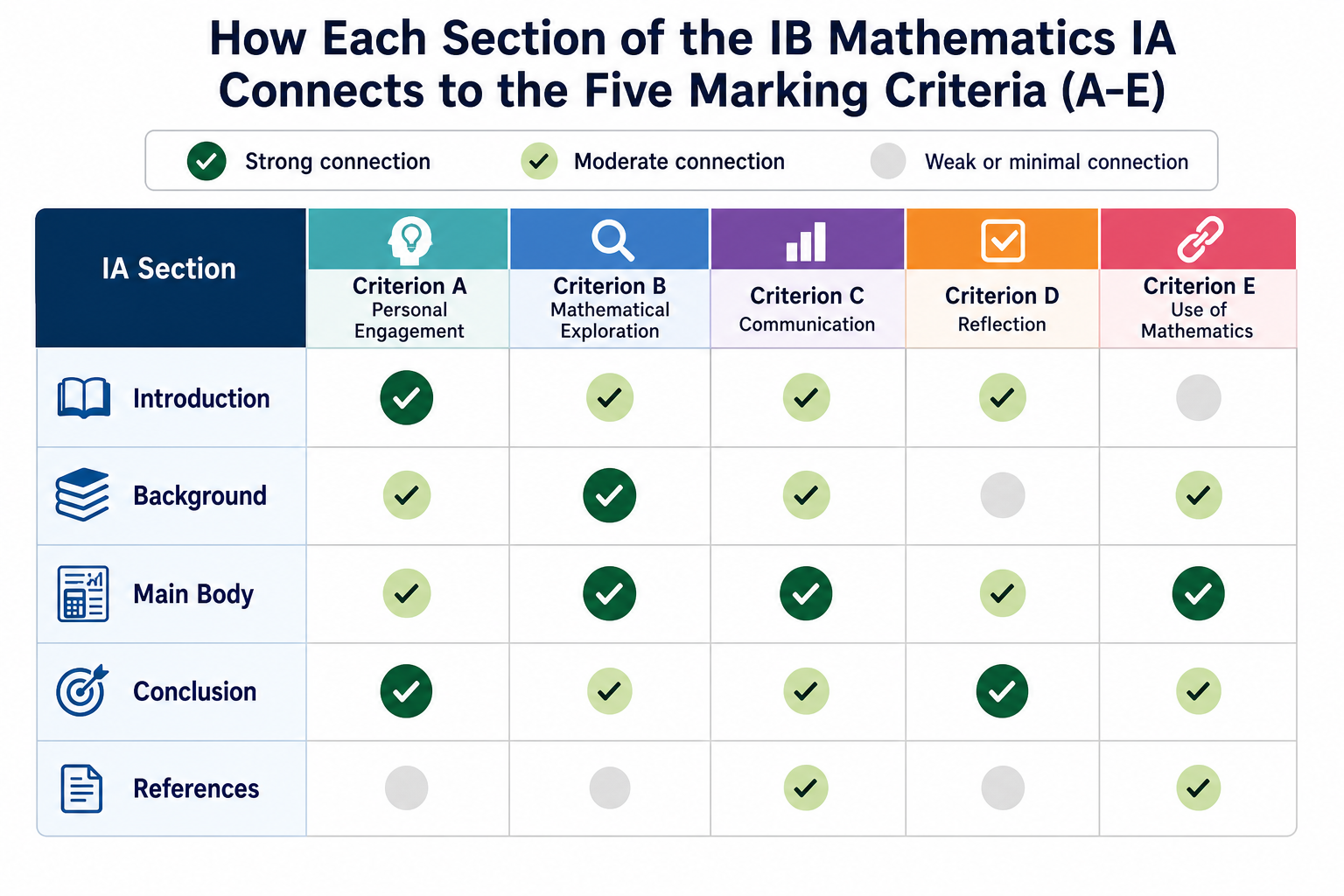
Structure isn’t just an organisational preference — it’s a scoring mechanism. Here’s how your IB Math IA structure choices translate directly into marks across the five criteria:
Criterion A — Presentation
This criterion is almost entirely about structure. A clearly defined aim, a logical flow between sections, and a conclusion that directly addresses the aim are the three pillars of a top-band Criterion A score. Poor structure — sections that don’t connect, an aim that drifts, or a conclusion that doesn’t match the introduction — will cap your Criterion A score regardless of how good the mathematics is.
Criterion B — Mathematical Communication
Structure supports communication. When your mathematical working is presented in a logical sequence with clear transitions, examiners can follow your reasoning. When it’s scattered or jumps between ideas without explanation, Criterion B suffers even if the individual calculations are correct.
Criterion C — Personal Engagement
Where your moments of personal engagement appear in the structure matters. If they’re only in the introduction, they feel like decoration. When they appear in the body — at the point where you make an independent mathematical decision, notice something unexpected, or extend your investigation — they feel genuine and earn marks.
Criterion D — Reflection
Reflection distributed throughout the exploration scores higher than reflection confined to a closing paragraph. Build reflective moments into your main body, not just your conclusion. When something doesn’t work as expected, address it there — not in a rushed final paragraph.
Criterion E — Use of Mathematics
A well-structured main body allows the mathematics to be assessed clearly. When working is presented logically, with each step connected to the next, examiners can see precisely what you understand. Disorganised working obscures your mathematical ability — even when the underlying understanding is solid.
📌 Important
Structure is not neutral. Every structural decision you make either supports or undermines your score across multiple criteria. Students who treat structure as an afterthought and focus only on the mathematics are consistently leaving marks on the table that better organisation would have secured.
Practical takeaway: Map each section of your planned exploration to the criteria it primarily serves. If a section doesn’t clearly serve at least one criterion, question whether it belongs in your IA at all.
📚 Recommended Resource
IA Mini Packs — Section-by-Section Structural Guidance
If you have your topic but aren’t sure how to organise your specific exploration, our IA Mini Packs give you section-by-section structural guidance tailored to your maths area, with guiding questions for each part of your exploration to help you build a logical, well-evidenced investigation. They’re designed to help you think through your own structure — not to write it for you.
$5–$10 per pack
Browse IA Mini Packs on SamzHub →Common IB Math IA Structure Mistakes
Even students who understand the ideal structure often make avoidable mistakes when it comes to execution. Here are the most common ones — and how to fix them before they cost you marks.
Writing a Vague or Missing Aim
The single most damaging structural mistake is failing to state a clear, specific aim at the start. Without it, the examiner has no anchor for evaluating your exploration. Every other section becomes harder to score because there’s no defined purpose to measure it against.
Letting the Main Body Become a Dump of Calculations
A main body full of calculations with no explanation, no transitions, and no narration is one of the most common structural failures in IB Math IAs. Mathematics without commentary doesn’t demonstrate understanding — it demonstrates computation. Every significant step needs a brief explanation of what you’re doing and why.
Saving All Reflection for the Conclusion
As covered above, reflection distributed throughout the exploration scores significantly higher than reflection crammed into a final paragraph. If you’re writing an entire exploration and only reflecting once, you’re leaving Criterion D marks behind.
Disconnected Introduction and Conclusion
Your conclusion must directly address the aim in your introduction. If you read your aim and then your conclusion and they feel like they belong to different explorations, Criterion A will suffer. Always write your conclusion with your aim statement visible in front of you.
Using Appendices as a Shortcut
Appendices are appropriate for raw data tables, lengthy code, or supplementary calculations that aren’t central to the exploration. They are not appropriate for cutting important working out of your main body to hit a page limit. If a calculation is essential to your argument, it belongs in the body — not hidden in an appendix.
- Does my introduction contain a clear, specific aim statement?
- Does every section in my main body include explanatory narration alongside the mathematics?
- Does reflection appear at multiple points throughout the exploration — not just the conclusion?
- Does my conclusion directly answer the aim from my introduction?
- Are my appendices used appropriately — for supplementary material only?
- Is the total length within the 12–20 page recommendation?
For more on the specific errors that cost students marks at the writing stage, read our post on the 5 most common IB Math IA mistakes and how to avoid them.
Practical takeaway: Run through this checklist on your completed draft before you hand it to your teacher. Fixing structural issues at the self-review stage is far more efficient than trying to address them after teacher feedback.
✅ Key Takeaways
- A strong IB Math IA structure has five core sections: Introduction, Mathematical Background, Main Body, Conclusion, and References — each with a specific purpose.
- The total exploration should be 12–20 pages, with the main body taking up the majority of that space.
- Your structural decisions directly affect your scores on Criterion A, B, C, D, and E — poor structure costs marks across multiple criteria at once.
- State your aim clearly in the introduction and answer it directly in the conclusion — examiners check this connection explicitly.
- Avoid the most common mistakes: vague aims, calculation dumps, end-loaded reflection, and disconnected conclusions.
- Plan your IB Math IA structure before you write — not after. Writing into a structure is always more effective than writing and hoping structure appears.
Frequently Asked Questions
Structure might not be the most exciting part of writing your IB Math IA, but it’s one of the highest-leverage things you can get right. When your exploration has a clear aim, a logical flow, and a conclusion that genuinely answers what you set out to find, examiners can focus on your mathematics and your thinking — which is exactly where you want their attention. Plan your structure first, write into it deliberately, and review it carefully before submission. The marks are there — structure helps you keep them.