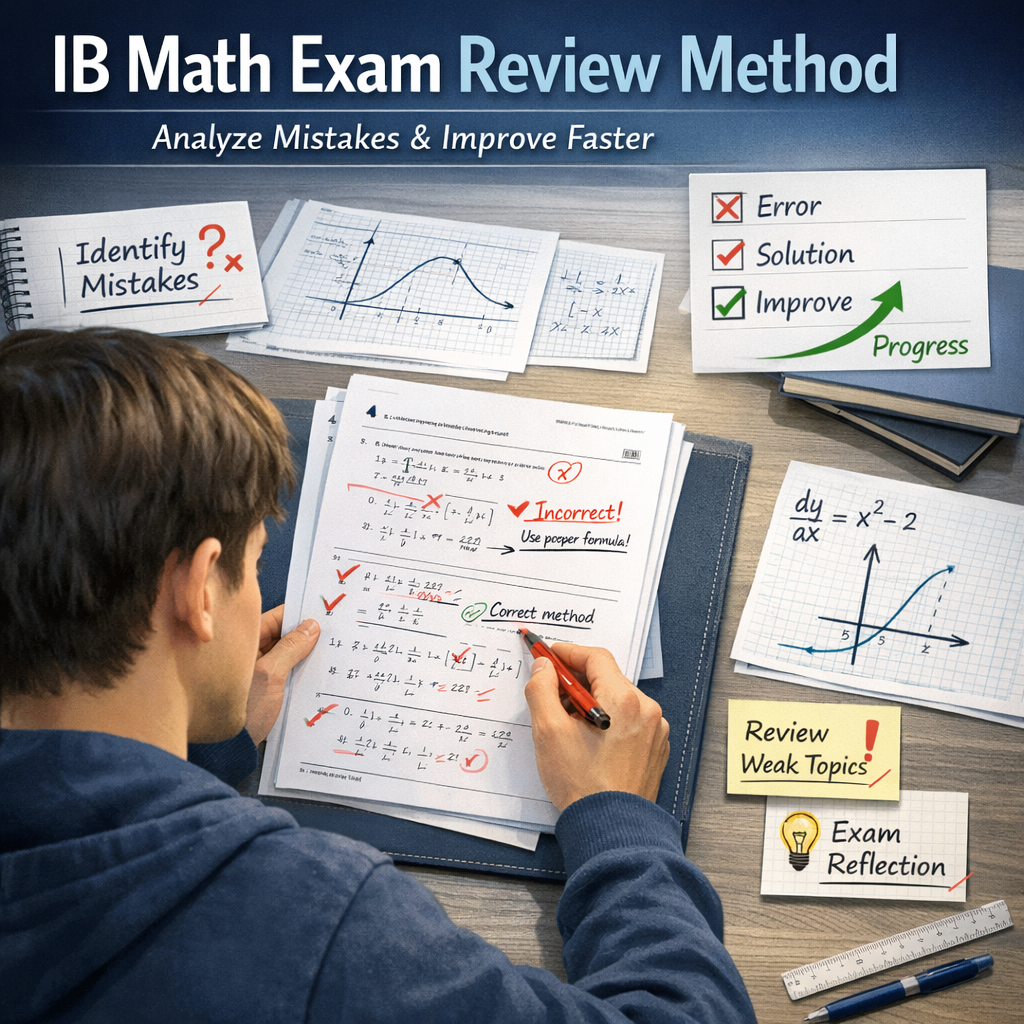
A thorough IB Math exam review post exam is one of the most valuable things you can do after a mock or practice paper — yet it’s the step most students skip entirely.
📋 In This Guide
You’ve just finished a mock exam or practice paper. You check the score, feel either relieved or frustrated, and move on to the next topic. Sound familiar? If so, you’re throwing away one of the most powerful study tools available to you.
A proper IB Math exam review post exam process turns every mistake into a roadmap for improvement. Instead of vaguely thinking “I need to get better at calculus,” you’ll know exactly which calculus skills tripped you up, why they went wrong, and what to practise next. This applies whether you’re doing AA SL, AA HL, AI SL, or AI HL — the method works across all courses.
Whether you’re a DP Year 1 student reviewing your first mock or a DP Year 2 student doing final exam prep, this guide will show you how to conduct an IB math exam analysis that actually moves the needle on your grade. If you’re building a bigger study strategy, pair this with our complete guide to scoring a 7 in IB Math AA SL.
Why Most Students Skip This Step and Regret It
Let’s be honest about why exam review doesn’t happen. After a tough mock, most students fall into one of two camps:
- The “I don’t want to look” camp: The exam was stressful, the score wasn’t great, and revisiting it feels painful. So the paper goes into a folder and never comes out again.
- The “quick glance” camp: You scan the markscheme, see where you lost marks, think “oh yeah, I should have done that,” and close the paper. No notes, no follow-up, no change in behaviour.
Both responses are completely natural — but neither leads to improvement. Here’s the uncomfortable truth: the mistakes you make on a mock are almost certainly the same mistakes you’ll make on the real exam unless you actively intervene.
⚠️ Watch Out
Simply re-doing the same paper isn’t enough either. You’ll remember some of the answers, which gives you a false sense of mastery. The goal isn’t to get the right answer on that specific question — it’s to understand why you got it wrong so you can handle similar questions in the future.
Students who commit to a structured IB Math exam review post exam process consistently outperform those who don’t — not because they’re more talented, but because they’re learning from every single paper they sit.
How to Analyze Your IB Math Exam Review Post Exam Mistakes Systematically
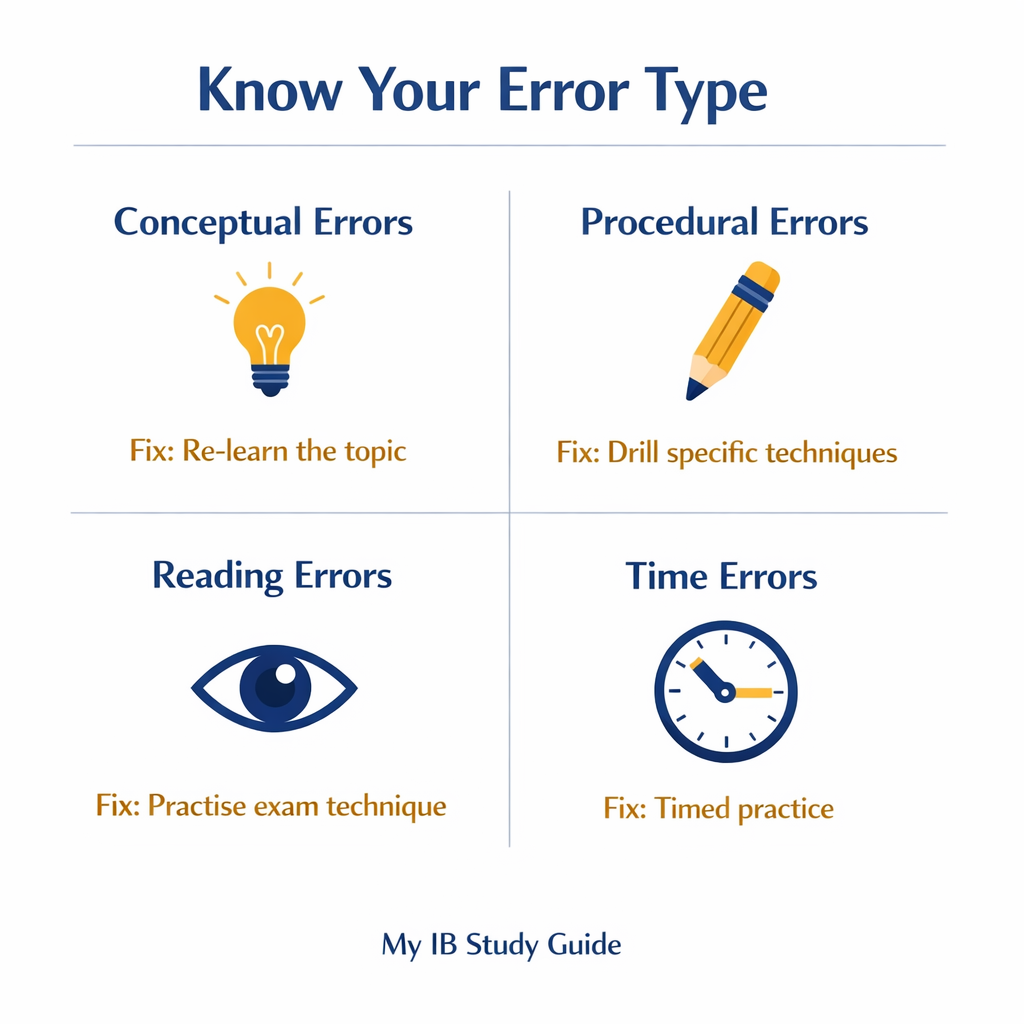
The first step in any effective IB math mock review is classifying your errors. Not all mistakes are created equal, and different types of mistakes require different fixes. Here are the four main categories:
1. Conceptual Errors
You didn’t understand the underlying maths. For example, you confused the derivative with the integral, or you applied the wrong probability rule. These errors mean you need to go back and re-learn the topic — not just practise more questions.
2. Procedural Errors
You understood the concept but made a mistake in execution. Sign errors, distribution mistakes, forgetting to apply the chain rule, or using the wrong formula from the booklet all fall here. These require focused drill on specific techniques.
3. Reading or Interpretation Errors
You misread the question, missed a key word like “hence” or “exact value,” or answered a different question from the one asked. These are about exam technique, not mathematical knowledge.
4. Time Management Errors
You ran out of time and left questions blank, or you spent too long on an early question and rushed the rest. These require practising under timed conditions and developing a pacing strategy.
💡 Pro Tip
Go through your exam with a different coloured pen for each error type. This makes patterns immediately visible — if your paper is covered in one colour, you know exactly where to focus your revision energy.
The Error Log Method
The error log is a simple but powerful tool for turning your IB math exam analysis into real improvement. It’s a structured record of every mistake you make across all your practice papers, and over time it reveals your personal weak spots with unmistakable clarity.
Here’s how to set one up:
Create Your Error Log
Use a spreadsheet, notebook, or digital document with the following columns:
- Date and Paper: Which exam or mock, and which paper (Paper 1 or Paper 2)
- Question Number: So you can find it again easily
- Topic: The syllabus topic (e.g., “Calculus — Chain Rule” or “Statistics — Normal Distribution”)
- Error Type: Conceptual, Procedural, Reading, or Time Management
- What Went Wrong: A brief description in your own words
- Correct Approach: What you should have done — written out so you understand it
- Marks Lost: How many marks this error cost you
Use It After Every Paper
Each time you complete a practice paper or mock, sit down with the markscheme and fill in your error log. This should take 15–20 minutes — a small investment compared to the hours you spent writing the paper.
📌 Important
Review your error log weekly. After three or four papers, patterns will emerge. You might discover that 40% of your lost marks come from procedural calculus errors, or that you consistently misread probability questions. These patterns are gold — they tell you exactly where to improve after your exam for maximum impact.
The error log method is recommended by experienced IB educators and aligns with the kind of reflective practice encouraged across the IB Diploma Programme curriculum.
📚 Recommended Resource
Mock Exam Pack AA SL & AA HL
Use our mock exam to practise the error log method before the real thing. Identify your mistake patterns with detailed solutions that reveal exactly what you missed — and the optimal approach for every question.
$12
Get the AA SL Mock Exam & AA HL Pack on SamzHub →Turning Mistakes Into a Study Plan
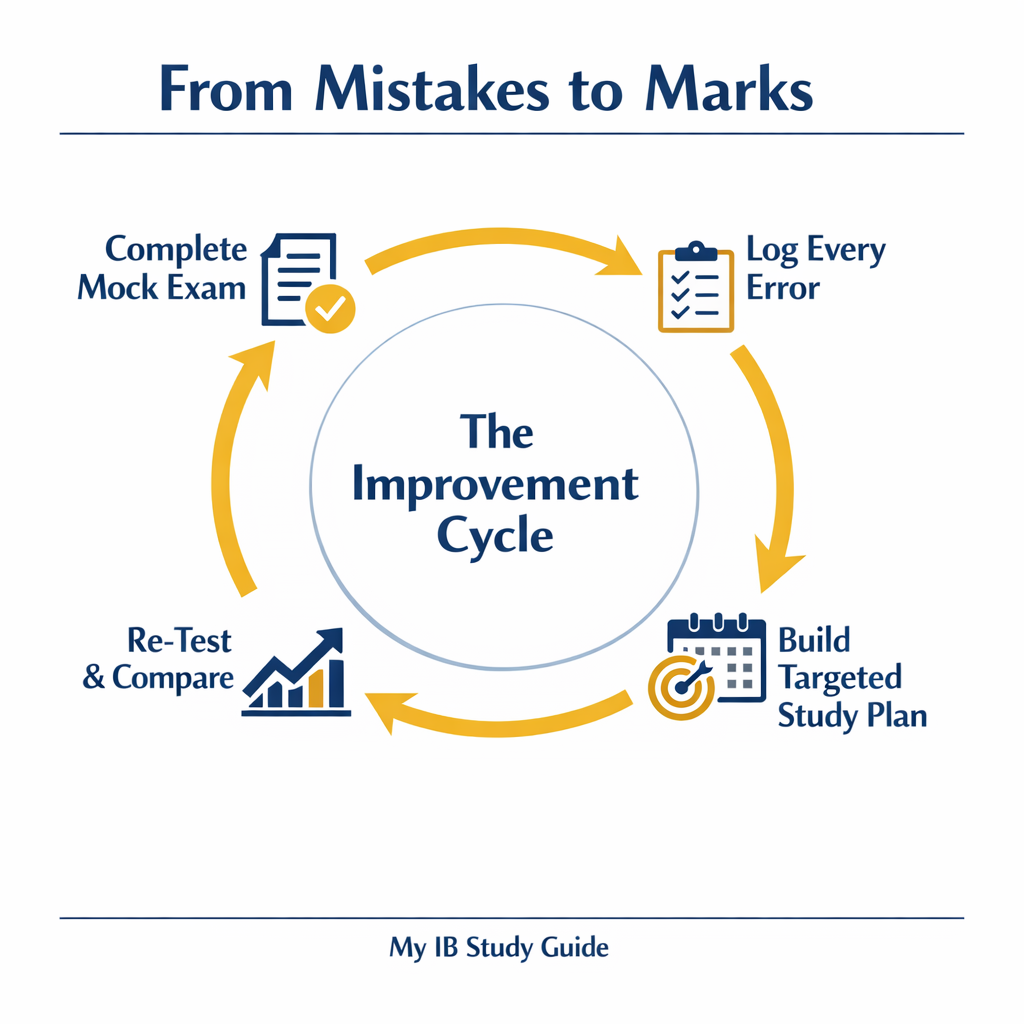
An error log without action is just a list. The real power of your IB Math exam review post exam process comes when you translate those patterns into a targeted study plan. Here’s how:
- Rank your error categories by marks lost. Add up the total marks lost to each topic and error type across all your logged papers. The category with the most lost marks gets top priority.
- Assign specific revision actions. For conceptual errors, re-watch lessons or re-read the textbook section. For procedural errors, drill 10–15 practice questions on that specific technique. For reading errors, practise past paper questions focusing only on identifying what’s being asked.
- Schedule your targeted practice. Block out time in your study schedule for each priority area. Don’t just “revise maths” — revise the specific skill your error log identified.
- Re-test yourself. After targeted revision, do another practice paper and log errors again. Compare your new log with the old one. If the same patterns appear, you need more work. If they’ve shrunk, you’re on track.
💡 Pro Tip
Share your error log findings with your teacher. They can give you additional resources or exercises targeting your specific weak spots — and they’ll appreciate seeing a student taking such a proactive approach to IB math improvement after an exam.
If you want to avoid the most common pitfalls before they even happen, check out our guide on Top 10 Mistakes Students Make in IB Math Exams. And for help structuring your overall revision timeline, see our post on How to Build an IB Math Revision Plan That Actually Works.
✅ Key Takeaways
- A structured IB Math exam review post exam is the fastest way to improve your score between papers or exam sessions.
- Classify every mistake as conceptual, procedural, reading, or time management — each type requires a different fix.
- Use the error log method to track patterns across multiple papers and identify your biggest mark-losing habits.
- Turn your error log into a targeted study plan by ranking priorities and scheduling specific revision actions.
- Re-test yourself and compare logs to measure genuine improvement over time.
Frequently Asked Questions
The difference between students who plateau and students who keep improving often comes down to one habit: reviewing their work. A structured IB Math exam review post exam approach transforms every practice paper from a one-time event into a lasting lesson. Start your error log today, commit to the cycle, and watch your marks climb paper after paper. Your future self — sitting in the real exam — will thank you for every minute you invested in this process.