Understanding what to expect IB Math first month can make the difference between walking into DP1 feeling confident and spending your opening weeks overwhelmed by a pace and depth you didn’t see coming.
📋 In This Guide
If you’re an MYP 5 student about to enter the Diploma Programme — or a fresh DP1 student counting down the days until term starts — the uncertainty around starting IB Math AA is completely normal. You’ve probably heard that DP maths is “a big step up,” but nobody tells you exactly what that looks like week by week.
This guide gives you a realistic, week-by-week preview of your first month IB Math DP1 experience in Analysis and Approaches (AA). We’ll cover what topics you’ll likely encounter, how assessments work, and the mindset shifts that separate students who thrive from those who fall behind early. If you’re taking Applications and Interpretation (AI), many of the adjustment themes still apply — we’ll flag the differences along the way.
Haven’t chosen your course yet? Our guide on AA vs AI: Which IB Math Course Should You Choose? can help you decide before term begins.
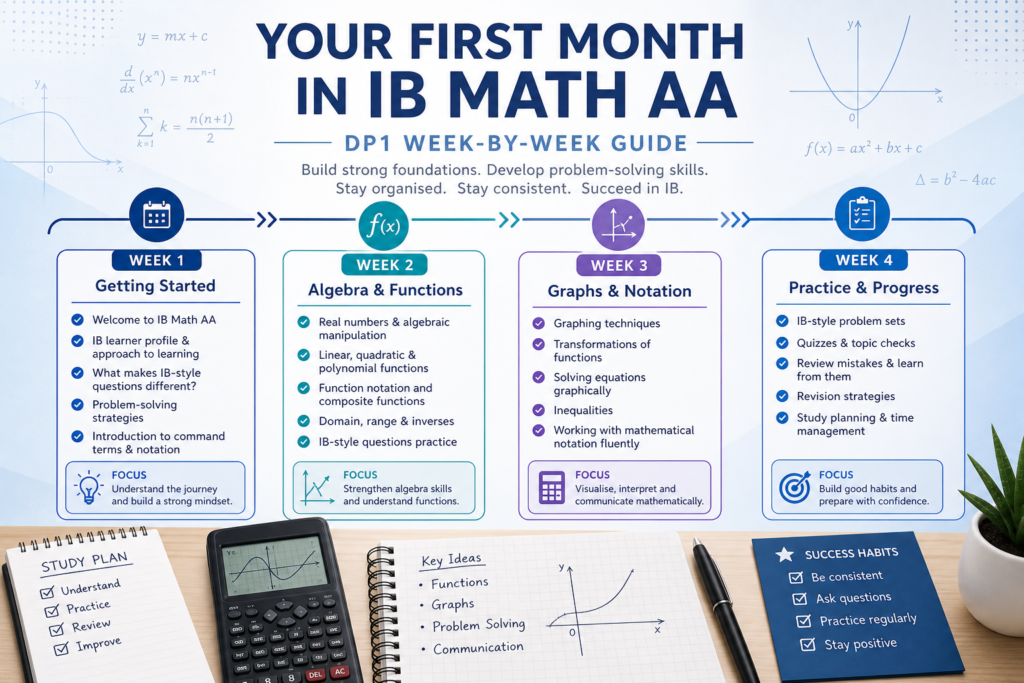
Week 1: Introduction and Expectations
Your first week of IB Math AA is rarely about diving straight into new content. Instead, most teachers use this time to set the stage for the two years ahead.
What Typically Happens
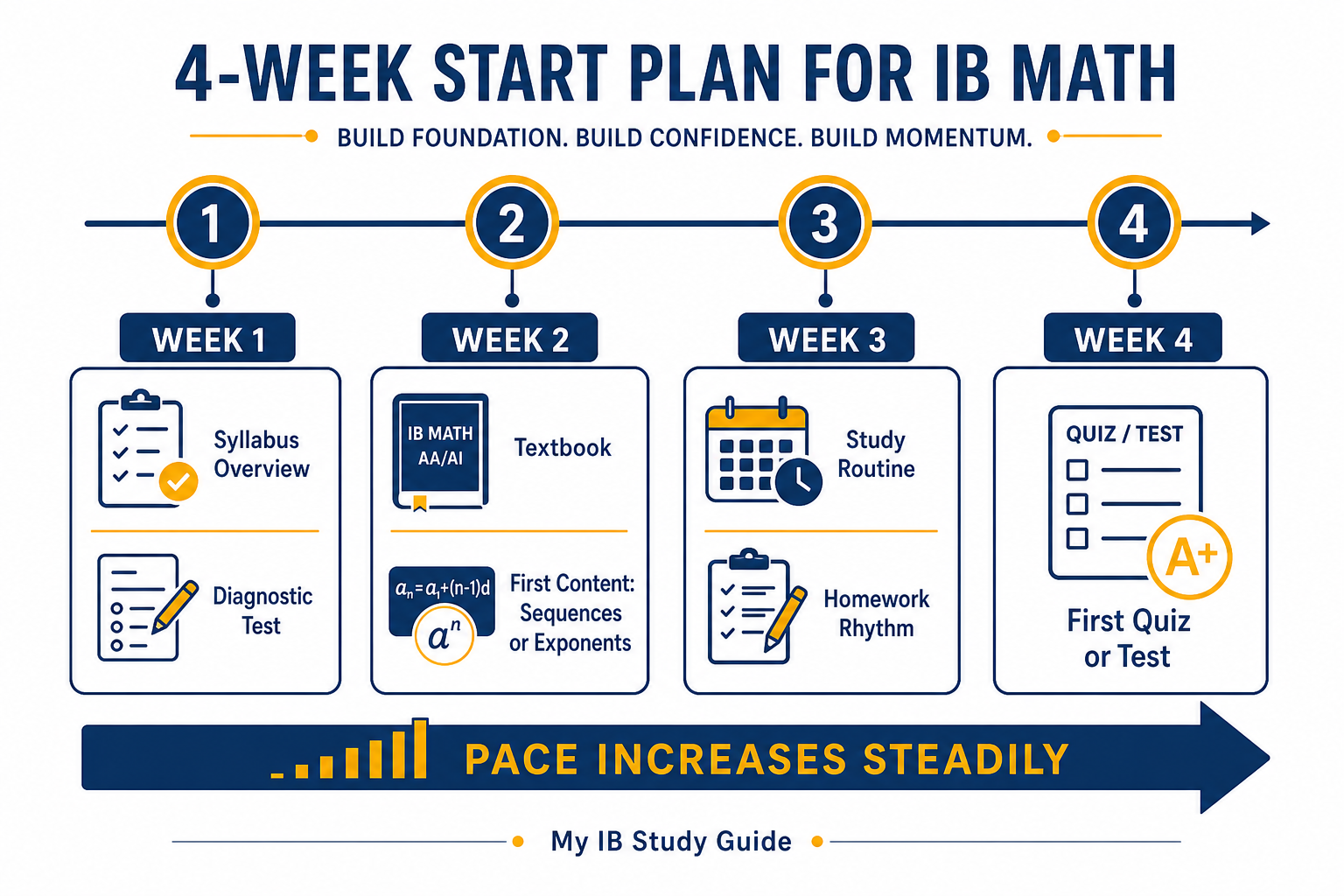
- Course overview: Your teacher will walk through the AA syllabus, explain the five core topics (Number and Algebra, Functions, Geometry and Trigonometry, Statistics and Probability, Calculus), and outline the assessment structure.
- IA introduction: You’ll hear about the Internal Assessment (the mathematical exploration worth 20% of your grade). Don’t worry — you won’t start it for months, but your teacher will plant the seed early.
- Diagnostic test: Many schools give a baseline test in week one to check your MYP foundations. This isn’t graded for your DP — it helps your teacher understand where the class stands.
- Calculator setup: You’ll likely set up your graphic display calculator (GDC) and learn the expectations for when you can and can’t use it.
💡 Pro Tip
Take the diagnostic test seriously even though it doesn’t count. It’s your personal roadmap — any gaps it reveals are exactly what you should address in the first few weeks before the content gets harder.
For AI students, week one looks similar, but you’ll notice more emphasis on technology tools and real-world context from the very start.
💡 For HL Students
If you choose AA HL or AI HL, you will eventually sit three exam papers instead of two. Paper 3 is an investigation-style paper unique to HL. You won’t encounter it in your first month, but knowing it exists helps you understand why HL requires more preparation time overall.
Week 2: First Real Content
This is where the pace picks up. By week two, your teacher will begin teaching actual syllabus content — and it moves faster than anything you experienced in MYP.
Common Starting Topics in AA
- Sequences and series — arithmetic sequences, geometric sequences, sigma notation. Many schools start here because it builds on MYP pattern work while introducing DP-level notation.
- Exponents and logarithms — some schools begin with this instead, especially at HL. You’ll formalise the exponent rules you learned in MYP and meet logarithms for the first time.
- Functions review and extension — function notation, domain, range, and composite functions. This connects directly to MYP but goes deeper and faster.
Regardless of which topic your school starts with, you’ll notice one thing immediately: the pace doesn’t slow down for anyone. Each lesson builds on the previous one, and falling behind by even a day creates a snowball effect.
⚠️ Watch Out
The biggest mistake in week two is thinking, “This feels familiar, so I don’t need to study much.” Early topics may seem like MYP review, but the depth and rigour increase rapidly. Build strong habits now while the content is still manageable.
Week 3: Finding Your Rhythm
By week three, you’ll start to feel the real rhythm of DP maths — and it’s noticeably different from MYP. Here’s what to expect in this transition period:
The Study Routine Shift
In MYP, you might have managed with minimal review between classes. In DP Math AA, you need a consistent daily study routine. Most successful students spend 30–45 minutes per day on maths outside of class — reviewing notes, completing problem sets, and practising skills from earlier lessons.
What You’ll Notice
- Homework is longer and more challenging than MYP assignments
- Your teacher expects you to attempt problems independently before asking for help
- Lessons connect to each other — missing one class means missing a building block
- Your GDC is a tool, not a crutch. You’ll need to show algebraic working even when technology gives you the answer
This is also the week where some students start feeling the gap between MYP and DP. If that’s you, don’t panic — but do act. Make sure your core MYP math skills are solid and address any weaknesses immediately.
📚 Recommended Resource
MYP to DP Transition Pack
Covers all essential MYP topics that DP builds on, includes DP-level practice for each skill, and shows you exactly what to review. Perfect for closing gaps in your first weeks.
$15
Get the MYP to DP Transition Pack on SamzHub →Week 4: First Assessment
Most AA teachers schedule the first quiz, test, or graded assignment by the end of week four. This is your first real indicator of where you stand — and for many students, it’s a wake-up call.
What the First Assessment Looks Like
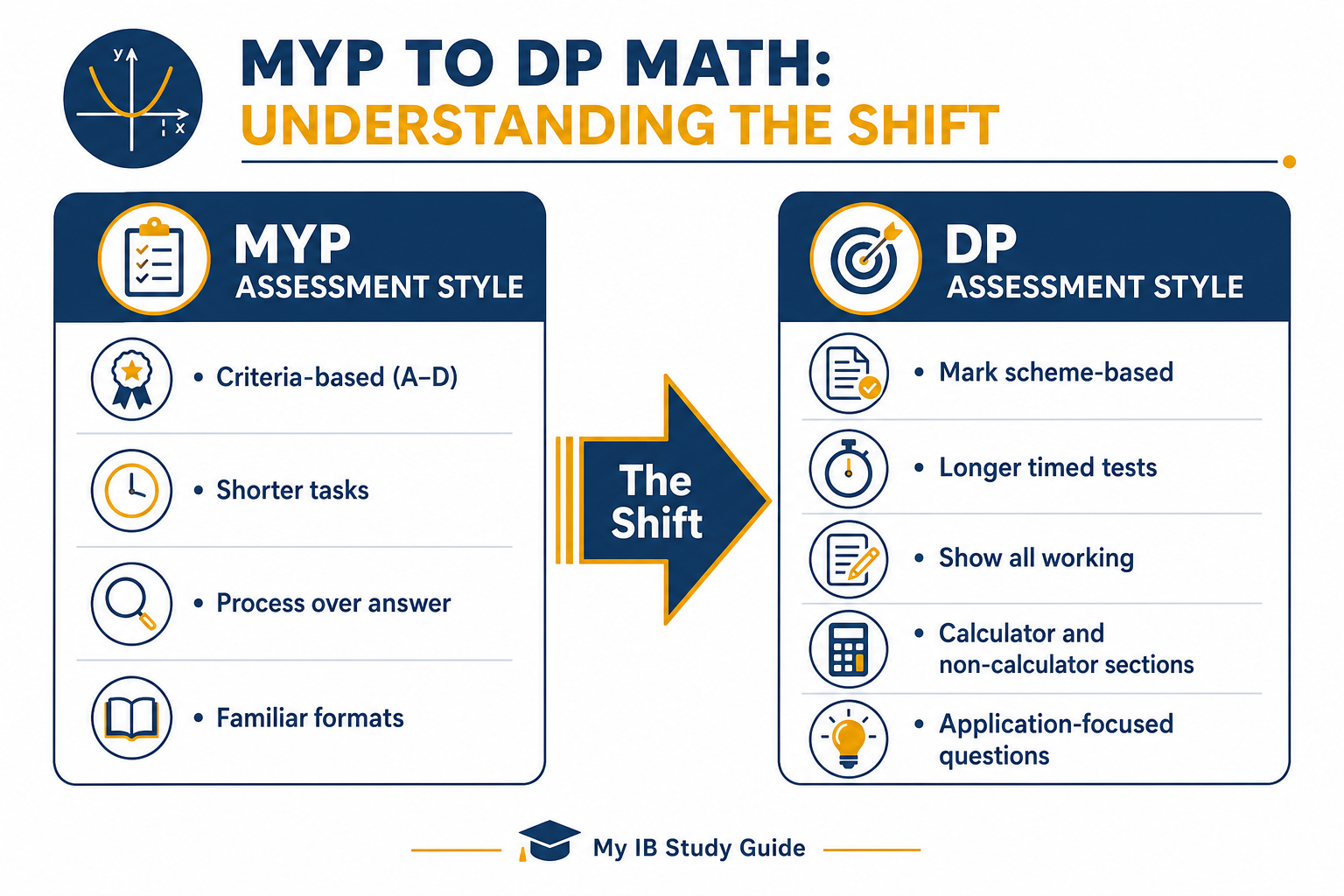
- Format: Typically a short test (30–50 minutes) covering the first syllabus topic. It may include both calculator and non-calculator sections.
- Question style: Expect a mix of short-answer and extended-response questions. “Show your working” will appear repeatedly — partial marks depend on visible reasoning.
- Difficulty: The questions will be noticeably harder than MYP assessments. They test application and understanding, not just procedures.
💡 Pro Tip
If your first test score is lower than you expected, don’t let it define your year. Use it as diagnostic feedback. Identify which question types you lost marks on and target those areas immediately. Early corrections lead to strong final results.
The Biggest Adjustments When Starting IB Math AA
Beyond the weekly content, there are broader mindset shifts that catch students off guard. Here are the most common adjustments you’ll face in your first month of IB Math:
- Speed of content: DP covers in one month what MYP might spread over a full term.
- Working without a calculator: AA Paper 1 is entirely non-calculator. You’ll need to practise mental arithmetic and algebraic manipulation by hand from the start.
- Showing full working: Marks are awarded for process, not just final answers. Writing clear, logical steps is now essential — not optional.
- Independent learning: Your teacher will expect you to review material, attempt problems, and identify your own confusion before class.
- Connecting topics: DP topics link together. A concept from week two will reappear in a harder context by week four.
📌 Important
AI students will face many of the same adjustments, but with more emphasis on technology skills and data interpretation from the outset. The pace and independence expectations are equally high in both courses.
What Your Teacher Wants You to Know
Every experienced DP maths teacher will tell you the same things — and most students don’t listen until it’s too late. Here’s what they wish you’d take seriously from day one:
- Ask questions early. A small confusion in week two becomes a major gap by month three. Don’t wait until you’re completely lost.
- Do your homework properly. Copying solutions teaches you nothing. Struggle with a problem for at least 10 minutes before seeking help — that struggle is where learning happens.
- Review before each class. Spend 5–10 minutes re-reading your notes from the previous lesson. This simple habit dramatically improves retention.
- Use your formula booklet. The IB provides a formula booklet for exams. Start familiarising yourself with it now so you know what’s given and what you need to memorise.
- Don’t compare yourself to others. Some classmates may have covered certain DP topics at their previous school. Focus on your own progress, not theirs.
Your teacher has guided dozens of students through this same transition. Trust their advice, even when it feels like overkill. You can find the complete syllabus details on the IBO’s official mathematics page.
✅ Key Takeaways
- Knowing what to expect IB Math first month helps you prepare mentally and practically — reducing anxiety and building confidence.
- Week one is about orientation; by week two, real syllabus content begins and the pace picks up quickly.
- Build a daily maths study habit of 30–45 minutes from the very first week — don’t wait until you fall behind.
- Your first assessment is diagnostic, not definitive. Use it to identify and close gaps early.
- Showing full working, practising without a calculator, and learning independently are the three biggest adjustments from MYP.
Frequently Asked Questions
Now that you know what to expect IB Math first month, you can walk into DP1 with a plan instead of guesswork. The transition from MYP to DP is real, but it’s entirely manageable when you understand the pace, prepare your foundations, and build the right habits from day one. Your future self will thank you for starting strong.