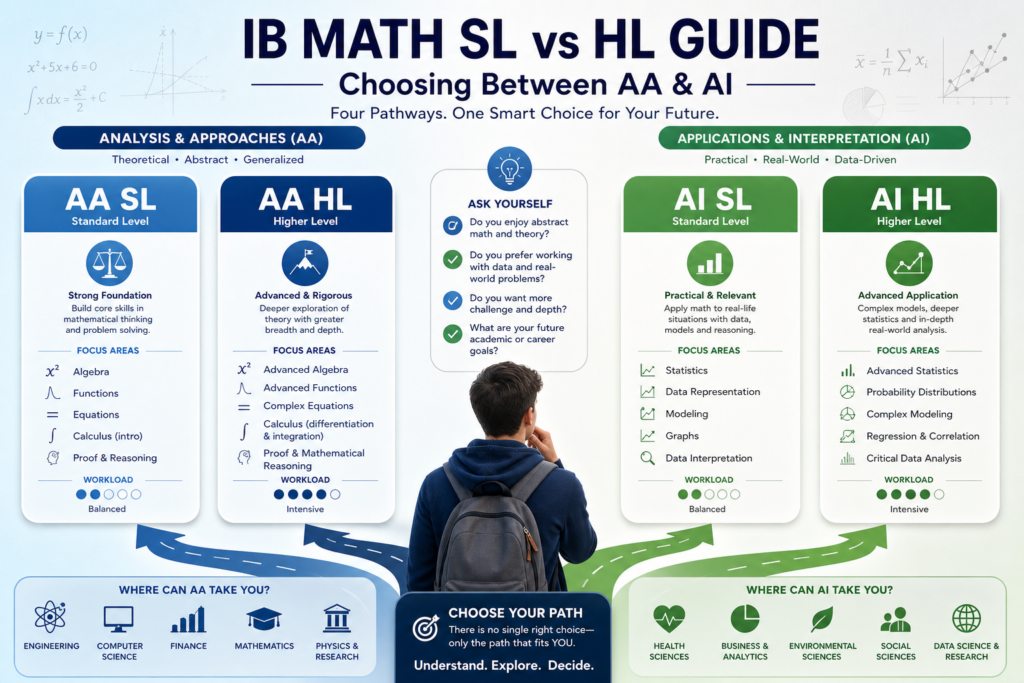
Deciding IB Math SL or HL which to choose is one of the most consequential decisions you’ll make during course selection — it affects your daily workload, your exam experience, and which university programmes you can apply to.
📋 In This Guide
You’ve probably already decided — or you’re close to deciding — whether you’ll take Analysis and Approaches (AA) or Applications and Interpretation (AI). But within each course, the next question is equally important: should I take IB Math HL or is SL the smarter choice?
This isn’t just about difficulty. The IB Math level choice determines how many teaching hours you receive, which topics you cover, how many exam papers you sit, and critically, which university doors stay open. Choosing HL when SL would serve you better can drain time from other subjects. Choosing SL when you need HL can lock you out of programmes you want.
This guide walks you through every factor so you can answer the IB Math SL or HL which to choose question with clarity. If you haven’t chosen between AA and AI yet, start with our guide on AA vs AI: Which IB Math Course Should You Choose? — then come back here for the level decision.
The Difference Between SL and HL Explained
Before comparing specific courses, let’s clarify what SL and HL actually mean in the IB Diploma Programme:
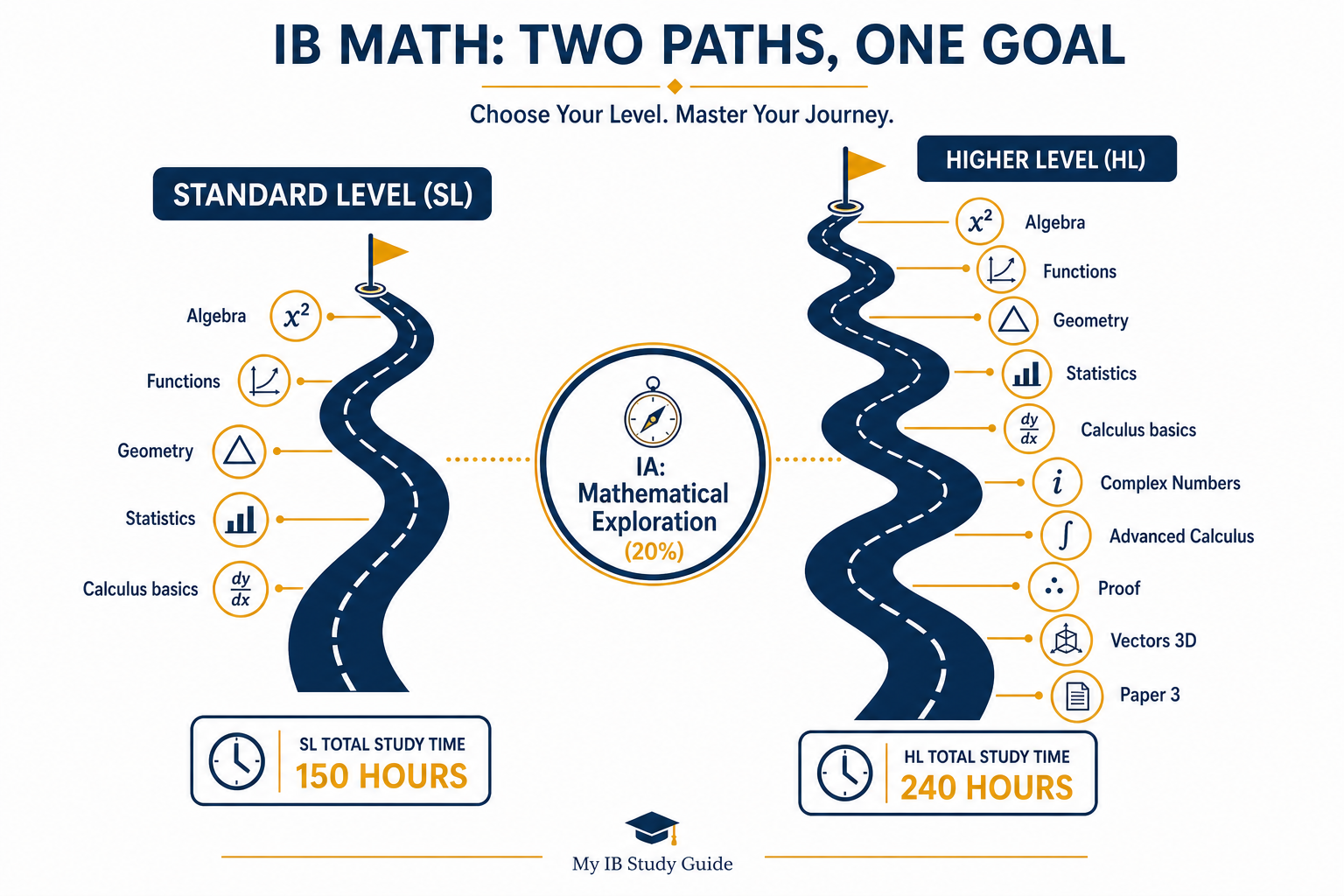
- Standard Level (SL): 150 teaching hours over two years. Two exam papers. Covers the core syllabus.
- Higher Level (HL): 240 teaching hours over two years. Three exam papers (including Paper 3, which tests problem-solving in unfamiliar contexts). Covers the core syllabus plus significant additional content.
Both levels share the same Internal Assessment — a mathematical exploration worth 20% of your final grade. The difference lies entirely in the depth and breadth of the external exams and the additional topics HL students must learn.
📌 Important
HL is not simply “SL with more homework.” The additional topics at HL are genuinely advanced, requiring a different level of mathematical maturity. HL Paper 3, in particular, tests your ability to apply maths in extended, unfamiliar problem-solving scenarios.
Every DP student takes three HL subjects and three SL subjects. Maths doesn’t have to be one of your HLs — unless your university programme specifically requires it.
⚠️ Key HL Difference: Paper 3
One of the biggest differences between SL and HL that students overlook is Paper 3. HL students sit an additional investigation paper that tests mathematical exploration, conjecture, and extended reasoning. This paper does not exist at SL level. If you are considering HL, factor this into your decision — it adds significant preparation time and requires a different skill set from Papers 1 and 2.
AA SL vs AA HL: Key Differences
If you’re taking Analysis and Approaches, here’s what separates the two levels:
| Feature | AA SL | AA HL |
|---|---|---|
| Teaching Hours | 150 hours | 240 hours |
| Exam Papers | Paper 1 (no GDC) + Paper 2 (GDC) | Paper 1 + Paper 2 + Paper 3 |
| Calculus Depth | Introduction to differentiation and integration | Advanced calculus: series, differential equations, Maclaurin series, limits |
| Additional Topics | — | Complex numbers, proof by induction, vectors in 3D, advanced trigonometric identities |
| Weekly Commitment | ~4–5 hours (class + study) | ~7–9 hours (class + study) |
| Best For | Students who enjoy maths and want a solid foundation without the full HL demand | Future engineers, physicists, mathematicians, and economists at competitive universities |
💡 Pro Tip
AA HL is widely considered one of the most challenging subjects in the entire IB Diploma. If you’re choosing it, make sure your other HL subjects leave you enough time and energy to dedicate to maths consistently.
AI SL vs AI HL: Key Differences
For students taking Applications and Interpretation, the IB Math SL vs HL distinction looks a bit different:
| Feature | AI SL | AI HL |
|---|---|---|
| Teaching Hours | 150 hours | 240 hours |
| Exam Papers | Paper 1 (GDC) + Paper 2 (GDC) | Paper 1 + Paper 2 + Paper 3 |
| Statistics Depth | Descriptive stats, basic probability, chi-squared test | Advanced hypothesis testing, Markov chains, regression analysis, confidence intervals |
| Additional Topics | — | Graph theory, Voronoi diagrams, advanced modelling, kinematics |
| Weekly Commitment | ~4–5 hours (class + study) | ~6–8 hours (class + study) |
| Best For | Students who need maths for DP but don’t plan maths-heavy degrees | Future data scientists, social scientists, business analysts, and quantitative researchers |
⚠️ Watch Out
AI SL is the lowest maths option in the IB. While it’s perfectly valid for many pathways, some competitive university programmes may not accept it — even for non-STEM degrees. Always verify before finalising your choices.
How to Decide: IB Math SL or HL Which to Choose
The decision between SL and HL should be based on three factors, in this order of priority:
- University requirements. This is non-negotiable. If your target programme requires HL maths, you must take HL. If it doesn’t, SL is a perfectly valid — and often strategically smarter — choice.
- Your mathematical ability and enjoyment. HL demands genuine interest and strong foundations. If you find maths stimulating and regularly score well, HL is rewarding. If maths is a struggle or you’re simply completing a requirement, SL will serve you better.
- Your overall DP balance. Consider your other HL subjects. If you’re already taking two demanding HLs (like Physics HL and Chemistry HL), adding Maths HL creates an extremely heavy workload. Balance matters for your wellbeing and your total IB score.
Quick Decision Framework
- My university programme requires Maths HL → Take HL
- I love maths and want a challenge, even if HL isn’t required → Consider HL
- I’m strong in maths but need time for other demanding subjects → SL may be the smarter choice
- I find maths stressful and my programme accepts SL → Take SL confidently
- I’m unsure about my university programme → Research first, then decide
📚 Recommended Resource
AA vs AI Decision Guide
Includes detailed SL vs HL comparison within both AA and AI, university requirement tables, career path mapping, and a personal decision matrix to help you make the right call.
Free
Download the Free AA vs AI Decision Guide →University Requirements for SL vs HL
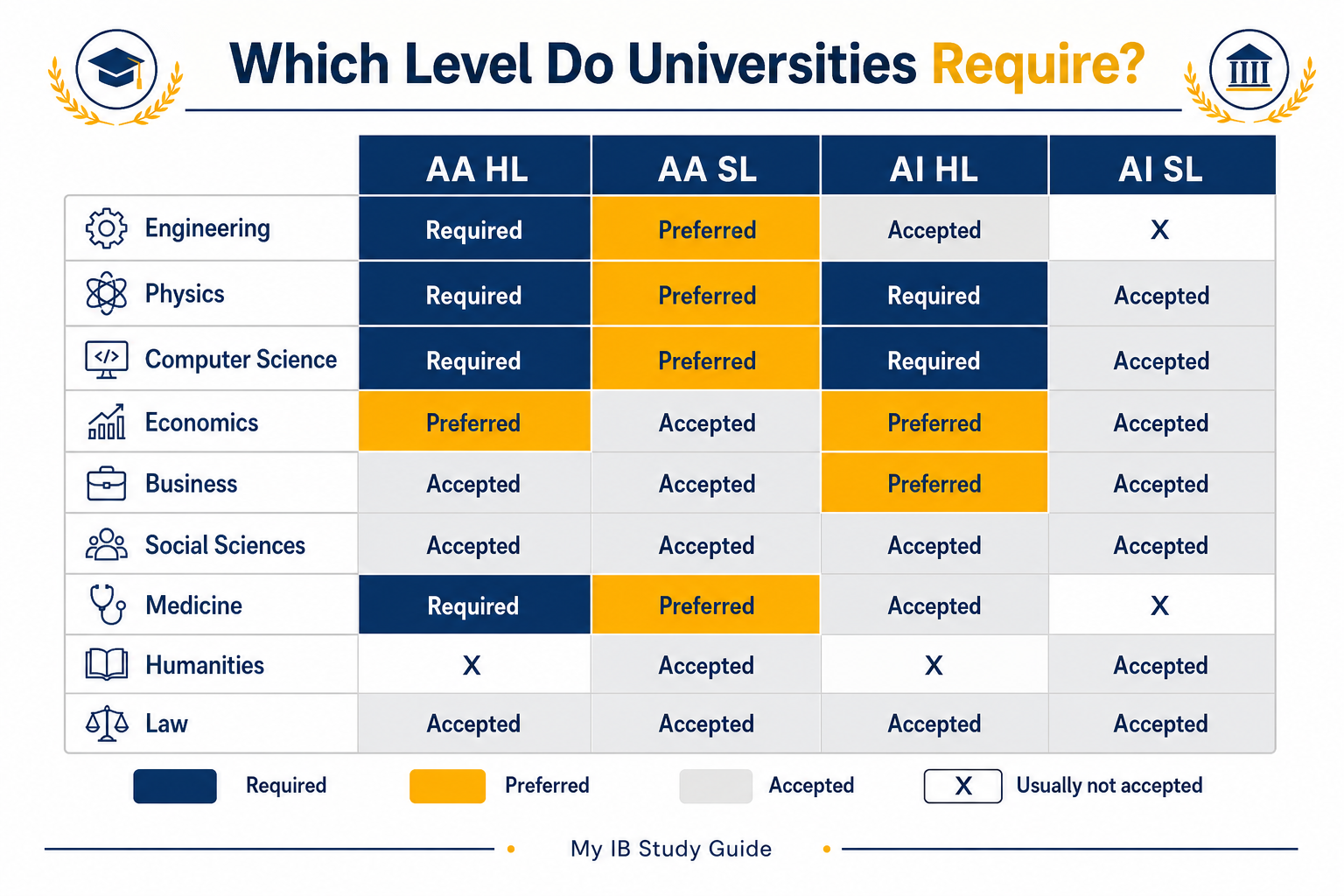
University requirements are the single most important factor in the IB Math level choice. Here’s a general overview — but always verify with your specific target institutions:
Programmes That Typically Require HL
- Engineering (most require AA HL specifically)
- Physics (AA HL strongly preferred or required)
- Mathematics degrees (AA HL required)
- Computer Science at top universities (AA HL often required)
- Economics at competitive universities (AA HL preferred, sometimes AA SL accepted)
Programmes That Typically Accept SL
- Business and Management (AA SL or AI SL usually accepted)
- Psychology and Social Sciences
- Languages and Humanities
- Law (maths requirement varies widely)
- Many health sciences programmes (check each school individually)
For engineering and medicine specifically, we have dedicated guides: check out our posts on IB Math for Engineering and IB Math for Medicine for detailed university requirement breakdowns.
💡 Pro Tip
Check requirements for at least 3–5 universities you’re interested in. If even one requires HL and you’re serious about that programme, it’s usually safer to take HL than to limit your options later.
The IBO’s official mathematics curriculum page outlines the full content of each course and level, which can help when cross-referencing with university prerequisite lists.
What If You Choose Wrong?
Let’s address the fear directly: what happens if you pick the wrong level? The answer depends on timing and direction.
Switching from HL to SL
This is the more common switch, and most schools allow it — especially within the first term of DP1. Since HL covers everything SL covers (and more), you won’t have content gaps. You’ll simply stop the additional HL topics and adjust your exam preparation.
Switching from SL to HL
This is much harder and often not possible after the first few weeks. HL moves faster and covers additional content from early on, so an SL student switching to HL will likely have significant catching up to do. Most schools and IB coordinators discourage this switch unless it happens very early.
⚠️ Watch Out
If you’re genuinely torn between SL and HL, it’s generally better to start at HL and switch down if needed. Starting at SL and trying to move up is far more difficult and disruptive.
Talk to your DP coordinator and maths teacher as early as possible if you’re considering a switch. They can advise based on your school’s specific policies and timelines.
✅ Key Takeaways
- When deciding IB Math SL or HL which to choose, university requirements should be your first consideration — not difficulty or peer pressure.
- HL adds 90 teaching hours, advanced topics, and a third exam paper. It’s a significant commitment that demands genuine mathematical interest.
- AA HL is typically required for engineering, physics, maths, and competitive economics programmes. AI HL suits data science and quantitative social sciences.
- SL is a strong, valid choice for most non-STEM pathways and allows you to allocate time to other demanding subjects.
- If unsure, start at HL — switching down to SL is far easier than switching up.
Frequently Asked Questions
The question of IB Math SL or HL which to choose comes down to three things: what your university needs, what your mathematical ability supports, and how it fits within your overall DP balance. Take the time to research, reflect honestly on your strengths, and talk to your teachers. With the right level choice, maths becomes a subject that works for you — not against you — throughout your diploma journey.