
If you’ve ever spent hours reviewing your notes and still bombed the test, you need to learn the right IB math active studying techniques — because what you’re doing now probably isn’t real studying at all.
📋 In This Guide
Here’s an uncomfortable truth: most IB Math students spend the majority of their study time doing things that barely move the needle. They re-read textbook chapters, highlight notes in three colours, and watch YouTube videos — then wonder why their scores don’t improve.
The problem isn’t effort. The problem is method. There’s a massive difference between passive studying (absorbing information) and active studying (forcing your brain to retrieve and apply information). Research consistently shows that active recall and deliberate practice are far more effective than re-reading or highlighting.
In this post, we’ll break down exactly what IB math active studying techniques look like in practice, why passive habits are so hard to break, and how you can start making the switch today. Whether you’re in Analysis and Approaches (AA) or Applications and Interpretation (AI), at Standard Level (SL) or Higher Level (HL), these IB math revision methods apply to you. If you’re looking for broader success strategies, check out our guide on the habits of IB Math students who score 7swhich will be coming out soon.
Why Passive Studying Feels Productive But Is Not
Passive studying is sneaky because it feels like learning. When you re-read your notes on derivatives or watch a video on normal distributions, everything makes sense in the moment. You nod along. You think, “Yeah, I get this.”
But that feeling of familiarity is not the same as understanding. Psychologists call this the fluency illusion — the mistaken belief that because something feels easy to process, you’ve actually learned it. Recognition is not retrieval. Being able to follow along with a worked example is a completely different skill from solving a similar problem on a blank page under timed conditions.
This is why so many IB Math students feel confident going into an exam and then freeze when they see the paper. The questions look vaguely familiar, but their brains can’t produce the steps. They studied — they just studied the wrong way.
💡 Pro Tip
A simple test: close your notes and try to solve a problem from scratch. If you can’t, you haven’t truly learned the concept yet — you’ve only recognised it.
What Passive Studying Looks Like
Before you can change your habits, you need to honestly identify which of your current study methods are passive. Here are the most common ones among IB Math students:
- Re-reading textbook chapters or class notes without doing problems
- Highlighting or colour-coding formulas
- Watching tutorial videos without pausing to attempt problems yourself
- Copying worked solutions from the textbook into your notebook
- Reading through your formula booklet “to memorise it”
- Looking at past paper mark schemes without first attempting the questions
None of these activities are inherently bad. Watching a video can clarify a tricky concept. Re-reading notes can be a useful refresher. The problem is when these activities make up the majority of your study sessions. They keep your brain in consumption mode rather than production mode — and IB Math exams test production.
⚠️ Watch Out
If you can study for an hour without picking up a pencil and writing out solutions, you’re almost certainly studying passively. Effective IB math study methods always involve working through problems.
What IB Math Active Studying Techniques Actually Look Like
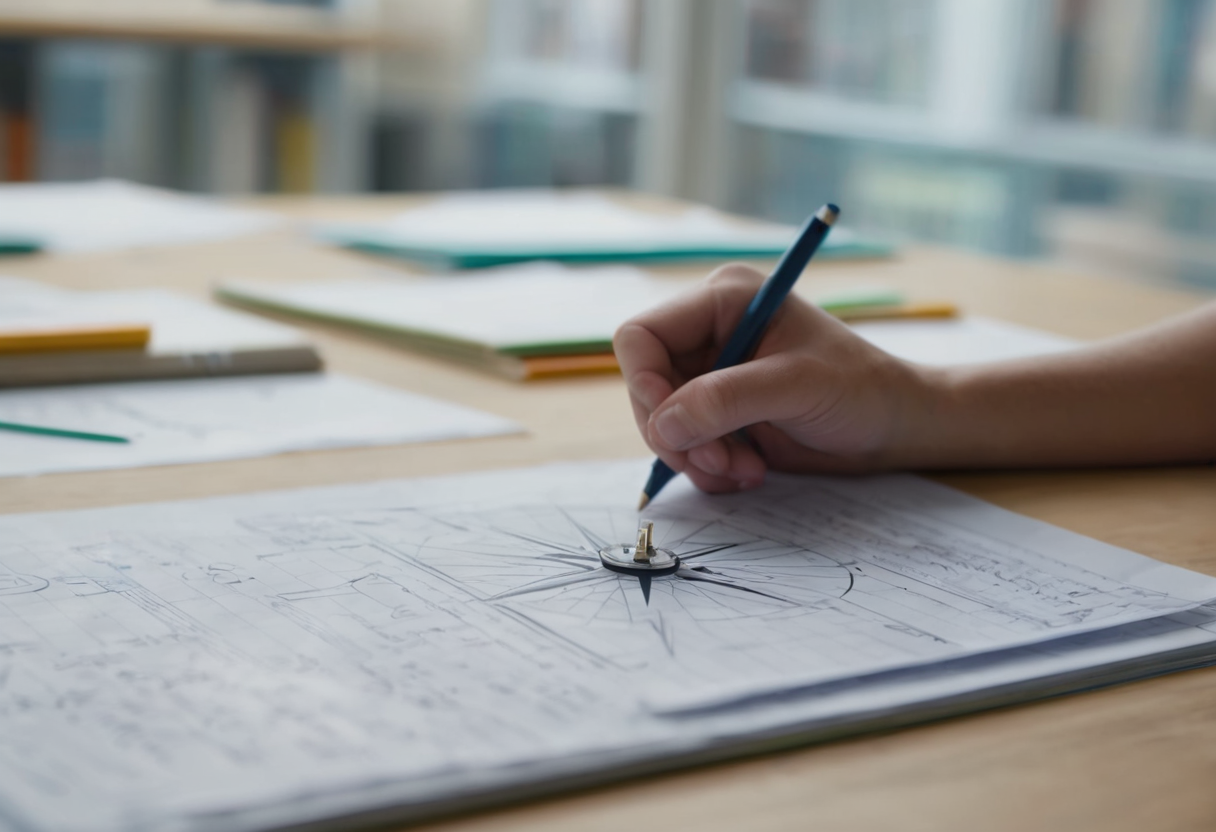
Active studying forces your brain to retrieve, apply, and connect information rather than passively absorb it. Here’s what effective active recall for IB Math looks like in practice:
- Solve problems without looking at notes first. Attempt every question cold. Struggle is where learning happens.
- Use active recall. Close your notebook and write down everything you know about a topic from memory — formulas, methods, conditions, common mistakes.
- Do past paper questions under timed conditions. Simulate exam pressure regularly, not just before finals.
- Check your work against mark schemes and diagnose errors. Don’t just note what you got wrong — figure out why you got it wrong.
- Teach a concept to someone else (or to an empty chair). If you can’t explain it simply, you don’t understand it well enough.
- Space your practice. Revisit topics after a few days rather than cramming everything into one session.
The key difference? Active studying is uncomfortable. It exposes gaps. It forces you to confront what you don’t know. That discomfort is actually the strongest signal that real learning is happening. According to the IBO’s own Mathematics curriculum guidance, mathematical understanding is demonstrated through application and problem-solving — not recognition.
Converting Notes Into Questions
One of the simplest and most powerful IB math active studying techniques is turning your notes into questions. Instead of passively reviewing what you’ve written, you transform your material into a self-testing tool.
Here’s how to do it:
Step 1: Review a Section of Notes
Pick one topic — say, geometric sequences in AA SL, or chi-squared tests in AI SL.
Step 2: Write Questions Based on Your Notes
For every key concept, formula, or method, write a question that would require you to recall it. Examples:
- “What is the formula for the sum of a geometric series, and what condition must be met for convergence?”
- “What are the steps for setting up a chi-squared test, including hypotheses and expected values?”
- “When do I use the chain rule vs. the product rule?”
- “How do I find the angle between two vectors in 3D?”
Step 3: Answer From Memory
Close your notes. Answer your own questions. Then check. This single habit, done consistently, will transform your retention. If you want to learn how to take this even further by analysing your mistakes systematically, read our post on how to learn from your mistakes in IB Math.
💡 Pro Tip
Keep a “question bank” notebook. Every time you study a topic, add 3–5 new questions. Before exams, you’ll have a personalised revision tool that’s far more effective than re-reading notes.
📚 Recommended Resource
IB Math Topic Workbooks
Topic-by-topic practice with full solutions — ideal for active studying and deliberate practice. Available for Calculus, Functions, Statistics, and Geometry. These workbooks give you exactly the kind of structured problem-solving practice that makes active studying effective.
$9.45
The Practice-Review Cycle
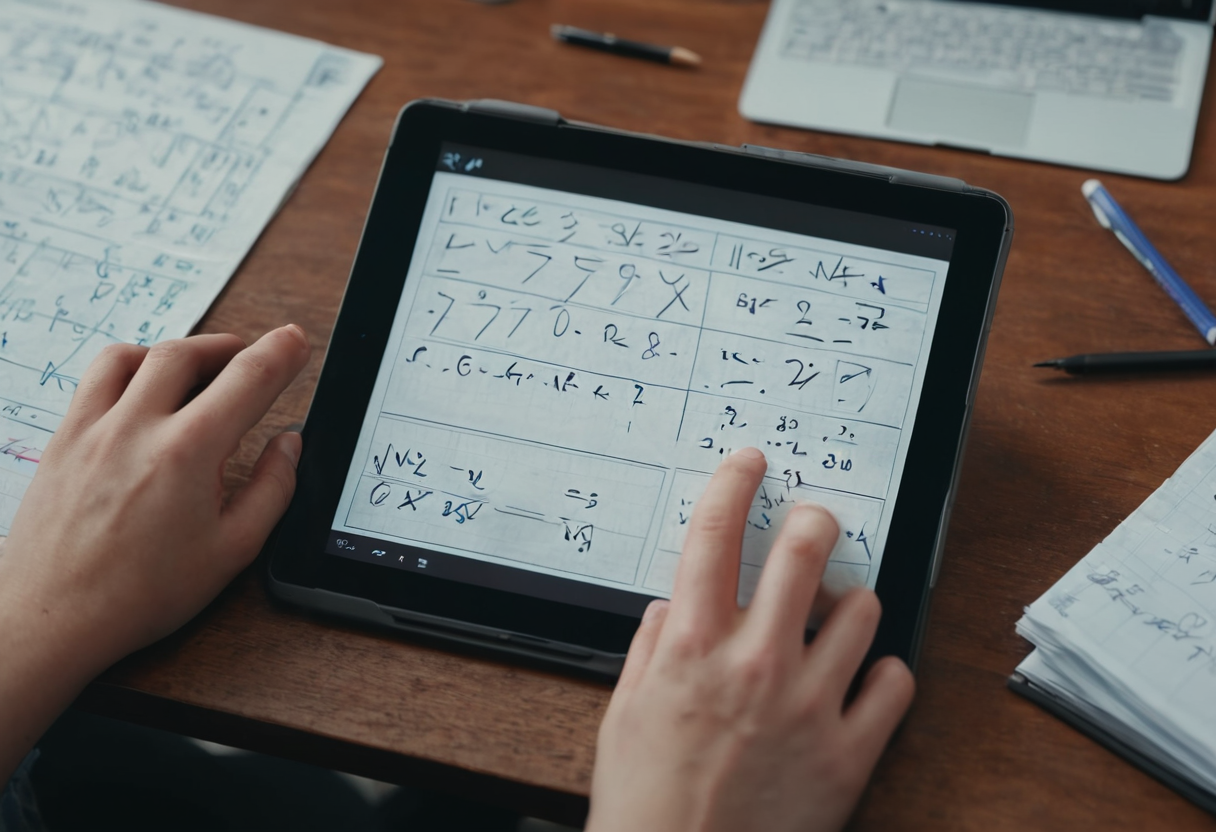
The most effective IB math study methods follow a cycle, not a one-off session. Think of active studying as a loop that you repeat for every topic throughout the year:
- Attempt: Try problems without any notes or help. Set a timer.
- Check: Compare your solutions to mark schemes or answer keys. Be brutally honest.
- Diagnose: For every mistake, categorise it — was it a conceptual gap, a calculation error, or a misread question?
- Review: Go back to your notes or textbook only for the specific gaps you identified. This is where passive resources become useful — targeted review, not blanket re-reading.
- Re-attempt: Try similar problems (or the same ones after a few days) to confirm the gap is closed.
This cycle is how real mastery develops. Each loop strengthens your understanding and builds the kind of fluency that shows up on exam day. It works for every topic across AA and AI, SL and HL.
📌 Important
The review step should always be targeted. Don’t re-read an entire chapter because you got one question wrong. Go back only to the specific concept you struggled with. This keeps your study time efficient and active.
If you’re struggling to fit this cycle into a busy IB schedule, our guide on how to balance IB Math with your other subjects can help you build a realistic plan.
✅ Key Takeaways
- Passive studying (re-reading, highlighting, watching) creates a fluency illusion — familiarity without real understanding.
- Active studying forces retrieval and application, which is exactly what IB Math exams test.
- The simplest shift: close your notes and solve problems from scratch before checking answers.
- Convert your notes into questions to build a personalised self-testing tool using IB math active studying techniques.
- Follow the Practice-Review Cycle (Attempt → Check → Diagnose → Review → Re-attempt) for every topic.
- Discomfort during studying is a sign of real learning — embrace it.
Frequently Asked Questions
Changing how you study is one of the highest-impact things you can do for your IB Math grade. The content doesn’t change — but applying IB math active studying techniques consistently will change how deeply you understand it and how confidently you perform under exam conditions. Start small. Pick one topic this week, close your notes, and try to solve problems from scratch. That discomfort you feel? That’s your brain actually learning.