If you’re failing IB Math and wondering how to recover, take a breath — you’re not alone, and it’s not too late to turn things around.
📋 In This Guide
Seeing a 2 or a 3 on your report — or watching test scores drop lower each unit — is genuinely scary. You might be questioning whether you chose the right course, whether you’re “smart enough,” or whether your diploma is at risk. Those feelings are completely valid.
But here’s what we want you to know: students recover from failing IB Math every single year. The situation feels permanent, but it isn’t. What matters now is what you do next. This guide walks you through a clear, actionable process for how to recover when you’re struggling with IB Math — whether you’re in Year 1 or already deep into Year 2.
The steps below work for both Analysis and Approaches (AA) and Applications and Interpretation (AI), at Standard Level (SL) and Higher Level (HL). If you’re also feeling overwhelmed about your confidence, we have a dedicated guide on how to build confidence in IB Math when you feel lost that pairs well with this post.
Let’s build your IB math recovery plan, one step at a time.
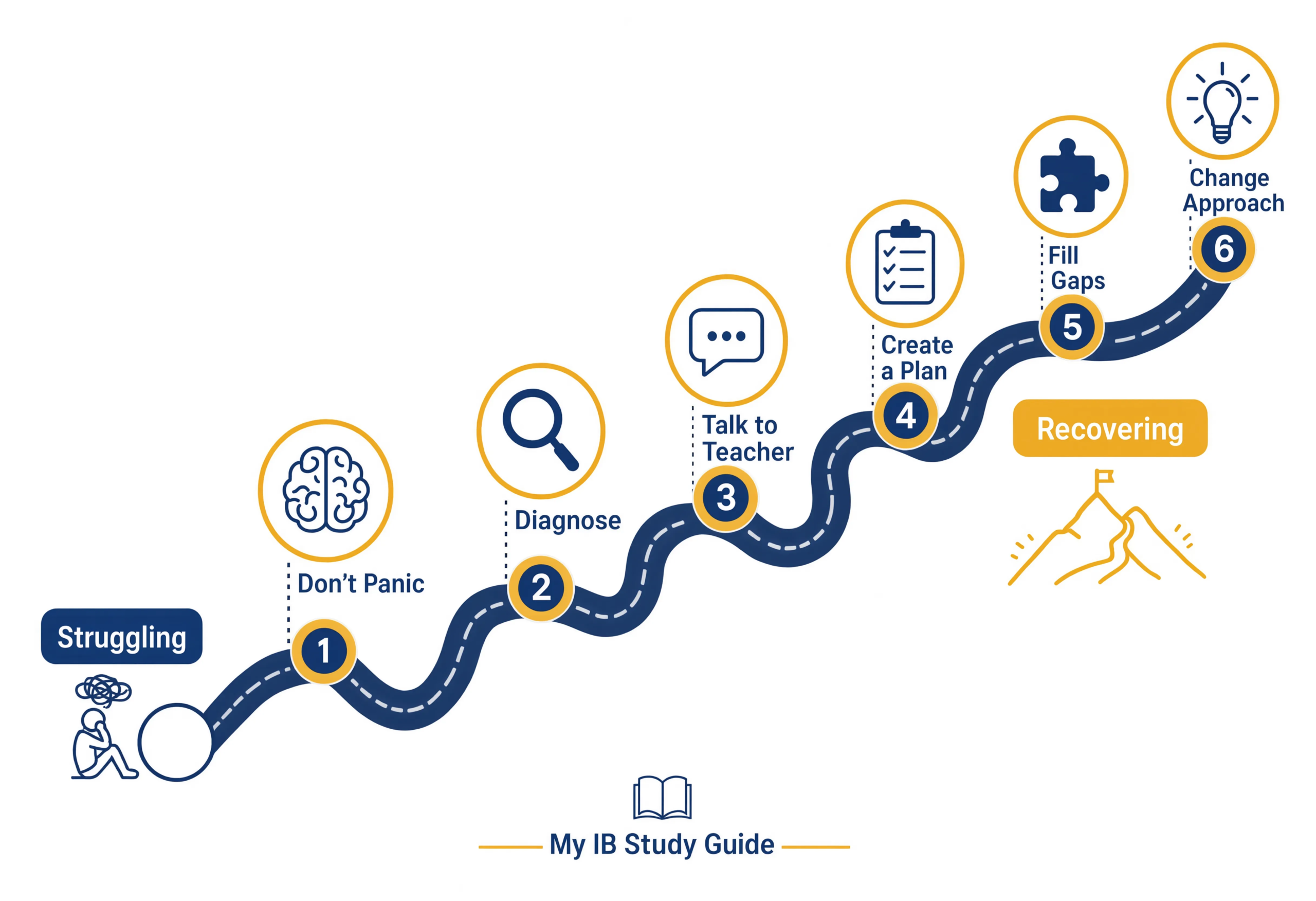
First — Do Not Panic
This is the most important step, and it comes before any studying. When you’re failing IB Math, your brain goes into threat mode. You start catastrophizing — imagining the worst outcomes, losing motivation, and sometimes shutting down entirely.
Here’s what panic does to your recovery:
- It makes you avoid the subject instead of facing it
- It leads to cramming sessions that don’t stick
- It destroys your confidence, making every problem feel impossible
- It makes you compare yourself to others, which helps no one
Instead, try to shift your mindset to something more useful: “I’m behind, but I can catch up if I work smart.” That’s not toxic positivity — it’s realistic. IB Math is graded on a 1–7 scale, and the jump from a 3 to a 4 or even a 5 is absolutely achievable with the right approach and enough time.
💡 Pro Tip
Write down your current grade, your target grade, and today’s date. Put it somewhere you’ll see daily. This small act turns a vague fear into a concrete goal — and concrete goals are much easier to work toward.
Step 1: Identify the Real Problem
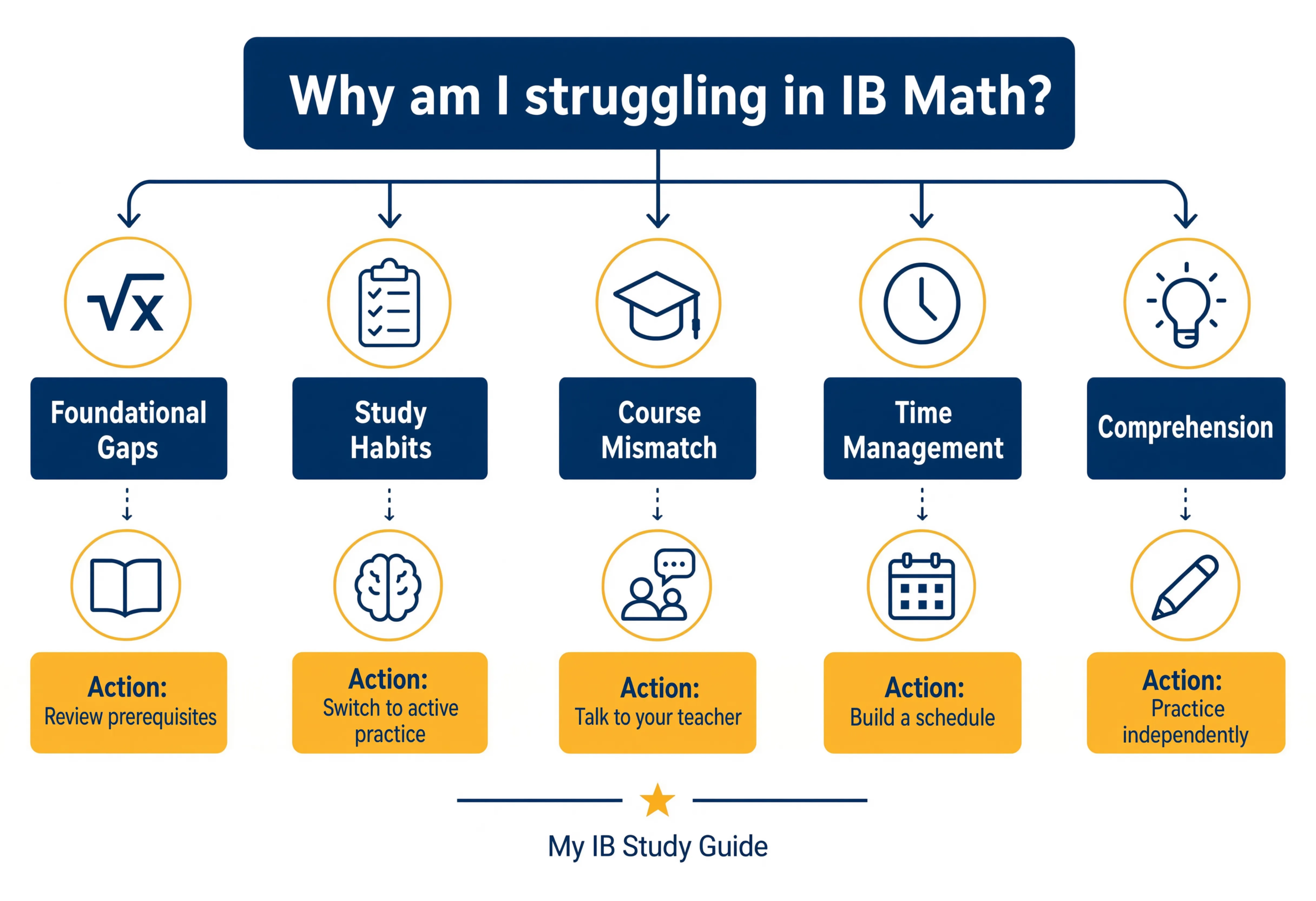
Before you change anything, you need to understand why you’re struggling. “I’m bad at math” is not a diagnosis — it’s a feeling. The real issue is usually one or more of the following:
- Foundational gaps: You’re missing prerequisite skills (algebra, fractions, equations) that the current topics depend on
- Study habits: You’re not practising enough problems, or you’re practising passively (reading solutions instead of solving)
- Course mismatch: You’re in HL when SL would be more appropriate, or you’re in AA when AI would suit your strengths better
- Time management: Other subjects and commitments are squeezing out your math study time
- Comprehension issues: You understand during class but can’t apply concepts independently
Be honest with yourself. Most students who are struggling with IB Math have a combination of these issues, not just one. Identifying them is the first step in any serious recovery.
Step 2: Talk to Your Teacher
This step feels uncomfortable, but it’s one of the most impactful things you can do. Your IB Math teacher has seen students in your exact situation before. They know where the course is heading, what topics carry the most weight on exams, and what specific areas you need to improve.
Here’s what to ask in that conversation:
- “Based on my recent assessments, what are my biggest gaps?”
- “Are there specific foundational topics I should review?”
- “Do you think my current course level (SL/HL) is realistic for me?”
- “Can I come for extra help sessions, and when are those available?”
- “What would you suggest I prioritize for the next 4–6 weeks?”
📌 Important
Having this conversation also shows your teacher that you care and are taking action. Teachers are far more likely to provide extra support, extended deadlines, and helpful feedback when they see a student actively trying to improve. This matters especially when predicted grades are being discussed.
Step 3: Create a Recovery Plan
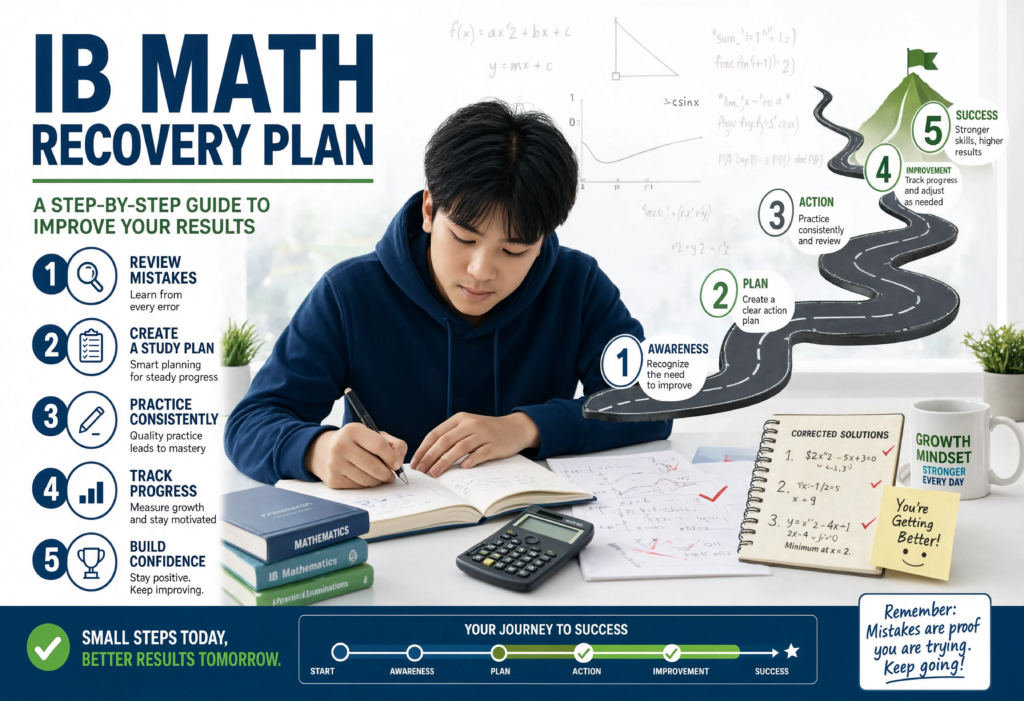
Now it’s time to get organized. Your IB math recovery plan should be realistic, specific, and time-bound. Here’s a framework:
Your Recovery Plan Framework
- Set a target grade — aim for one to two grades above your current level (e.g., from a 3 to a 5)
- List your weak topics — use past tests, quizzes, and teacher feedback to identify 3–5 specific areas
- Allocate weekly time — block out specific hours each week dedicated only to math recovery
- Set 2-week checkpoints — review your progress every two weeks and adjust your plan
- Track everything — use a topic tracker or study planner so you can see what you’ve covered
This isn’t about studying harder — it’s about studying with direction. Without a plan, you’ll waste time on topics you already know while ignoring the ones dragging your grade down.
Step 4: Fill Foundational Gaps
This is where most recovery efforts succeed or fail. If you’re struggling with calculus, the problem might actually be that you never fully understood functions or algebra. IB Math is brutally cumulative — every topic builds on earlier ones.
Common foundational gaps that cause cascading problems:
- Algebra: Expanding, factoring, solving equations, and manipulating expressions
- Functions: Domain, range, notation, transformations, and composition
- Fractions and indices: Operations with fractions, negative exponents, and fractional powers
- Coordinate geometry: Gradients, equations of lines, and distance formulas
- Basic trigonometry: SOHCAHTOA, the unit circle, and exact values
Spend 1–2 weeks focused on filling these gaps before moving to current content. It feels counterintuitive to “go backward,” but it will make everything ahead of you significantly easier.
⚠️ Watch Out
Don’t just re-read notes on these topics. You need to do problems. Work through 10–15 practice problems per foundational topic, check your answers, and redo the ones you got wrong. Passive review won’t fix foundational gaps.
Step 5: Change Your Study Approach When Failing IB Math — How to Recover Through Active Practice
If your current study approach led to failing grades, then your current study approach needs to change. That sounds obvious, but many students keep doing the same thing while hoping for different results.
Swap These Habits
- Instead of reading through worked examples → try covering the solution and solving it yourself first
- Instead of studying for 3 hours once a week → try studying 30–40 minutes five days a week
- Instead of only doing homework problems → try adding 5 extra exam-style problems per session
- Instead of skipping problems you find hard → try spending 10 minutes struggling before checking the answer
- Instead of studying alone always → try working with a study partner once a week for accountability
The key shift is from passive to active learning. You learn math by doing math — not by watching someone else do it.
Step 6: Get Help If Needed
There’s no shame in getting support. In fact, seeking help is one of the smartest decisions you can make when you’re behind. Here are your options:
- Your teacher: Free, knows the IB syllabus, and can give targeted advice
- Peer tutoring: Studying with a classmate who’s strong in your weak areas can help both of you
- Online resources: The official IB Mathematics page has curriculum details that help you know exactly what’s expected
- Private tutoring: If budget allows, a tutor experienced in IB Math can accelerate your recovery
- IA support services: If your IA is a major source of stress, getting structured feedback can be a game changer
Don’t wait until you’re desperate. The earlier you seek help, the more time you have to recover.
Focus on Your IA
Here’s something many struggling students overlook: your Internal Assessment (IA) is worth 20% of your final grade. Unlike exams — where you’re under time pressure and can’t control which questions appear — the IA is a project you have full control over.
This makes the IA one of the most powerful recovery tools available to you. A strong IA can boost your overall grade significantly, even if your exam performance isn’t perfect.
💡 Pro Tip
If you’re currently scoring a 3 and your IA earns 15–18 out of 20, that alone could push you into passing territory. Don’t treat the IA as just another assignment — treat it as your strongest opportunity to recover marks. Learn how to evaluate your own work with our guide on how to self-score your IA before submitting.
Focus on choosing a topic you genuinely find interesting, applying math at an appropriate level, and revising multiple drafts. For a full breakdown of what examiners are looking for, check out our post on the IB Math IA rubric explained.
📚 Recommended Resource
IA Boost Service
If your IA feels overwhelming, our IA Boost Service provides full support until submission. Upload your drafts and get detailed, criterion-by-criterion feedback designed to help struggling students recover marks through the IA. This is not about doing the work for you — it’s about making sure the work you do earns the marks it deserves.
$150
Learn about the IA Boost Service on SamzHub →Timeline for Recovery
How quickly can you realistically improve? That depends on where you are in the course and how much time you have before final exams.
If You Have 6+ Months
You have plenty of time. Focus on foundational gaps first (2–3 weeks), then build a consistent weekly study routine. You can realistically improve by 2–3 grade levels with sustained effort.
If You Have 3–6 Months
Time is tighter but still workable. Prioritize your weakest high-value topics (the ones that appear most on exams), and dedicate serious effort to your IA. Aim for a 1–2 grade improvement.
If You Have Less Than 3 Months
Focus on exam technique and your strongest topics. At this stage, it’s about maximizing the marks you can get rather than trying to master everything. Practice past papers under timed conditions and review mark schemes carefully to understand how marks are awarded.
📌 Important
Recovery is not linear. You’ll have good weeks and frustrating weeks. What matters is that your overall trajectory is upward. Don’t quit your plan after one bad quiz — trust the process and keep showing up.
✅ Key Takeaways
- If you’re failing IB Math, how to recover starts with staying calm and getting honest about what’s going wrong.
- Diagnose the real problem — foundational gaps, study habits, course mismatch, or time management — before changing anything.
- Talk to your teacher early. They can provide targeted advice and are more likely to support students who show initiative.
- Build a specific, time-bound recovery plan with 2-week checkpoints.
- Your IA is worth 20% of your grade — treat it as your biggest recovery opportunity.
- Recovery takes time. Aim for steady progress, not overnight transformation.
🎁 Free Download
IB Math Study Schedule Template
Structure your recovery with our free weekly planner, topic tracker, and exam countdown — designed specifically for IB Math students who need to get back on track.
Download Free Study Schedule Template →No spam. Unsubscribe anytime.
Frequently Asked Questions
Failing IB Math feels like the end of the world when you’re in it — but it’s not. Students recover from this situation every year, and with a clear plan, honest self-assessment, and consistent effort, you can too. Start with step one today. You don’t need to fix everything at once — you just need to start moving in the right direction. If you’re failing IB Math, how to recover is simpler than you think: stop panicking, get organized, and show up every day.