
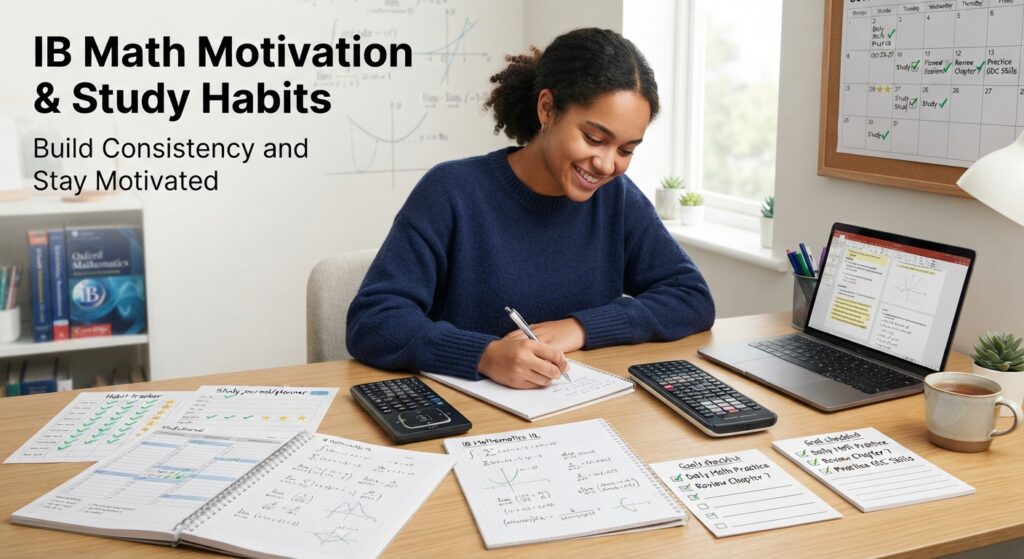
If you’re searching for IB math motivation study tips, chances are you’re sitting in front of your textbook right now feeling absolutely nothing — and that’s more common than you think.
📋 In This Guide
Let’s skip the pep talk. You already know IB Math is important. You know your grade matters. The problem isn’t awareness — it’s that knowing something matters and actually feeling motivated to do it are two completely different things.
Maybe you’ve been grinding for weeks and you’re burnt out. Maybe the topic you’re on feels pointless. Maybe you got a bad test score and now everything feels hopeless. Whatever the reason, your IB math motivation has flatlined — and no amount of “just try harder” advice is going to fix that.
This guide takes a different approach. Instead of trying to pump you full of temporary inspiration, we’ll focus on practical IB math motivation study tips that work even when you feel nothing. These strategies are designed for real students in real slumps — not motivational poster clichés. If you’re also looking to build a study structure that requires less willpower, check out our ultimate IB Math study schedule guide.
Why Motivation Disappears
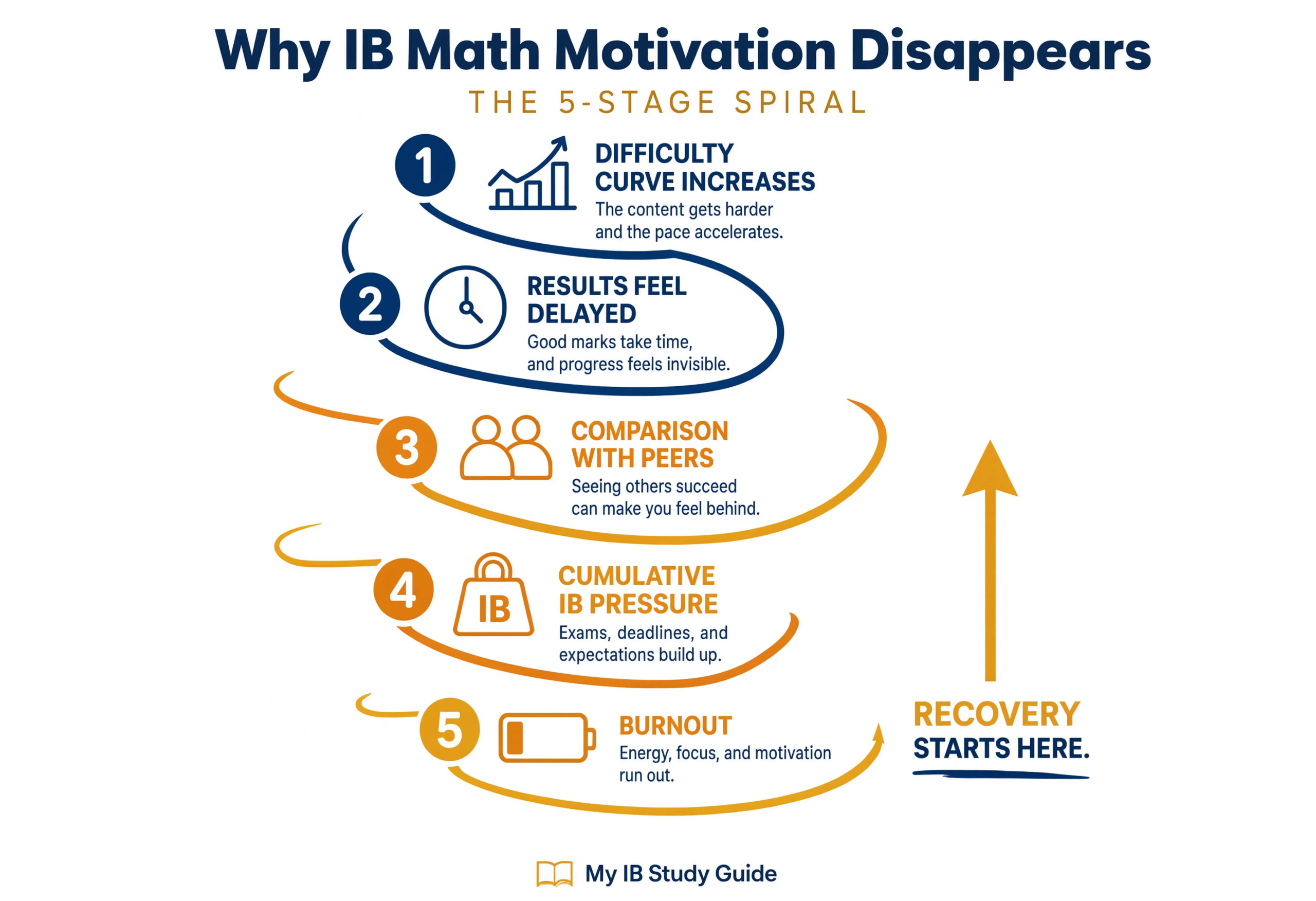
Before you can fix the problem, it helps to understand why it’s happening. Motivation isn’t a personality trait — it’s a temporary emotional state that fluctuates constantly. And several things specific to IB Math make it especially fragile:
- The difficulty curve: IB Math gets harder as the course progresses. What felt manageable in September can feel crushing by February.
- Delayed results: Unlike some subjects where effort translates quickly to better grades, math improvement is often slow and invisible — until it suddenly clicks.
- Comparison: Seeing classmates who seem to “get it” effortlessly can make you feel like something is wrong with you. It isn’t.
- Cumulative pressure: IB Math doesn’t exist in isolation. You’re also managing five other subjects, TOK, CAS, your Extended Essay, and your Internal Assessment (IA).
- Burnout: If you’ve been pushing hard without real breaks, your brain eventually shuts down the motivation system to protect itself.
Notice that none of these causes are about you being lazy or incapable. They’re natural responses to a genuinely demanding programme. Understanding this is the first step in rebuilding your IB math motivation.
💡 Pro Tip
If your motivation has been gone for more than two weeks and you’re also feeling persistently sad, exhausted, or withdrawn, please talk to a trusted adult, your school counsellor, or your IB coordinator. Burnout and mental health struggles are real, and getting support is a sign of strength — not weakness.
The Difference Between Motivation and Discipline
Here’s the most important mindset shift in this entire post: you don’t need motivation to study — you need a system.
Motivation is an emotion. It comes and goes like any other feeling. Some days you’ll feel excited about math. Most days you won’t. If you only study when you feel motivated, you’ll study about 20% of the time you actually need to.
Discipline is different. Discipline is showing up because you’ve decided in advance that this is what you do at this time, regardless of how you feel. It sounds less exciting — but it’s far more reliable.
📌 Important
Discipline doesn’t mean forcing yourself through two-hour sessions when you’re exhausted. It means doing something — even something small — on the days you’ve committed to. The size of the session can vary. The consistency of showing up cannot.
The good news? Discipline gets easier over time. The first week of showing up without motivation is hard. By week three, it starts to feel automatic. And here’s the irony — motivation often returns once you start seeing progress, and progress only comes from consistent action.
What to Do on Low-Motivation Days
Not every study session needs to be a full-intensity, deep-focus marathon. On days when your IB math motivation is at rock bottom, your goal shifts from “learn new things” to “don’t break the chain.” Here’s what that looks like in practice:
Low-Energy Study Options
- Review your formula sheet — spend 10 minutes reading through formulas for the current topic. No problem solving required.
- Redo a problem you’ve already solved — repetition builds fluency without requiring new cognitive effort.
- Organise your notes — clean up your binder, label sections, or create a topic summary page.
- Watch one short explanation video — sometimes a different voice explaining a concept can reignite interest.
- Do exactly 3 problems — not 10, not 20. Just 3. Choose ones from a topic you’re relatively comfortable with.
The point isn’t to make massive progress on these days. The point is to maintain your connection to the subject so that when your energy returns, you’re not starting from zero.
⚠️ Watch Out
Don’t let “low-motivation days” become every day. These reduced sessions are a bridge to get you through tough patches — not a permanent study strategy. If every day feels like a low-motivation day for more than two weeks, something deeper needs to change. Revisit your schedule, your sleep, and your overall workload.
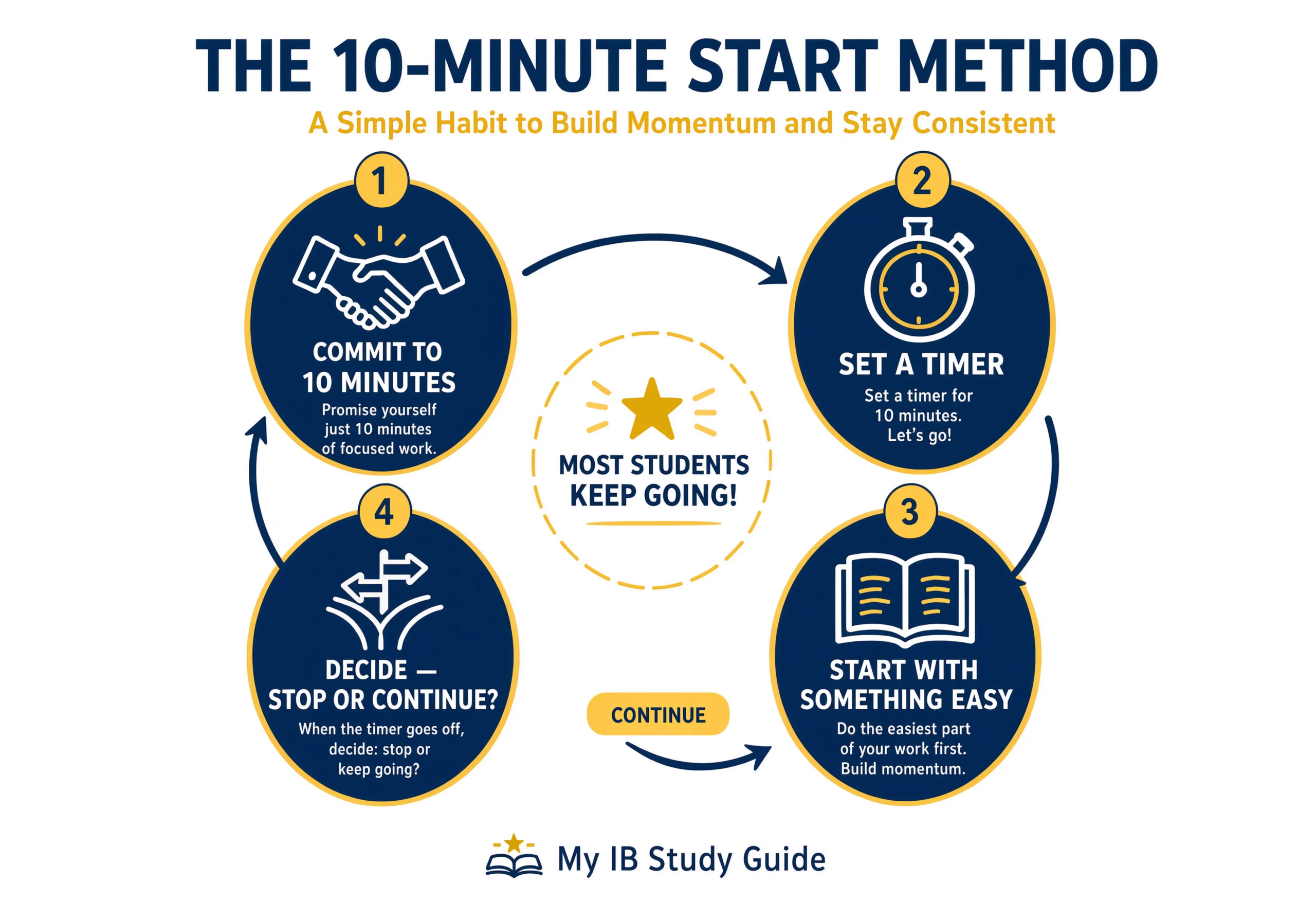
The 10-Minute Start Method — The Most Effective IB Math Motivation Study Tip
This is the single most powerful technique for overcoming motivation blocks, and it works because it exploits how your brain actually functions.
How It Works
- Commit to exactly 10 minutes. Not 30. Not an hour. Tell yourself: “I will do 10 minutes of math, and then I can stop.”
- Set a timer. Use your phone, a kitchen timer, or any app. The timer makes it concrete.
- Start with something easy. Open your textbook to a section you’ve already covered. Do one or two straightforward problems.
- When the timer goes off, decide. You have full permission to stop. But ask yourself: “Do I want to keep going for 10 more minutes?”
Here’s what happens almost every time: once you’ve started, continuing feels easier than stopping. The hardest part of any study session is the first 60 seconds. After that, your brain enters a working state and resistance drops dramatically.
Most students who use the 10-minute method end up studying for 25–40 minutes — not because they forced themselves, but because starting removed the friction. For more strategies to build sustainable routines around techniques like this, read our post on how to stay consistent with IB Math over long holidays.
💡 Pro Tip
Pair the 10-minute method with a specific location. Sit in the same chair, at the same desk, every time you study math. Over time, your brain will associate that location with “math mode,” and the activation energy needed to start will decrease significantly.
📚 Recommended Service
IB Math IA Feedback
Written your IA but unsure where you stand? Submit your draft and receive a written feedback report with your estimated score out of 20 and a clear criterion-by-criterion breakdown of exactly where you are losing marks. Delivered in 3–5 business days.
$30
Get the IA Feedback Service on SamzHub →How to Build Momentum Again
Getting through one low day is a win. But the real goal is building enough momentum that studying math feels less painful over time. Here’s how to rebuild that momentum after a slump:
Week 1: Foundation Reset
- Lower your expectations dramatically. Aim for 10–15 minutes per day, 4 days this week. That’s it.
- Study topics you’re already decent at. Success builds confidence. Save the hard stuff for when you’re rolling again.
- Track your sessions. Put a checkmark on your calendar for every day you show up. Seeing the streak grow is surprisingly motivating.
Week 2: Gradual Increase
- Increase sessions to 20–25 minutes
- Add one slightly challenging topic alongside comfortable ones
- Continue tracking your streak
- Notice how it feels easier to start than it did last week
Week 3: Return to Normal
By week three, you should be able to return to regular-length sessions. You’ll probably find that studying feels different now — not necessarily exciting, but manageable. That’s the goal. Manageable is sustainable. Sustainable beats motivated every time.
If you’re looking for deeper strategies on how to study more effectively once your momentum returns, our guide on active vs passive studying will help you make every session count.
📌 Important
Momentum is fragile when it’s new. Protect it fiercely during weeks 1–3. Say no to unnecessary commitments if you can. Guard your study blocks. Every time you show up, you’re proving to yourself that you can do this — and that proof compounds over time.
✅ Key Takeaways
- Motivation is a temporary emotion — don’t build your entire IB math study strategy around it. Use these IB math motivation study tips to show up regardless of how you feel.
- Discipline and systems are more reliable than inspiration. A schedule removes the daily decision of “should I study?” — the answer is always yes, even if the session is small.
- On low-motivation days, aim to maintain your streak, not make major progress. Three problems or 10 minutes of review is enough.
- The 10-Minute Start Method is the most effective tool for overcoming resistance. Most students continue well beyond the initial 10 minutes once they start.
- Rebuild momentum gradually over 3 weeks — start tiny, track your streak, and increase slowly.
Frequently Asked Questions
Here’s the truth that nobody puts on a motivational poster: you don’t need to feel inspired to make progress. You just need to start. Use these IB math motivation study tips not as a one-time fix, but as a toolkit you come back to whenever the slump hits. Because it will hit again — that’s normal. What matters is that now you know exactly what to do when it does.