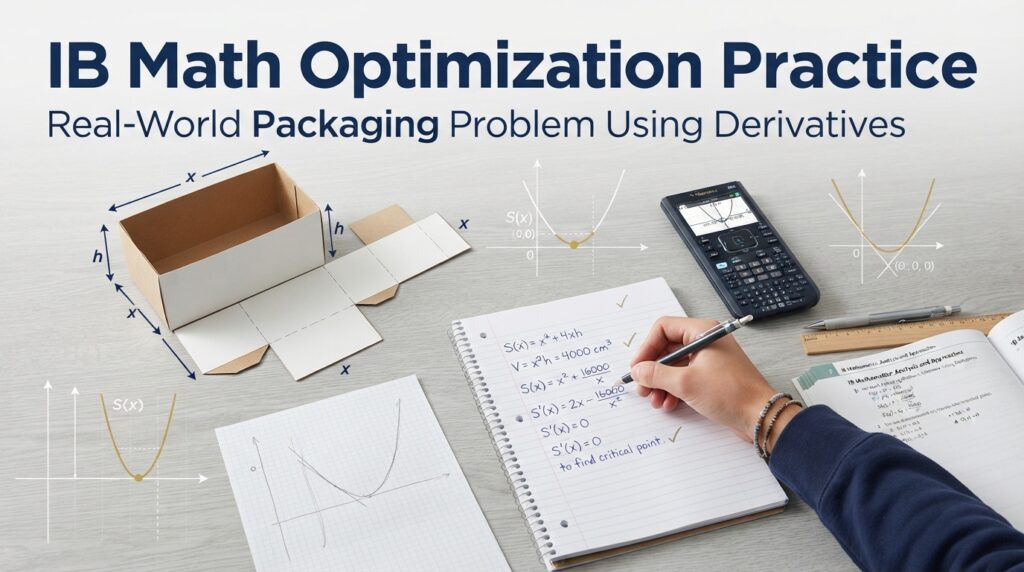
This IB math calculus practice question will test your ability to apply derivatives to a real-world optimization problem — exactly the type of challenge you will face on your IB Math AA exam. Optimization questions are among the most rewarding in the calculus syllabus because they connect abstract differentiation skills to practical decision-making. Before you look at any hints or the solution, grab a pen and paper and give this one a genuine attempt. That is where real learning happens.
Paper 2 style (calculator allowed)
📋 Jump To
This Week’s IB Math Calculus Practice Question
📝 Question of the Week
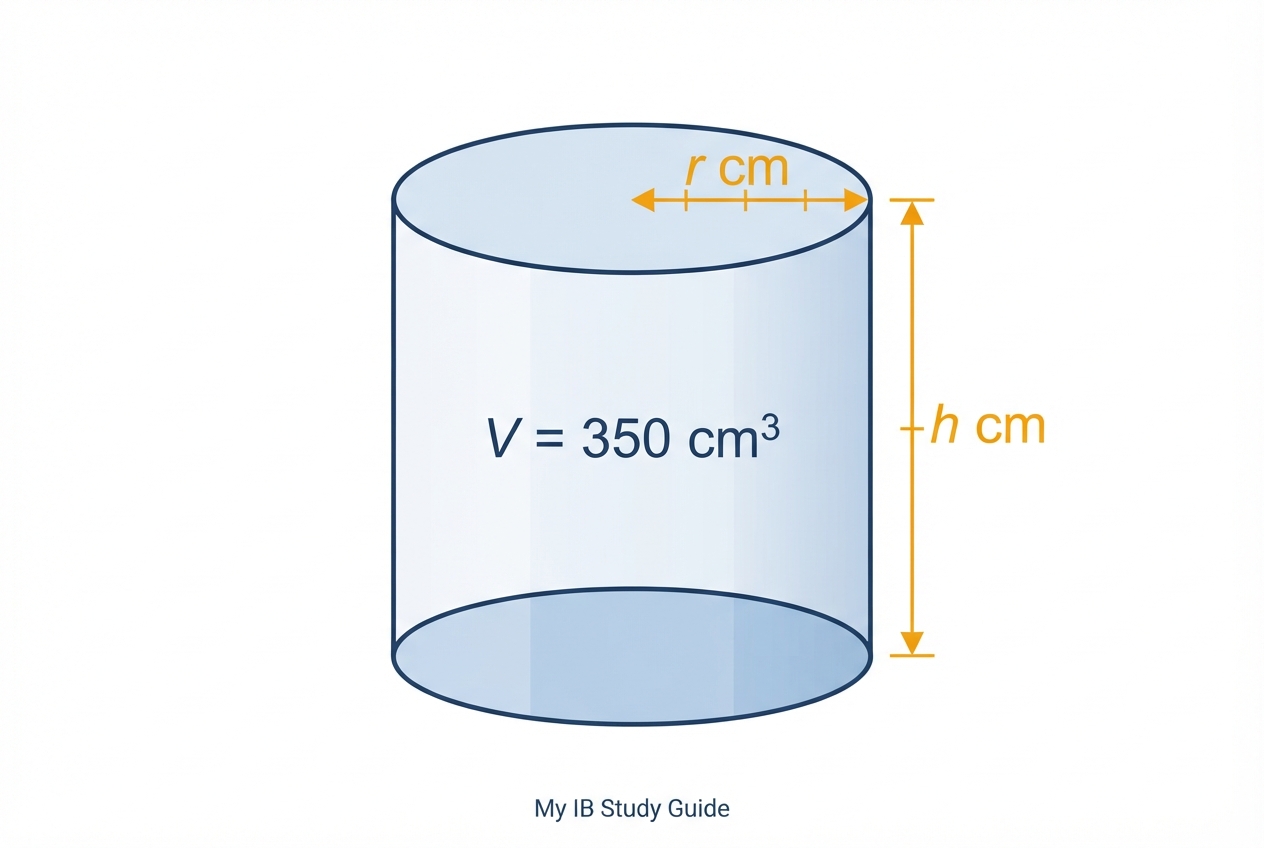
A small tea company is designing a closed cylindrical tin to hold exactly 350 cm³ of loose-leaf tea. The tin has a circular base of radius r cm and a height of h cm.
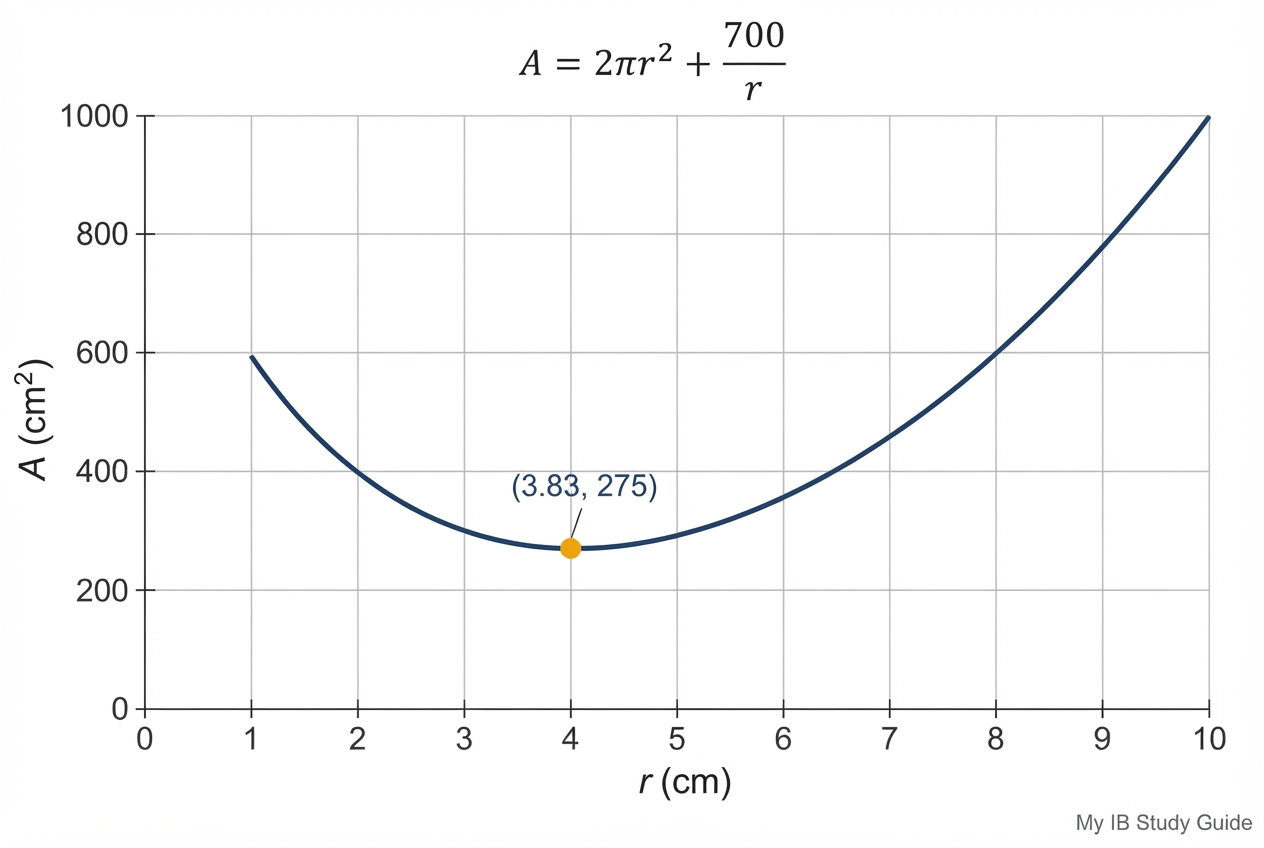
(a) Show that the total surface area of the tin, in cm², can be written as
(b) Find $$\frac{dA}{dr}$$.
(c) Hence find the value of r that minimizes the total surface area of the tin.
(d) Calculate the minimum total surface area, giving your answer correct to three significant figures.
Total: [8 marks]
HL Extension: If you are studying Math AA HL, try proving that your answer to part (c) gives a minimum rather than a maximum by using the second derivative test. What does $$\frac{d^2A}{dr^2}$$ tell you at this point?
What You Need to Know
📖 Key Information
Topic: Calculus — Optimization using derivatives (AA SL 5.8, AA HL 5.8)
Paper style: Paper 2 style (calculator allowed)
Estimated time: 8–10 minutes
Formulas you need from the data booklet:
- Volume of a cylinder: V = πr²h
- Surface area of a closed cylinder: A = 2πr² + 2πrh
Skills tested: Substitution to reduce variables, differentiation of polynomial and negative-power terms, solving equations, and interpreting results in context.
If you need a refresher on how derivatives connect to optimization problems, check out our guide on how to get a 7 in IB Math AA SL for effective study strategies. You can also review the official syllabus content on the IB Mathematics curriculum page.
Hints
Hint 1 — Getting Started
For part (a), you need to eliminate h from the surface area formula. Use the volume constraint πr²h = 350 to write h in terms of r, then substitute into the surface area formula.
(Try working through this before reading Hint 2.)
Hint 2 — The Derivative
When you differentiate $$\frac{700}{r}$$, rewrite it as 700r⁻¹ first. Then apply the power rule. Remember that a minimum occurs where $$\frac{dA}{dr} = 0$$.
(Try setting the derivative equal to zero before reading Hint 3.)
Hint 3 — Solving for r
After setting $$\frac{dA}{dr} = 0$$, you should reach 4πr³ = 700. Isolate r³ and take the cube root. Then substitute this value back into your expression for A to find the minimum surface area.
(Now try completing the full solution on your own.)
Full Worked Solution
✍️ Step-by-Step Solution
Part (a) — Express A in terms of r only
Start with the volume constraint:
Solve for h:
The total surface area of a closed cylinder is:
Substitute the expression for h:
Part (b) — Find $$\frac{dA}{dr}$$
Rewrite $$\frac{700}{r}$$ as 700r⁻¹ and differentiate term by term:
Or equivalently:
Part (c) — Find the value of r that minimizes A
Set the derivative equal to zero for this ib math calculus practice question:
Multiply both sides by r²:
Part (d) — Calculate the minimum surface area
Substitute r = 3.8264… into the surface area formula (use the unrounded value for accuracy):
(a) [M1] Expressing h in terms of r using volume constraint; [A1] Correctly substituting and simplifying to reach given expression — 2 marks
(b) [M1] Evidence of differentiation attempt; [A1] Correct derivative — 2 marks
(c) [M1] Setting derivative to zero; [A1] Correct value of r — 2 marks
(d) [M1] Substituting their r into A; [A1] Correct answer to 3 s.f. — 2 marks
Total: 8 marks
Examiner Notes
🎓 What the Examiner Wants to See
- Part (a) is a “show that” question. You must show every algebraic step clearly. If you skip the substitution or simplification, you will lose the A1 mark even if you write the correct final expression.
- Correct notation matters. Write $$\frac{dA}{dr}$$ explicitly — do not just write the derivative without stating what you are differentiating.
- Use unrounded values in follow-through calculations. In part (d), substitute the full unrounded value of r to avoid premature rounding errors. Store the value in your calculator.
- State the answer in context with units. The question asks for surface area, so include cm² in your final answer.
- For HL students: If asked to justify that a stationary point is a minimum, compute $$\frac{d²A}{dr²} = 4π + \frac{1400}{r³}$$. Since this is always positive for r > 0, the stationary point is indeed a minimum.
Common Mistakes
❌ Common Mistakes to Avoid
1. Forgetting to cancel π when substituting h into the surface area
When you substitute $$h = \frac{350}{πr²}$$ into 2πrh, the π in the numerator and denominator must cancel. Students who miss this end up with π still in the second term, producing an incorrect expression. This costs both marks in part (a) and creates errors in every subsequent part.
2. Sign error when differentiating 700r⁻¹
The derivative of 700r⁻¹ is −700r⁻², not +700r⁻². A positive sign here leads to an equation with no positive real solution, which should signal something has gone wrong — but under exam pressure students often do not catch it. Always double-check the sign when differentiating negative powers.
3. Rounding too early in part (d)
Using r = 3.83 (the rounded value) instead of the full calculator value when computing the minimum surface area can give an answer of 274 or 276 instead of 275. The IB expects you to use stored calculator values and only round at the final step. This mistake typically costs the final A1 mark.
📚 Want More Practice?
Calculus Workbook (Coming Soon)
Topic-by-topic calculus practice with full solutions — covers derivatives, integration, and optimization. Builds from basic skills to exam-level questions so you can master every type of calculus problem on the IB exam is coming soon.
$10.45
Get the Calculus Workbook on SamzHub →How did you go with this week’s IB math calculus practice question? Whether you nailed it or needed the hints, working through optimization problems like this one builds the exact skills the IB examiners are looking for. Keep practising and come back next week for a new challenge.