
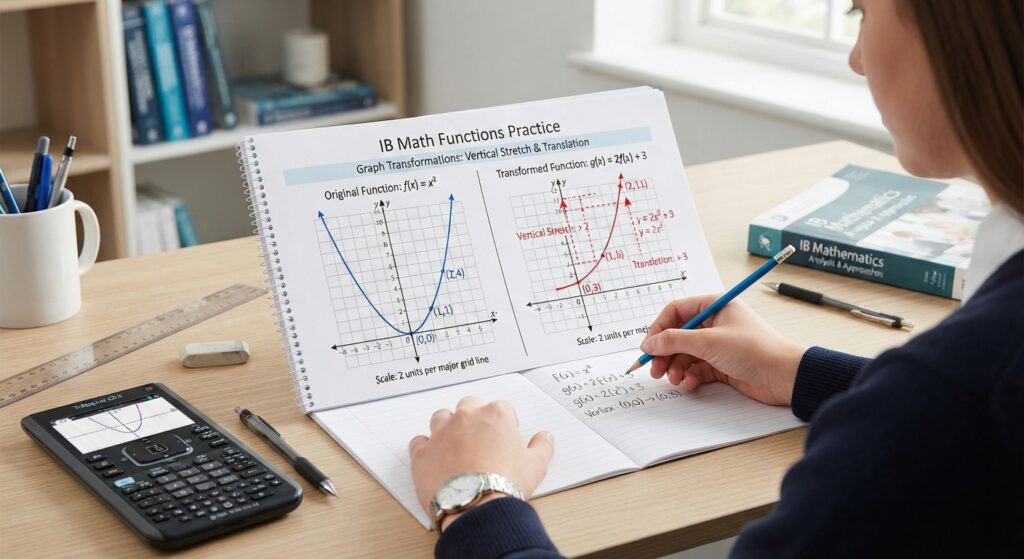
This IB math functions practice question focuses on transformations — one of the most visual and frequently tested topics in the IB Math AA syllabus. You will need to analyse a given function, apply a sequence of transformations, and sketch the result. Before you peek at any hints or the worked solution, challenge yourself to work through the entire question independently. That struggle is exactly what builds exam-ready confidence.
Paper 1 style (no calculator)
📋 Jump To
This Week’s IB Math Functions Practice Question
📝 Question of the Week
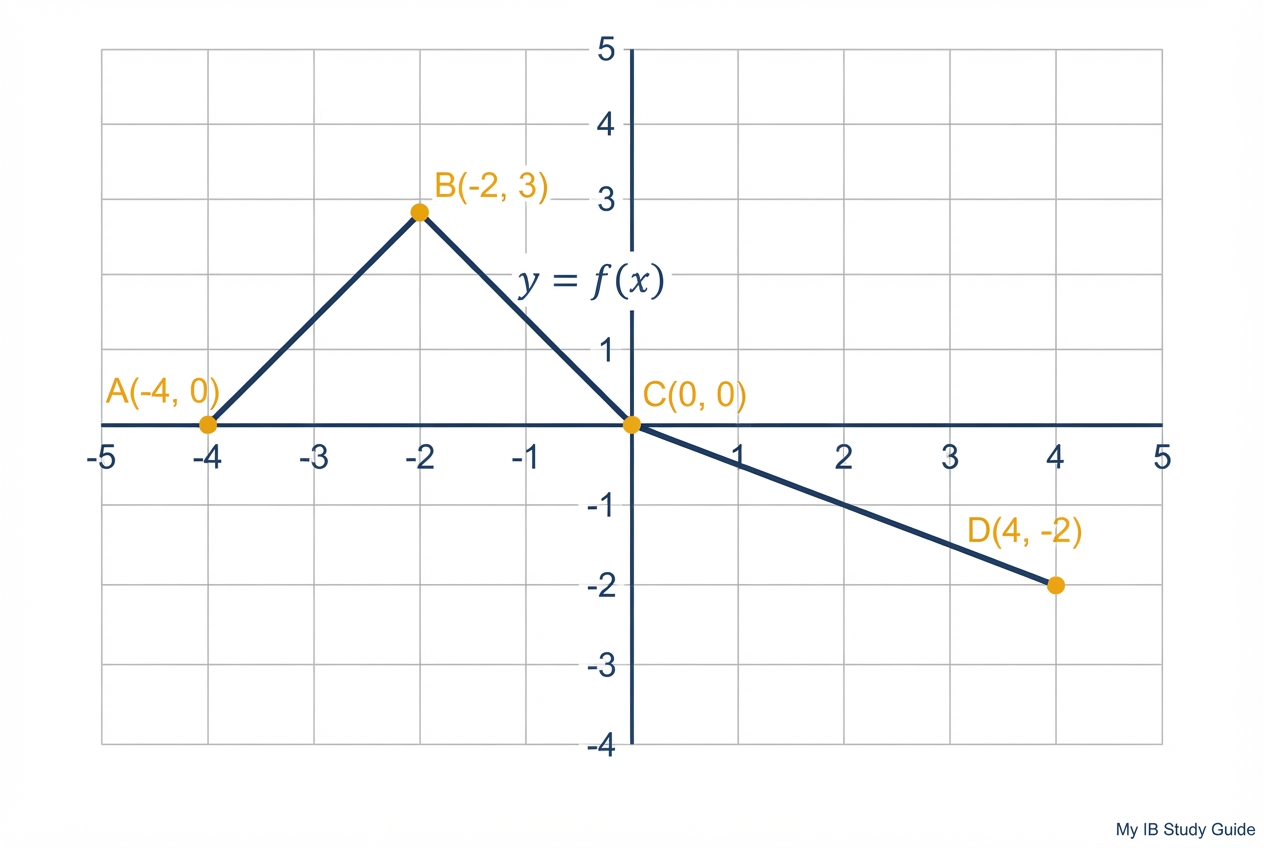
The graph of \( y = f(x) \) is shown below. The function \( f \) has a domain of \( -4 \leq x \leq 4 \) and passes through the points \( A(-4, 0) \), \( B(-2, 3) \), \( C(0, 0) \), and \( D(4, -2) \).
A new function \( g \) is defined by
(a) Describe the three transformations that map the graph of \( y = f(x) \) to the graph of \( y = g(x) \).
[3 marks](b) Find the coordinates of the image of each of the points \( A \), \( B \), \( C \), and \( D \) under the transformation.
[3 marks](c) State the domain and range of \( g \).
[2 marks]Total: [8 marks]
What You Need to Know
📖 Key Information
Topic: Functions — Transformations of graphs (AA SL 2.11, AA HL 2.11)
Paper style: Paper 1 style (no calculator)
Estimated time: 8–10 minutes
Key transformation rules:
- \( y = f(x – h) \) — horizontal translation \( h \) units to the right
- \( y = af(x) \) — vertical stretch by scale factor \( a \)
- \( y = f(x) + k \) — vertical translation \( k \) units up
Order matters: Apply transformations in the correct sequence — inside the function (horizontal) first, then outside (vertical stretch, then vertical translation).
If you want to strengthen your understanding of how domain and range change under transformations, check out our post on 10 calculator skills every IB Math student needs for tips on verifying your graphs. You can also review the official syllabus details on the IB Mathematics curriculum page.
Hints
💡 Hint 1 — Getting Started
Break \( g(x) = 2f(x-1) + 3 \) into three separate transformations. Start by identifying what happens inside the brackets (to \( x \)) and what happens outside (to \( y \)). Think about the order: which transformation do you apply first?
⏸ Try working with this hint before opening Hint 2.
💡 Hint 2 — Mapping the Points
For each original point \( (x, y) \), the image under \( g(x) = 2f(x-1) + 3 \) is \( (x + 1, \; 2y + 3) \). The \( x \)-coordinate shifts by \( +1 \), while the \( y \)-coordinate is first multiplied by 2, then increased by 3. Apply this rule to each of the four given points.
⏸ Try completing the question before opening Hint 3.
💡 Hint 3 — Domain and Range
The domain of \( f \) is \( -4 \leq x \leq 4 \). Since the horizontal translation shifts everything 1 unit right, the domain of \( g \) shifts accordingly. For the range, find the minimum and maximum \( y \)-values of \( f \) first (look at the graph — the lowest is \( -2 \) and the highest is \( 3 \)), then apply the vertical transformations to these values.
⏸ Now try finishing the solution on your own.
Full Worked Solution
✍️ Step-by-Step Solution
Part (a): Identify the Three Transformations
We need to break down \( g(x) = 2f(x – 1) + 3 \) into individual transformations applied to \( f(x) \). Reading the expression carefully for this IB math functions practice question:
1. The \( (x – 1) \) inside the function represents a horizontal translation 1 unit to the right.
2. The factor of \( 2 \) multiplying \( f \) represents a vertical stretch by scale factor 2.
3. The \( + 3 \) outside the function represents a vertical translation 3 units up.
Part (b): Find the Image of Each Point
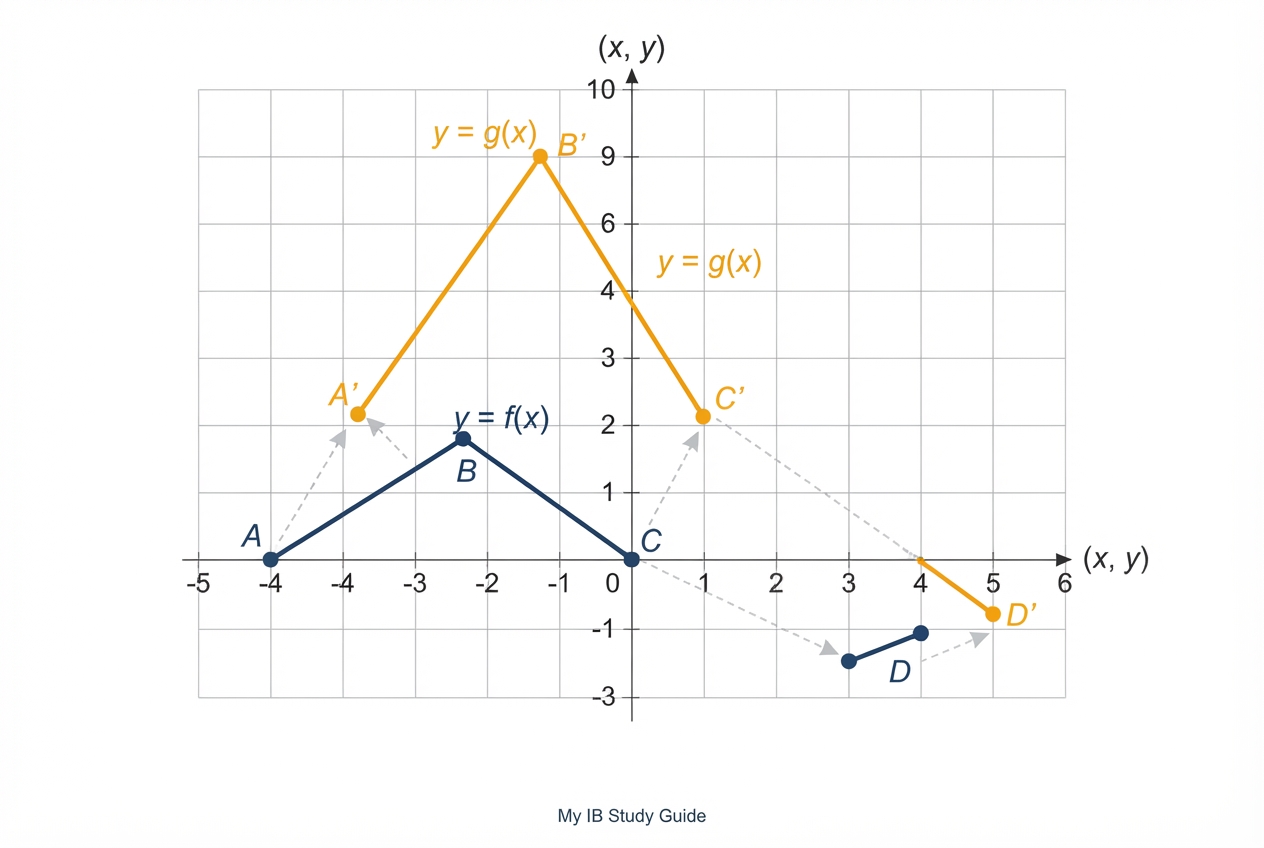
For each point \( (x, y) \) on \( f \), the corresponding point on \( g \) is \( (x + 1, \; 2y + 3) \). We apply this mapping to each point:
Part (c): State the Domain and Range of g
Domain: The original domain of \( f \) is \( -4 \leq x \leq 4 \). The horizontal translation shifts every \( x \)-value 1 unit to the right:
Range: From the graph of \( f \), the minimum \( y \)-value is \( -2 \) (at point \( D \)) and the maximum is \( 3 \) (at point \( B \)). Applying the vertical transformations \( y \mapsto 2y + 3 \):
(a) Horizontal translation 1 unit right; vertical stretch by scale factor 2; vertical translation 3 units up.
(b) \( A'(-3, 3) \), \( B'(-1, 9) \), \( C'(1, 3) \), \( D'(5, -1) \)
(c) Domain: \( -3 \leq x \leq 5 \); Range: \( -1 \leq y \leq 9 \)
(a) [A1] Horizontal translation 1 unit right; [A1] Vertical stretch by scale factor 2; [A1] Vertical translation 3 units up — 3 marks
(b) [A1] Any two correct image points; [A1] Remaining two correct image points; [A1] All four coordinates correct with no errors — 3 marks
(c) [A1] Correct domain; [A1] Correct range — 2 marks
Total: 8 marks
Examiner Notes
🎓 What the Examiner Wants to See
- Use precise IB language for transformations. Say “horizontal translation 1 unit to the right,” not “shift right by 1.” The IB expects the words translation, stretch, and reflection along with direction and scale factor.
- Direction matters for translations. Writing “translation of 1 unit” without specifying “to the right” will lose you the mark. Similarly, “3 units” without “up” is incomplete.
- Show the mapping rule clearly in part (b). Writing \( (x, y) \rightarrow (x+1, 2y+3) \) before listing the coordinates demonstrates understanding and earns method credit even if one coordinate has an arithmetic error.
- Use inequality notation for domain and range. The IB accepts \( -3 \leq x \leq 5 \) or \( [-3, 5] \) — but be consistent. Avoid writing “from -3 to 5” in words.
- If sketching is required, label key features. Mark the image points, label axes, and clearly indicate which curve is \( f \) and which is \( g \).
Common Mistakes
❌ Common Mistakes to Avoid
1. Translating horizontally in the wrong direction
Many students see \( f(x – 1) \) and shift the graph 1 unit to the left instead of to the right. Remember: \( f(x – h) \) moves the graph \( h \) units to the right. The sign is counterintuitive. This error affects all four image points in part (b) and the domain in part (c), potentially costing you 5 marks.
2. Applying transformations in the wrong order
Some students add 3 before multiplying by 2, computing the \( y \)-coordinate as \( 2(y + 3) \) instead of \( 2y + 3 \). Order of operations matters: the vertical stretch (multiply by 2) applies to \( f \) first, then the vertical translation (add 3) is applied. For point \( B(-2, 3) \), the wrong order gives \( y = 2(3+3) = 12 \) instead of the correct \( y = 2(3) + 3 = 9 \).
3. Forgetting to transform the domain
Students often state the range correctly but write the original domain \( -4 \leq x \leq 4 \) instead of the transformed domain \( -3 \leq x \leq 5 \). Horizontal transformations affect the domain — if you shift the graph 1 unit right, every \( x \)-boundary shifts by \( +1 \). This costs the A1 mark for domain.
📚 Want More Practice?
Functions Workbook (Coming Soon)
Complete functions practice covering domain, range, transformations, and compositions — with full solutions and examiner notes for every question. Build from basic skills to exam-level confidence.
$10.45
Get the Functions Workbook on SamzHub →How did you handle this week’s IB math functions practice question? Transformations are a topic that rewards careful, methodical thinking — and the more you practise, the more automatic the mapping rules become. Come back next week for a brand new challenge, and keep building that exam confidence one question at a time.