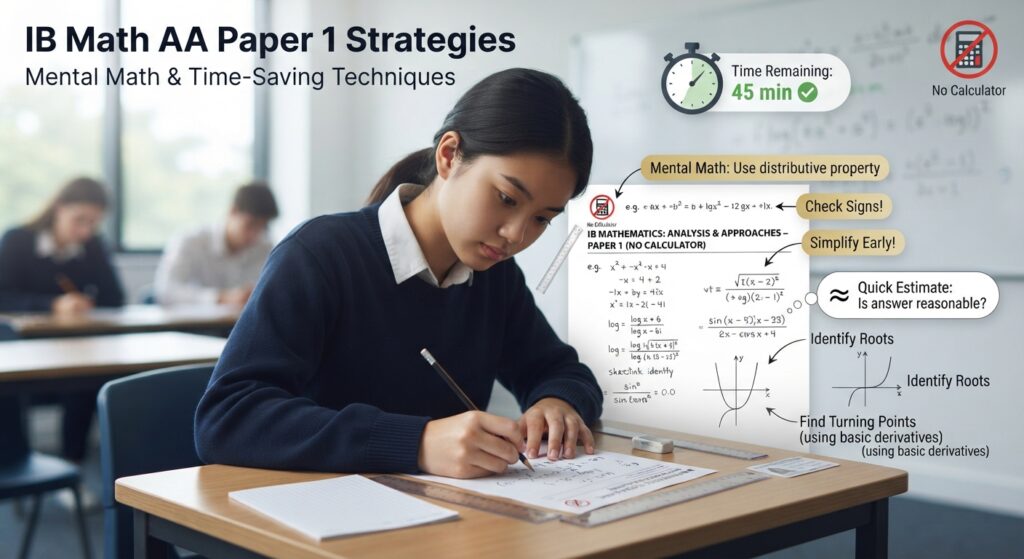
A solid IB math paper 1 no calculator strategy is the difference between students who panic when they can’t reach for their GDC and students who walk into the exam room feeling genuinely confident with nothing but a pen and the formula booklet.
📋 In This Guide
Paper 1 is the no-calculator paper for IB Math Analysis and Approaches (AA), and it tests a fundamentally different skill set from Paper 2. Many students spend months mastering their GDC only to realise they haven’t practised enough without it. That’s a problem because Paper 1 carries significant weight in your final grade — and your ib math paper 1 no calculator strategy needs to be just as polished as your calculator skills.
This post is a deep dive into Paper 1 specifically, complementing our broader overview in IB Math Paper 1 vs Paper 2: Different Strategies for Each. Whether you’re AA SL or AA HL, these IB math non calculator tips will help you work faster, avoid silly mistakes, and pick up marks you might otherwise lose.
Let’s break down exactly how to prepare for — and perform in — Paper 1.
Why Paper 1 Requires a Different Mindset
When you sit down for Paper 2, your GDC does the heavy lifting on computation. You can graph functions, solve equations numerically, and verify answers instantly. Paper 1 strips all of that away.
This means the examiners are testing something different. They want to see that you understand the mathematics, not just that you can press buttons. Questions on Paper 1 are designed so that every calculation can be done by hand — but only if you know the right approach.
Here’s what changes in Paper 1:
- You must show full algebraic working — no “from GDC” answers accepted
- Exact values are expected (fractions, surds, π) rather than decimals. Please note that surds are also known as radicals or nth-root that leads to an irrational number such as √2.
- Questions are structured so clever shortcuts beat brute force
- Mental arithmetic fluency matters — slow computation costs minutes
- You rely on the formula booklet more strategically
The biggest mindset shift? Stop thinking about getting a number and start thinking about showing a process. Paper 1 rewards elegant, efficient working far more than it rewards grinding through arithmetic.
💡 Pro Tip
Start every Paper 1 study session by putting your calculator in another room. If it’s within arm’s reach, you’ll unconsciously reach for it and miss the chance to build mental math fluency.
Mental Math Techniques That Save Time on IB Math Paper 1
Speed in Paper 1 doesn’t come from rushing. It comes from recognising patterns and using efficient mental math techniques. Here are the ones that matter most for IB Math AA.
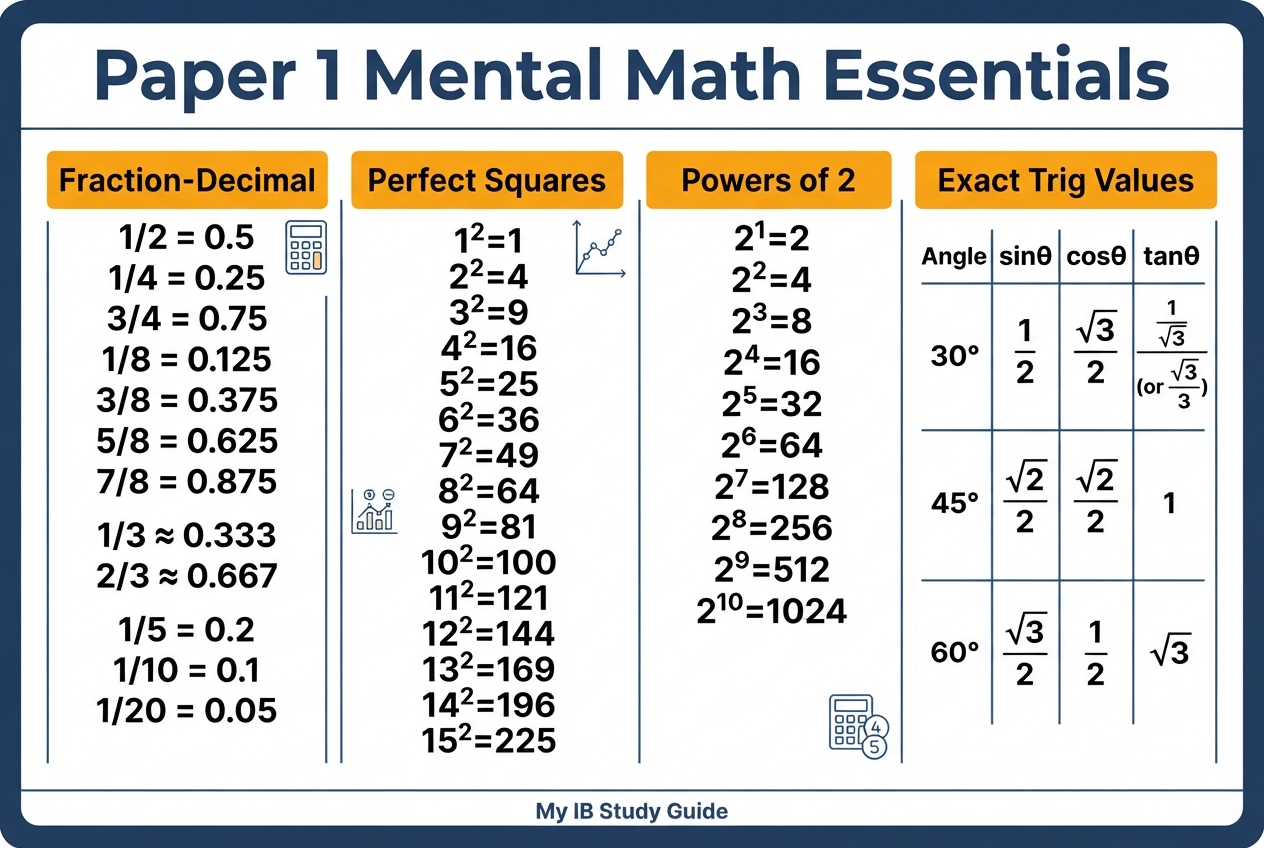
Fraction Fluency
You’d be surprised how many marks are lost to slow fraction arithmetic. Practise these until they’re automatic:
- Adding fractions: Find the LCD quickly. For denominators like 3 and 7, multiply (21). For 4 and 6, recognise 12 immediately.
- Multiplying fractions: Cancel common factors BEFORE multiplying across. This keeps numbers small.
- Converting between forms: Know that 0.25 = 1/4, 0.125 = 1/8, 0.2 = 1/5 without thinking.
Powers and Roots
Memorise these cold:
- Perfect squares up to 15² = 225
- Perfect cubes: 2³ = 8, 3³ = 27, 4³ = 64, 5³ = 125
- Key powers of 2: 2¹ through 2¹⁰ (up to 1024)
- Exact trig values: sin 30° = 1/2, cos 45° = √2/2, tan 60° = √3
Estimation as a Check
Even without a calculator, you can estimate to verify your answers. If you’re solving a quadratic and get x = 247, that’s probably wrong — most Paper 1 answers are “nice” numbers, exact fractions, or expressions involving π or surds.
Algebraic Manipulation Without Calculator
This is where your IB math paper 1 without calculator skills really get tested. The examiners expect clean, efficient algebra — and there are techniques that make this much faster.
Factoring Efficiently
Before expanding anything, ask: “Can I factor instead?” Factoring is almost always faster than expanding and collecting terms. For quadratics in the form ax² + bx + c, look for factor pairs of ac that sum to b.
Working with Surds
Rationalising denominators and simplifying surds appear frequently. Remember these rules:
- √(ab) = √a × √b — use this to simplify √72 = √(36 × 2) = 6√2
- To rationalise 1/(a + √b), multiply top and bottom by (a − √b)
- Never leave a surd in a denominator in your final answer
Log and Exponent Rules
Paper 1 frequently tests whether you can manipulate logs without a calculator. The three essential rules — product, quotient, and power — must be completely automatic. When you see ln(e³), you should instantly write 3, not start working through steps.
⚠️ Watch Out
A common Paper 1 error: writing log(a + b) = log a + log b. This is WRONG. The product rule says log(ab) = log a + log b. Mixing these up costs marks in nearly every exam session.
How to Approach Each Question Type
Paper 1 for AA SL contains Section A (short-response questions) and Section B (extended-response questions). Your ib math paper 1 no calculator strategy should differ for each.
Section A: Short-Response Questions
- Read the full question before writing anything — the final part often hints at the method for the first part
- Show just enough working — you need to justify your answer but don’t need to write an essay
- Leave exact answers — if you get a decimal, convert it to a fraction or exact form
- Move on quickly — if a question worth 4 marks takes more than 5-6 minutes, flag it and return later
Section B: Extended-Response Questions
These are multi-part questions worth 12-15 marks each. The parts build on each other, so getting part (a) right is critical. If you make an error in (a), use your (incorrect) answer consistently in later parts — you can still earn follow-through marks.
📌 Important for HL Students
AA HL Paper 1 is 2 hours with more challenging questions, but the same non-calculator rules apply. Additionally, HL students sit Paper 3, which is a 1-hour 15-minutes investigation paper. Paper 3 does allow a calculator, but the algebraic thinking you build for Paper 1 is invaluable for structuring your Paper 3 investigation responses. For Paper 3-specific strategies, check the IB Mathematics curriculum page for the latest guidance.
📚 Recommended Resource
Mock Exam Pack AA SL
Paper 1 practice without calculator; full solutions show mental math and algebraic methods; timed conditions build speed. The best way to build your non-calculator confidence is to practise under real conditions.
$12.99
Get the AA SL Mock Exam Pack on SamzHub →Time Allocation Strategy for Paper 1
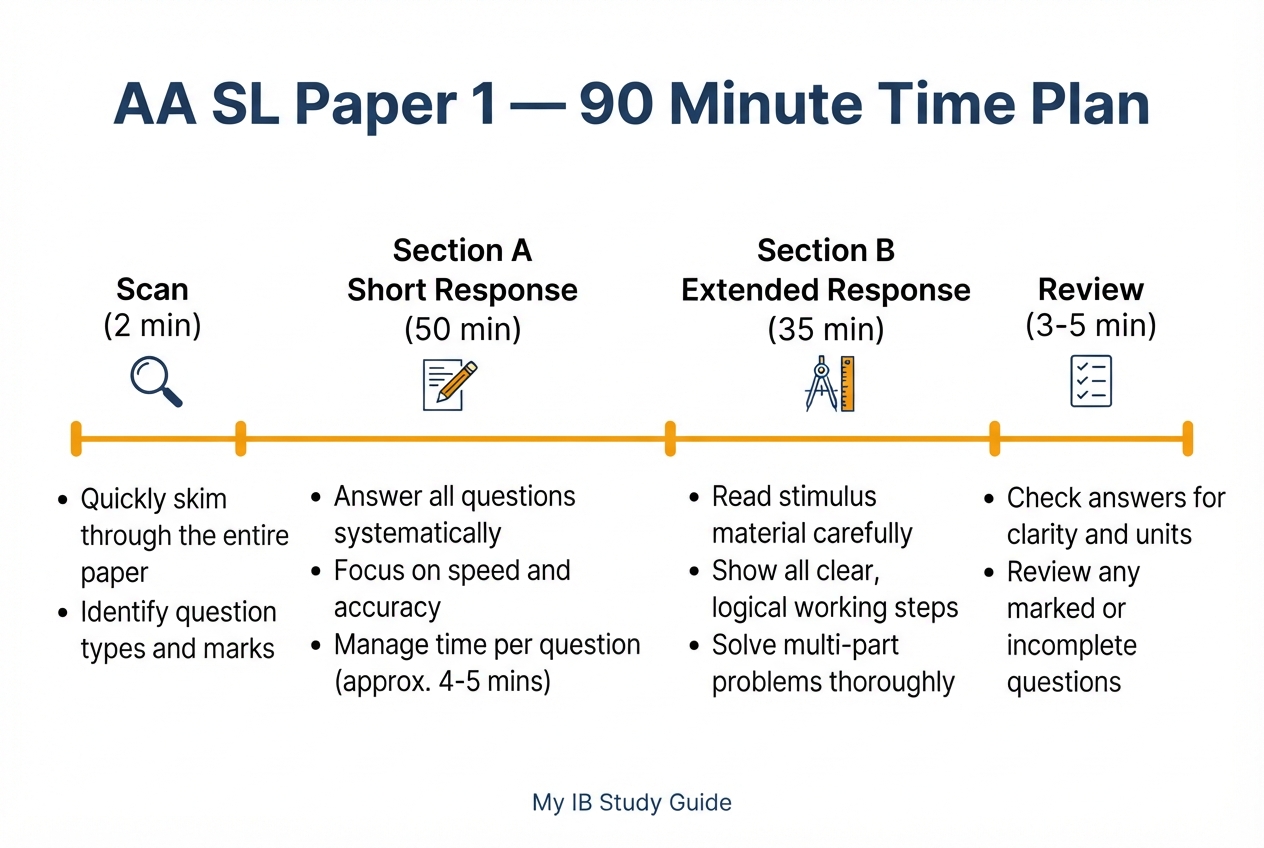
Time management is arguably even more important on Paper 1 than Paper 2, because without a calculator, everything takes longer. Here’s a practical IB math non calculator tips approach for AA SL Paper 1 (90 minutes):
- First 2 minutes: Scan the entire paper. Identify questions you feel confident about and any that look challenging
- Section A (approximately 50 minutes): Work through short-response questions. Spend roughly 4-6 minutes per question depending on marks
- Section B (approximately 35 minutes): Tackle extended-response questions. Budget time based on marks — roughly 1 minute per mark
- Final 3-5 minutes: Review flagged questions and check your answers for silly arithmetic errors
The golden rule: never spend more than the mark value in minutes on any question. A 6-mark question shouldn’t take more than 7-8 minutes. If it does, you’re probably using the wrong method. For more detailed timing strategies, wait for our guide on how to manage your time during IB Math exams (coming next week).
What to Do When Stuck
Every student gets stuck on Paper 1 at some point. Having a clear IB math paper 1 without calculator recovery plan prevents panic from costing you marks elsewhere.
- Re-read the question carefully. There’s often a clue in the wording — words like “hence” mean you must use the previous result; “show that” means the answer is given and you need to find the path
- Check the formula booklet. The answer might be one formula application away. Scan the relevant section
- Try a different representation. If algebra isn’t working, sketch a graph. If the graph doesn’t help, try a table of values
- Write what you know. Even partial working earns marks. Write down relevant formulas, define variables, and start the process
- Move on after 2 minutes of no progress. Circle the question, leave space, and come back with fresh eyes later
💡 Pro Tip
When a question says “show that” and gives you the answer, work backwards. Knowing where you need to end up makes the path much clearer — especially without a calculator to test possibilities.
✅ Key Takeaways
- Paper 1 tests mathematical understanding and process, not computation — adjust your mindset accordingly
- Build mental math fluency with fractions, surds, powers, and exact trig values before exam day
- Master algebraic manipulation — factoring, log rules, and rationalising denominators are essential
- Use a clear ib math paper 1 no calculator strategy for time allocation: scan, Section A, Section B, review
- When stuck, re-read the question, check the formula booklet, try a different approach, then move on
- Practise under timed, non-calculator conditions regularly — this is the single most effective preparation
Frequently Asked Questions
Paper 1 doesn’t have to be intimidating. With the right ib math paper 1 no calculator strategy, consistent practice, and a clear plan for managing your time and handling tricky questions, you can walk into that exam feeling prepared and confident. Start building your non-calculator skills today — your future self will thank you on exam day.