Figuring out how to get a 7 in IB Math AA SL isn’t about being a genius — it’s about having the right strategy, putting in consistent work, and knowing exactly where your marks come from.
📋 In This Guide
Let’s be honest — a grade 7 in IB Math Analysis and Approaches SL is one of the most satisfying achievements in the entire Diploma Programme. It signals to universities that you’ve got serious analytical skills, and it feels incredible to know you’ve truly mastered a challenging subject.
But here’s the thing: too many students study hard without studying smart. Understanding how to get a 7 in IB Math means breaking your overall score into its three components — the Internal Assessment, Paper 1, and Paper 2 — and maximising every single one. It’s not just about grinding through textbook problems at random.
In this guide, we’ll walk you through the exact IB math study strategy that targets a 7, pillar by pillar. Whether you’re a DP Year 2 student heading into the May exams or a DP Year 1 student planning ahead, these IB math AA SL tips will give you a clear roadmap. If you’re still figuring out the difference between the two papers, start with our guide on IB Math Paper 1 vs Paper 2: Different Strategies for Each and then come back here for the full picture.
What Does It Actually Take to Score a 7?
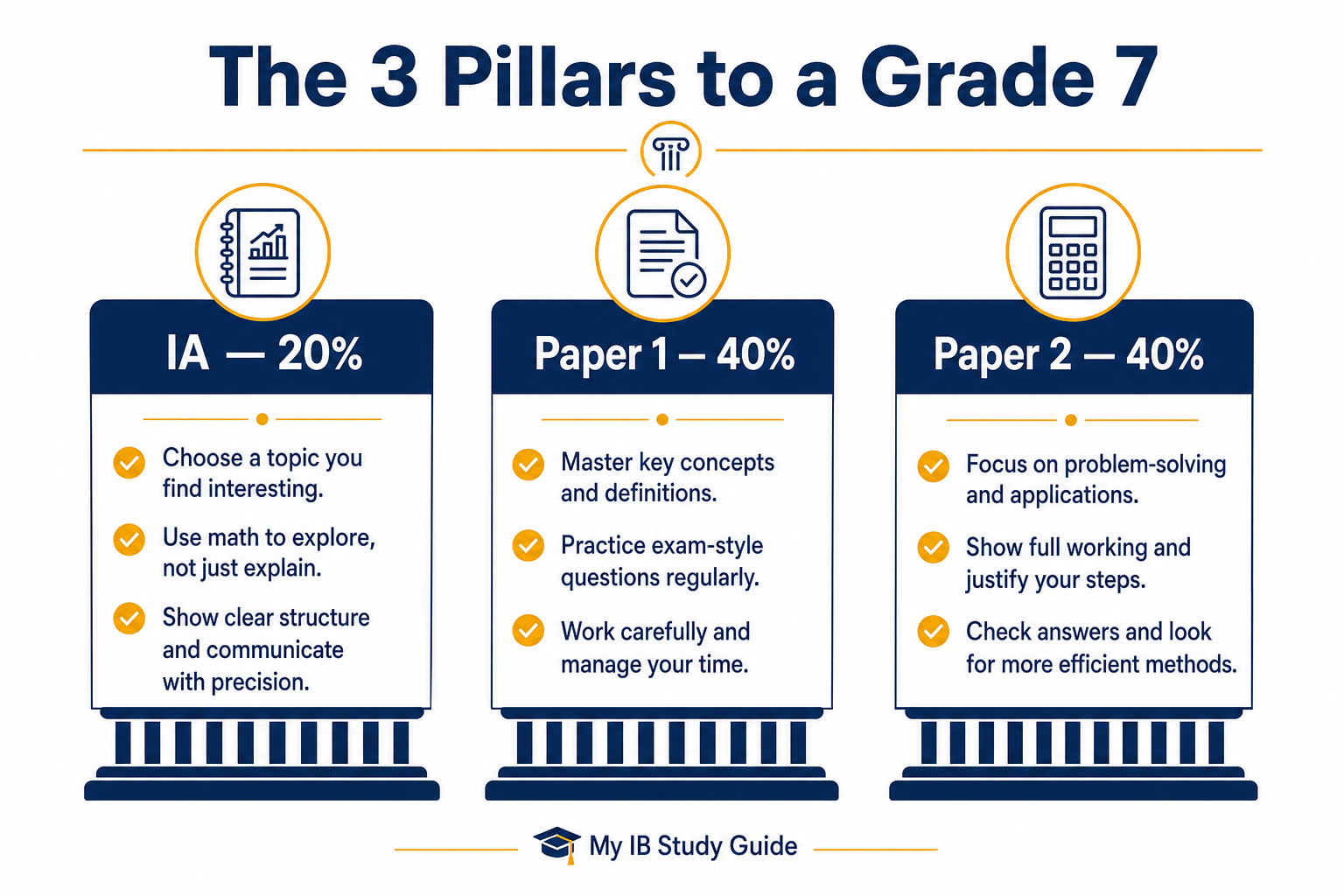
Before you plan anything, you need to understand the numbers. In IB Math AA SL, your final grade is calculated from three assessed components:
- Paper 1 (Non-Calculator): 40% of your final grade
- Paper 2 (Calculator): 40% of your final grade
- Internal Assessment (IA): 20% of your final grade
Grade boundaries shift slightly each exam session, but historically a 7 in AA SL typically requires around 70–78% overall. That might sound manageable, but the catch is that you need to be consistently strong across all three components. A weak IA or a poor Paper 1 can drag you below the boundary even if your Paper 2 is excellent.
📌 Important
Grade boundaries are set after each exam session by the IB and can vary. You can review past grade boundaries through the IB’s official assessment page. Always aim above the typical boundary to give yourself a buffer.
The real insight? A grade 7 doesn’t require perfection. You can afford to lose marks — you just can’t afford to lose them carelessly. Your IB math study strategy should focus on collecting every “easy” mark first and then reaching for the harder ones.
Pillar 1 — Maximize Your IA Score
Your Internal Assessment is worth 20% of your final grade, and it’s the one component you have the most control over. Unlike exams, you get weeks (sometimes months) to work on it, revise it, and polish it. If you’re serious about learning how to get a 7 in IB Math, this is your first pillar.
The IA is assessed across five criteria:
- Criterion A — Presentation: Is your work well-organised and coherent? (4 marks)
- Criterion B — Mathematical Communication: Are you using correct notation and terminology? (4 marks)
- Criterion C — Personal Engagement: Did you make the exploration your own? (3 marks)
- Criterion D — Reflection: Do you reflect meaningfully on your results? (3 marks)
- Criterion E — Use of Mathematics: Is the maths at the right level and used correctly? (6 marks)
Many students treat the IA as an afterthought, but top-scoring students start planning early and iterate through multiple drafts. Choose a topic that genuinely interests you, use AA SL-level mathematics (think derivatives, integrals, or modelling with functions), and make sure every formula and graph is properly labelled.
💡 Pro Tip
Aim for 17–20 out of 20 on your IA. Those marks are “banked” before you even walk into the exam hall, and they give you breathing room on Papers 1 and 2. Always write in your own words and show authentic personal engagement.
Pillar 2 — Master Paper 1 (Non-Calculator) for a Top IB Math Grade 7
Paper 1 is 90 minutes, no calculator, and worth 40% of your final grade. This is where many students panic — but it’s also where strong preparation pays off the most.
Paper 1 typically includes a mix of short-answer (Section A) and extended-response (Section B) questions. The topics tested span the entire AA SL syllabus, but certain areas appear more reliably:
- Algebra — sequences, series, binomial theorem, and logarithms
- Functions — transformations, composite and inverse functions
- Calculus — differentiation and integration by hand
- Trigonometry — exact values, identities, and solving equations
The key to Paper 1 success is fluency without a calculator. You need to practice mental arithmetic, know your exact trig values cold, and be comfortable differentiating and integrating without any technology support.
⚠️ Watch Out
The most common mark-killer on Paper 1 isn’t getting the wrong answer — it’s not showing your working. The IB awards method marks even when the final answer is incorrect. Always show every step clearly.
Here’s a practical approach for Paper 1 revision:
- Complete past Paper 1s under timed conditions — no calculator, 90 minutes
- Mark your work using the official markscheme and note every mark you lost
- Group your errors by topic and skill type (algebraic mistakes, forgetting a formula, running out of time)
- Spend targeted revision time on your weakest two topics
- Re-attempt the same paper 7–10 days later and compare your scores
If you’re not yet comfortable with your formula booklet, make sure you read our guide on The IB Math Formula Booklet: How to Use It Like a Pro. Knowing what’s in it — and what isn’t — saves precious time during the exam.
Pillar 3 — Solid Paper 2 Performance
Paper 2 is also 90 minutes and worth 40%, but this time you have your GDC (graphing display calculator). This changes the game significantly. Questions are often longer, involve more modelling or statistics, and expect you to use technology efficiently.
Strong Paper 2 performance depends on two things: knowing the maths and knowing your calculator. You’d be surprised how many marks are lost simply because a student doesn’t know how to find the intersection of two graphs or run a regression on their GDC.
💡 Pro Tip
Practise GDC skills separately from maths skills. Spend at least two revision sessions purely on calculator techniques — graphing, solving equations, finding areas, and running statistical tests. Our guide on 10 Calculator Skills Every IB Math Student Needs is a great starting point.
For Paper 2, pay special attention to these high-value topics:
- Statistics and probability — normal distribution, regression, and probability trees
- Calculus applications — optimisation, kinematics, and area under curves
- Functions and modelling — exponential models, sinusoidal models
- Financial maths — if applicable to your exam session
Always write down your calculator setup. If a question asks you to find the area between two curves, show the integral you entered, state the bounds, and then write the answer. The examiner can’t award method marks for work that only lives inside your calculator.
📚 Recommended Resource
Mock Exam Pack AA SL
Full Paper 1 and Paper 2 under exam conditions. Detailed solutions for every question. Matches real IB exam difficulty and style — so you know exactly what to expect before exam day.
$12
Get the AA SL Mock Exam Pack on SamzHub →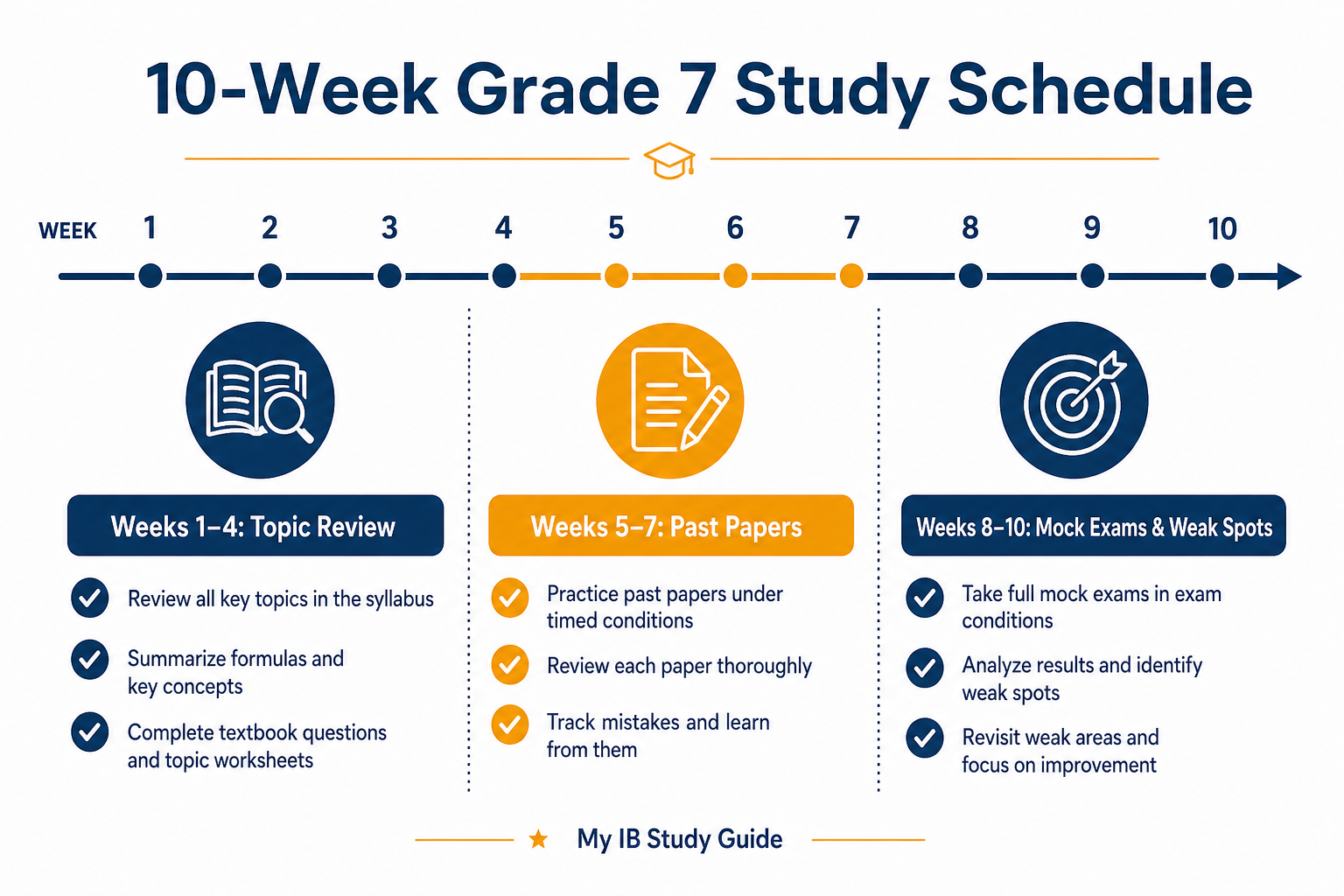
Study Schedule for a Grade 7
Knowing what to do is only half the battle — you also need a realistic plan for when to do it. Here’s a 10-week IB math study strategy framework you can adapt to your own schedule:
Weeks 1–4: Topic Review Phase
Go through each AA SL topic systematically. Use your textbook, class notes, and the syllabus guide. After reviewing a topic, complete 5–10 practice questions. Focus on understanding, not speed.
Weeks 5–7: Past Paper Phase
Start doing full past papers under timed conditions. Alternate between Paper 1 and Paper 2. After each paper, spend equal time reviewing your errors as you spent writing the paper.
Weeks 8–10: Mock and Polish Phase
Do full mock exams (both papers in one day if possible). Identify your remaining weak spots and target them aggressively. This is also when you should finalise your IA if it’s still in draft.
📌 Important
If you’re an AA HL student, the same three-pillar approach applies, but your content is deeper and you also have Paper 3. Allocate more time for topics like proof, complex numbers, and advanced calculus. The overall strategy for how to get a 7 in IB Math still holds — consistency and targeted practice remain the foundation.
Common Reasons Students Miss the 7
Even students who study hard can fall just short. Here are the most common pitfalls — and how to avoid every one of them:
- Neglecting the IA: A mediocre IA (12–14/20) forces you to score extremely high on both papers. Don’t leave free marks on the table.
- Not practising under timed conditions: Knowing how to solve a problem in 15 minutes doesn’t help if the exam only gives you 5. Practise with a timer every time.
- Ignoring “show that” questions: These are worth method marks and are designed to guide you through a problem. Students who skip steps here lose marks unnecessarily.
- Weak calculator skills: If you fumble with your GDC on Paper 2, you waste time and lose accuracy. Drill your calculator techniques until they’re automatic.
- Cramming everything in the last week: Maths is a skill, not a knowledge dump. You can’t cram algebra fluency overnight. Start early and build incrementally.
- Studying topics you already know: It feels good to practise easy problems, but your grade 7 depends on improving your weak areas. Be honest about where you need work.
⚠️ Watch Out
One of the biggest traps is comparing yourself to classmates. Grade boundaries are set globally, not within your school. Focus on your own progress and your own weak points — that’s what determines your IB math grade 7.
✅ Key Takeaways
- A grade 7 in AA SL typically requires around 70–78% overall — challenging but achievable with the right strategy.
- Maximise your IA score (aim for 17+/20) to bank marks before exam day.
- Paper 1 success comes from fluency without a calculator — practise exact values, algebra, and calculus by hand.
- Paper 2 success comes from combining strong maths with confident GDC skills.
- Follow a structured study schedule: topic review → past papers → mock exams.
- Understanding how to get a 7 in IB Math is ultimately about targeted, consistent practice — not last-minute cramming.
Frequently Asked Questions
Scoring a 7 in IB Math AA SL is one of those goals that feels ambitious — until you have a clear plan. Now you’ve got the three pillars, a study schedule framework, and a list of pitfalls to avoid. The rest comes down to execution. Start early, practise with purpose, and trust the process. You’ve got this — and we’re here to help you every step of the way. Knowing how to get a 7 in IB Math is the first step; putting the strategy into action is what gets you there.