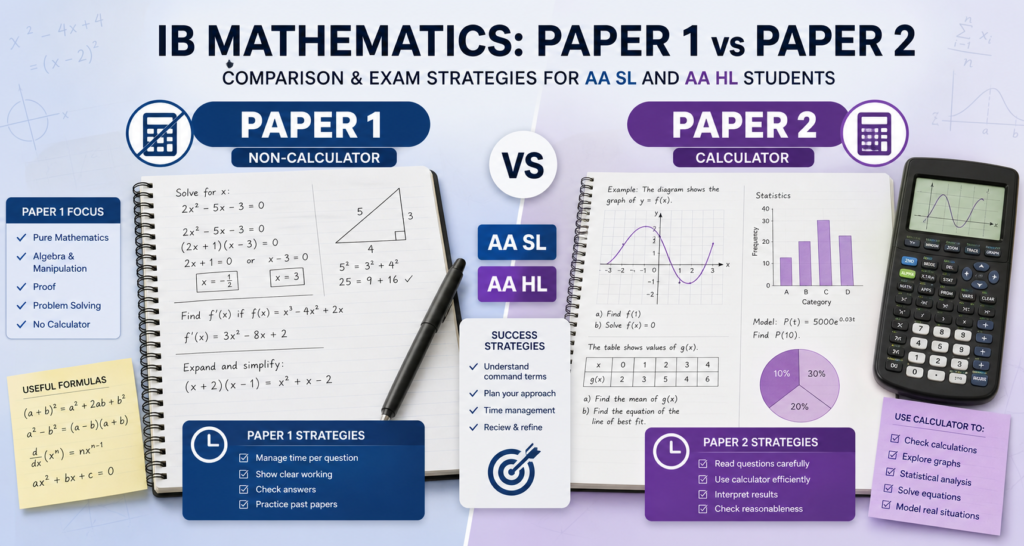
Understanding the differences between IB Math Paper 1 vs Paper 2 is one of the smartest moves you can make before exam season — because each paper demands a completely different approach.
📋 In This Guide
Most IB Math students know they have two exam papers — but far too many prepare for them in exactly the same way. That’s a mistake. The reality of IB Math Paper 1 vs Paper 2 is that they test different skills, reward different habits, and require different revision strategies.
Paper 1 strips away your calculator and asks you to demonstrate raw mathematical fluency. Paper 2 hands you a GDC and expects you to use it efficiently alongside strong analytical thinking. If you treat them interchangeably, you’re leaving marks on the table in both.
This guide breaks down the key differences for AA SL and HL students, gives you targeted IB math exam strategy tips for each paper, and shows you exactly how to practise so you walk into the exam hall feeling confident about both. If you’re building towards a top grade, pair this with our complete strategy guide for scoring a 7 in IB Math AA SL.
Why Paper 1 and Paper 2 Need Different Preparation
At first glance, both papers cover the same AA syllabus. So why can’t you just “revise maths” and sit both exams? Because the conditions change everything.
On Paper 1, you have no calculator. That means every calculation — from simplifying surds to differentiating polynomials — must happen in your head or on paper. The questions are designed knowing you don’t have technology, so they tend to use “cleaner” numbers and test algebraic manipulation directly.
On Paper 2, you have your GDC. The questions are designed knowing you do have technology, so they can involve messier numbers, require graphing, and expect you to use statistical or numerical features. The skill here isn’t just knowing the maths — it’s knowing when and how to use your calculator strategically.
📌 Important
Both Paper 1 and Paper 2 are worth 40% each of your final grade in AA SL. For HL students, Paper 1 and Paper 2 are also 40% each (with Paper 3 as a separate component at 20%). Neither paper is optional or less important — you need strong performance on both.
Paper 1 Overview — Non-Calculator
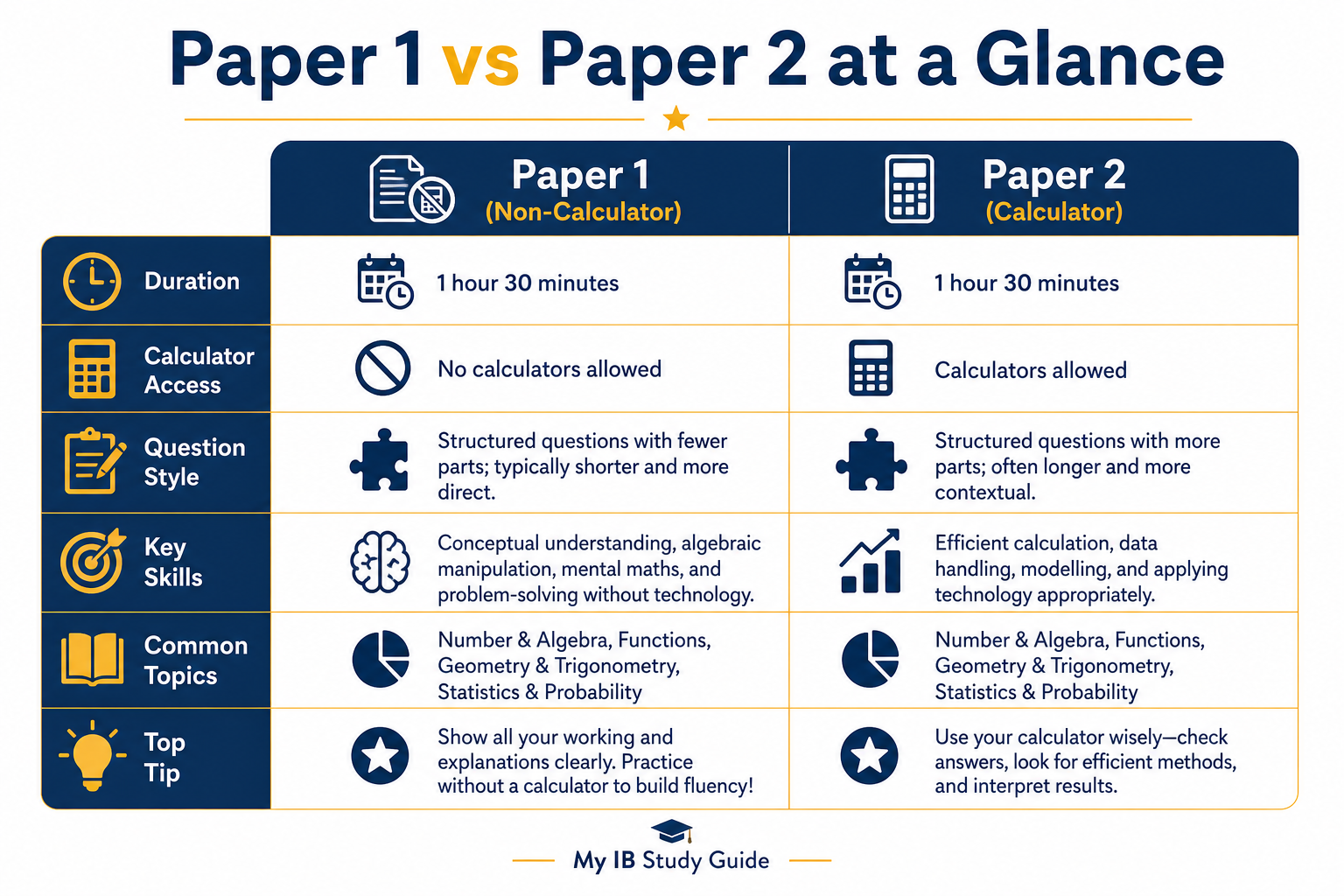
Here’s what you need to know about Paper 1 at a glance:
- Duration: 90 minutes (SL) or 120 minutes (HL)
- Calculator: Not allowed
- Structure: Section A (short response) and Section B (extended response)
- Total marks: 80 (SL) or 110 (HL)
- Weighting: 40% of final grade
Paper 1 questions test your ability to work through problems by hand. You’ll see algebra, functions, trigonometry, and calculus questions that require clean working and exact values. “Show that” questions appear frequently — these guide you through a proof or derivation and award marks for each logical step.
The formula booklet is your only support tool on Paper 1. Knowing what’s in it (and what isn’t) can save you valuable minutes. If you haven’t already, check out our guide on how to use the IB Math formula booklet like a pro.
Paper 2 Overview — Calculator Allowed
And here’s the snapshot for Paper 2:
- Duration: 90 minutes (SL) or 120 minutes (HL)
- Calculator: GDC required
- Structure: Section A (short response) and Section B (extended response)
- Total marks: 80 (SL) or 110 (HL)
- Weighting: 40% of final grade
Paper 2 questions tend to be more applied and context-driven. You’ll encounter modelling problems, statistics questions involving normal distributions, and calculus problems with values that aren’t “neat” enough to solve by hand. The GDC is not just allowed — it’s expected. Questions are written assuming you’ll use it.
💡 Pro Tip
Don’t make the mistake of thinking Paper 2 is “easier” because you have a calculator. The questions are often longer and more complex precisely because the IB knows you have technology. Your GDC is a tool, not a shortcut.
Paper 1 Strategies — Your IB Math Paper 1 Tips
Here are targeted IB math paper 1 tips that will help you maximise your score when there’s no calculator in sight:
- Memorise what’s NOT in the formula booklet. The quadratic formula is there, but the discriminant condition isn’t spelled out. Exact trig values for 30°, 45°, 60° are there, but you need to recall them quickly. Know the gaps.
- Show every step of working. Method marks are your safety net. Even if your final answer is wrong, clear working can earn you 3–4 marks on a 6-mark question.
- Do Section A first and quickly. Section A questions are shorter and worth fewer marks. Aim to complete them in about half your time, leaving the other half for the larger Section B problems.
- Practise mental arithmetic daily. Fractions, negative numbers, powers, factorising — these need to be automatic. Even five minutes of daily drill makes a difference over weeks.
- Watch your algebra. The most common errors on Paper 1 are sign errors, distribution mistakes, and incorrect factorisation. Slow down on algebraic steps — speed up elsewhere.
⚠️ Watch Out
Never leave a “show that” question blank. Even writing down the starting expression and one intermediate step can earn marks. The IB marking scheme is designed to reward partial understanding.
Paper 2 Strategies — Your IB Math Paper 2 Tips
Now let’s look at specific IB math paper 2 tips to help you leverage your calculator effectively:
- Write down your GDC setup. If you graph two functions to find an intersection, sketch the graph in your answer booklet, label the curves, and state the intersection point. Examiners can’t award marks for work that only exists on your calculator screen.
- Know your GDC’s key functions cold. Solve equations, find intersections, calculate definite integrals, run regressions, and find normal distribution probabilities — practise each until it’s automatic.
- Use the calculator to verify, not just to solve. After solving a problem algebraically, check your answer with the GDC. This catches errors before you move on.
- Manage your time differently. Section B questions in Paper 2 can be long and multi-part. Budget your time — if a sub-question is worth 2 marks and you’ve spent 5 minutes, move on and come back.
- Round only at the final step. Keep full precision in your GDC throughout intermediate calculations. Premature rounding is one of the most common reasons students lose marks on Paper 2.
If your GDC skills need a boost, our guide on 10 Calculator Skills Every IB Math Student Needs covers the essential techniques for both TI and Casio models.
📚 Recommended Resource
Mock Exam Pack AA SL
Separate Paper 1 and Paper 2 practice under full timed conditions with mark schemes. Helps you apply different strategies to each paper — exactly the kind of targeted preparation that makes a difference.
$12
Get the AA SL Mock Exam Pack on SamzHub →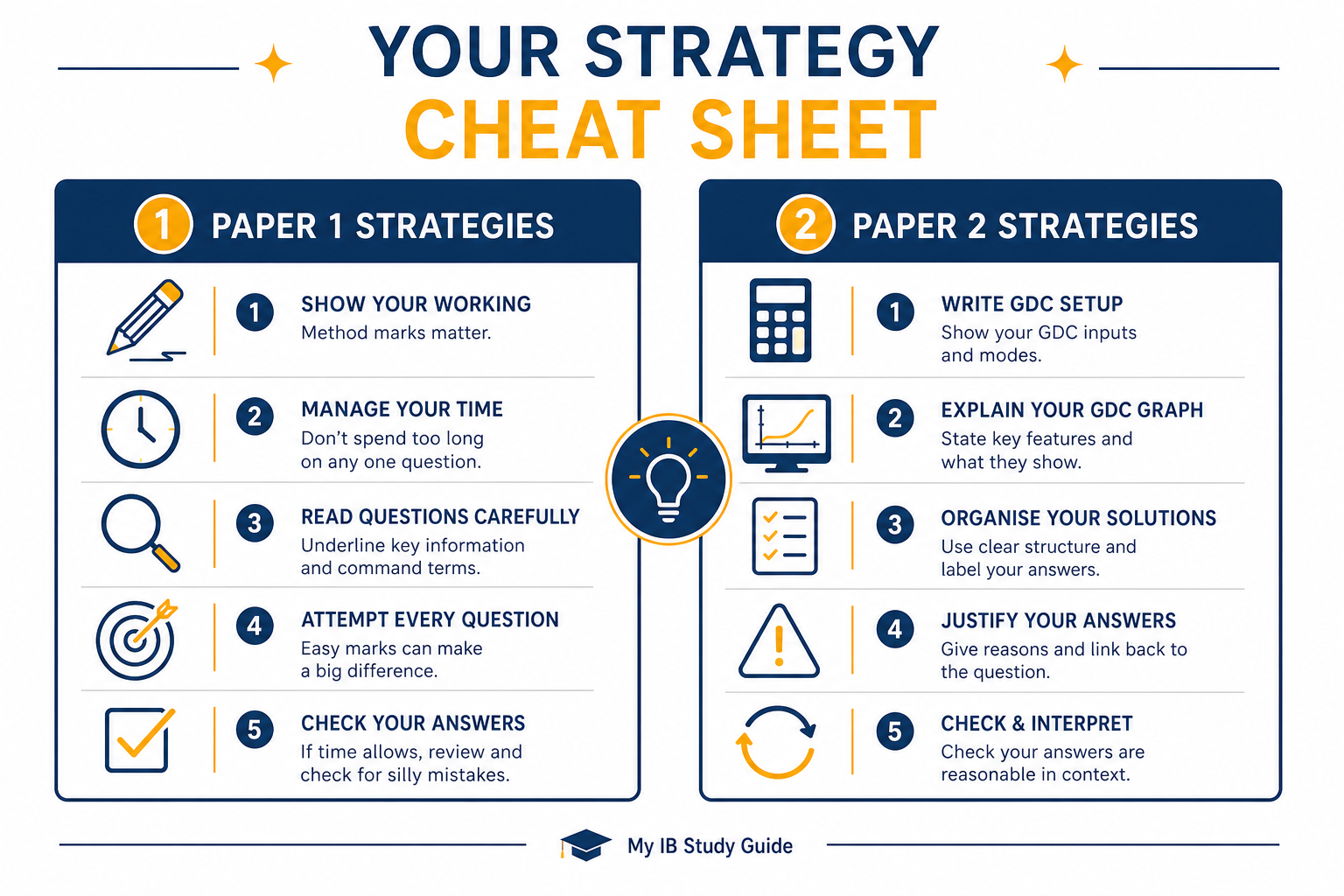
How to Practice for Each Effectively
The biggest mistake students make when revising for IB Math Paper 1 vs Paper 2 is doing all their practice with a calculator sitting on the desk. Here’s a better approach:
For Paper 1 Practice
- Remove your calculator from the room — not just off the desk, out of sight entirely
- Set a timer for 90 minutes (SL) or 120 minutes (HL)
- Use only the formula booklet as reference
- After completing the paper, mark it with the official markscheme and note every lost mark
- Categorise errors: algebraic mistakes, conceptual gaps, or time management issues
For Paper 2 Practice
- Have your GDC fully charged and in exam mode
- Set the same timer and work under real conditions
- For every GDC-based answer, write down the setup — graph sketches, function inputs, distribution parameters
- After marking, identify questions where better calculator use would have saved time
- Spend a separate session practising only GDC techniques (no full paper, just skills)
💡 Pro Tip
Alternate your practice sessions: Paper 1 one day, Paper 2 the next. This trains your brain to switch between “by hand” mode and “with technology” mode — exactly the shift you’ll need to make between exam days.
📌 HL Students: Don’t Forget Paper 3
If you are taking AA HL or AI HL, you also sit Paper 3 — an investigation-style paper that tests your ability to explore unfamiliar mathematical problems. Paper 3 requires a completely different approach from Papers 1 and 2. You need to read carefully, form conjectures, and communicate extended mathematical reasoning.
We cover Paper 3 strategies in detail in our dedicated guide: IB Math Paper 3: Complete Strategy Guide for HL Students.
✅ Key Takeaways
- IB Math Paper 1 vs Paper 2 require fundamentally different preparation strategies — don’t treat them the same.
- Paper 1 rewards algebraic fluency, clear working, and comfort without a calculator.
- Paper 2 rewards efficient GDC use, applied problem-solving, and writing down your calculator setup.
- Always practise under timed, exam-realistic conditions — separate your Paper 1 and Paper 2 sessions.
- Show all working on both papers — method marks are your safety net for partial credit.
Frequently Asked Questions
The difference between a good IB Math score and a great one often comes down to preparation strategy — and understanding IB Math Paper 1 vs Paper 2 is a crucial part of that. Treat each paper as its own challenge, practise under realistic conditions, and build the specific skills each one demands. When you walk into the exam hall knowing exactly what to expect and how to approach it, you’ve already given yourself an advantage. Now go put these strategies into practice.