
Your IB Math IA introduction is the first thing an examiner reads — and it sets the tone for every criterion that follows. Get it right, and you immediately signal clarity, purpose, and personal engagement. Get it wrong, and you’re climbing uphill from page one.
📋 In This Guide
Many students spend weeks choosing a topic but only minutes drafting their IB Math IA introduction. That’s a costly mistake. The introduction is where you establish what you’re investigating, why it matters to you, and which mathematical tools you plan to use. It directly feeds into Criterion A (Presentation) and Criterion C (Personal Engagement) — two areas where easy marks are often lost.
Whether you’re studying Analysis and Approaches (AA) or Applications and Interpretation (AI) at SL or HL, the principles of a strong ib math IA introduction are the same. This guide gives you a clear framework, a proven aim formula, and real examples of what works and what doesn’t. If you’re still finalising your overall structure, start with our guide on IB Math IA structure and what examiners actually want first, then come back here.
Let’s break down exactly how to start your IA in a way that hooks any examiner from the first paragraph.
What Your Introduction Must Achieve
Your introduction isn’t just a warm-up. It has a specific job — actually, it has four specific jobs. Every examiner expects to walk away from your first section knowing these things:
- What you’re investigating — your topic and research question
- Why this topic matters to you personally
- How you plan to approach it mathematically
- What you aim to find out or prove
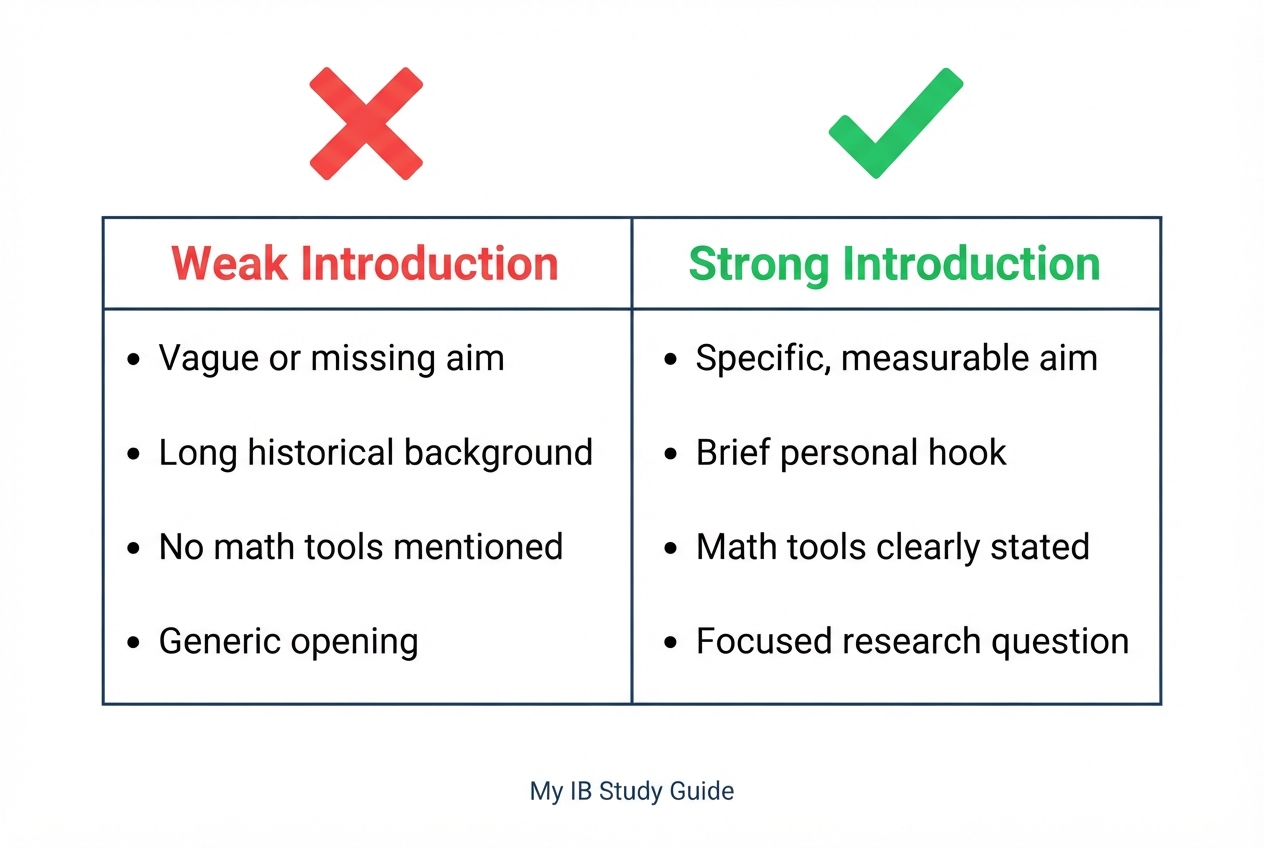
If your introduction answers all four, you’re already ahead of most students. The IB’s own Mathematics curriculum guide emphasises that the exploration should start with a clear statement of intent. Examiners have reported that weak introductions — ones that are vague, overly long, or missing a clear aim — immediately make them cautious about the rest of the paper.
💡 Pro Tip
Think of your introduction as a promise to the examiner. You’re saying: “Here’s exactly what I’ll explore, why I care, and what math I’ll use.” The rest of your IA delivers on that promise.
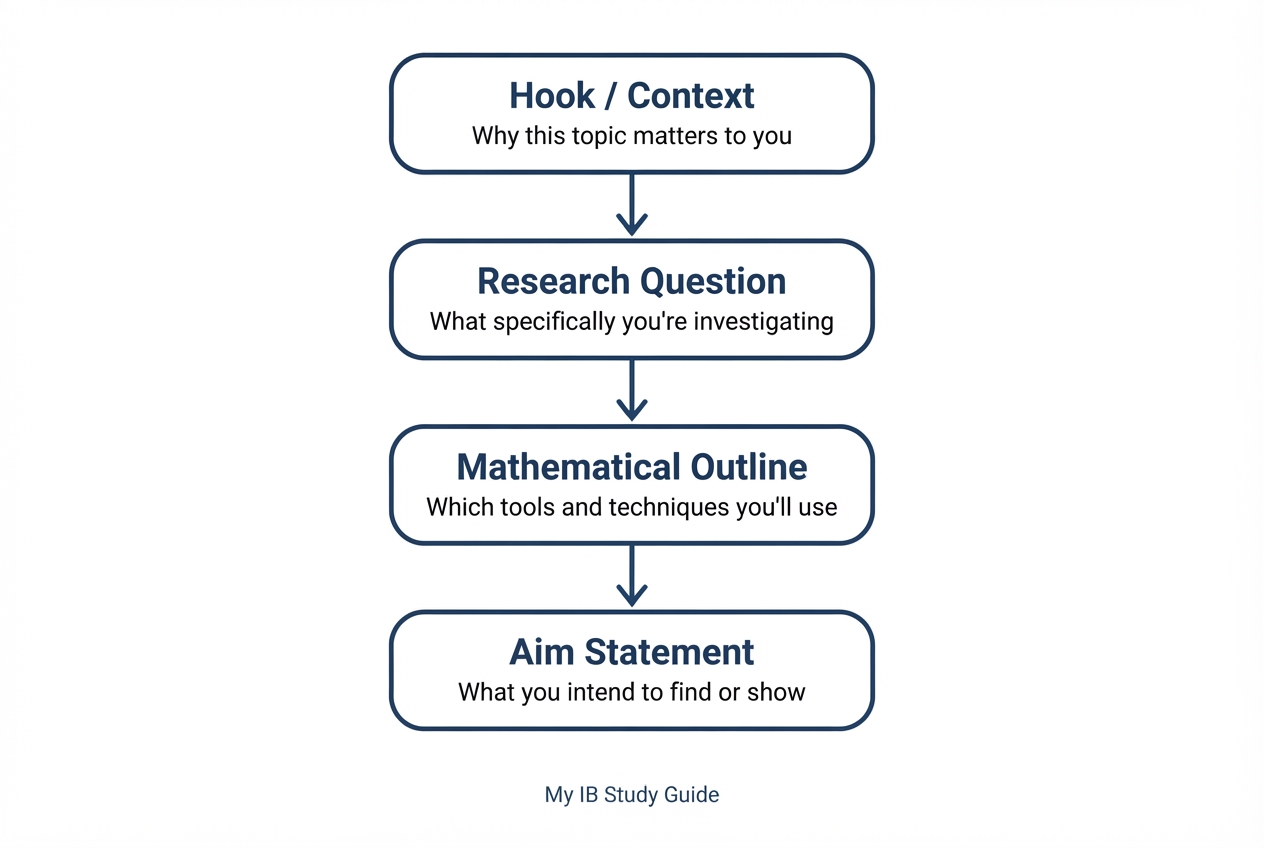
The Anatomy of a Strong IB Math IA Introduction
A well-crafted ib math IA introduction typically contains four distinct paragraphs or sections. Here’s the anatomy:
1. The Hook (Context)
Open with a brief, genuine connection to the topic. This is where personal engagement begins. Mention why this topic caught your attention — maybe it came from a hobby, a class discussion, something you noticed in daily life, or a problem that genuinely puzzled you.
Strong example: “While analysing my training data for competitive swimming, I noticed that my improvement rate seemed to slow down after each season. I wanted to understand whether a logarithmic model could describe this diminishing return.”
Weak example: “Mathematics is everywhere. It is used in many fields including sports. I have decided to use math to explore sports.”
2. The Research Question or Focus
State clearly and specifically what you’re investigating. Avoid questions so broad they’d take a PhD to answer, and avoid questions so narrow there’s nothing to explore.
3. The Mathematical Outline
Briefly name the mathematical tools, techniques, or concepts you plan to use. You don’t need to explain them in detail here — that comes in the body — but the examiner should know what’s coming.
4. The Aim Statement
End with a clear, one-to-two sentence aim. This is the anchor of your entire exploration.
The Aim Formula That Works for Your IB Math IA Introduction
The aim is the single most important sentence in your ib math IA introduction. A vague aim causes problems across every criterion because the examiner can’t tell what you set out to achieve. Here’s a simple formula that works for AA and AI students alike:
📌 The Aim Formula
“The aim of this exploration is to [action verb] + [specific mathematical relationship or model] + [applied to what context/data].”
Let’s see this in action with strong and weak versions:
Strong aim (AA-style): “The aim of this exploration is to determine whether a sinusoidal function can accurately model the monthly temperature variations in Stockholm over a 10-year period.”
Strong aim (AI-style): “The aim of this exploration is to use chi-squared testing to investigate whether there is a statistically significant relationship between screen time and sleep quality among students in my school.”
Weak aim: “The aim of this exploration is to explore trigonometry.” (Too vague — explore what about trigonometry? Using what data? To show what?)
Weak aim: “I want to see if math relates to music.” (No mathematical specificity, no methodology, no measurable outcome.)
- Does your aim contain a specific action verb (determine, model, compare, investigate, evaluate)?
- Does it name the mathematical concept or tool you’ll use?
- Does it specify the real-world context or data set?
- Could someone read your aim alone and understand what your IA is about?
If you can tick all four, your aim is solid. If you’re missing even one, tighten it before moving forward.
📚 Recommended Resource
IA Mini Packs
Get introduction frameworks specific to each math area, detailed Criterion A guidance, and personalisation prompts to help you craft a unique, examiner-ready introduction — all in your own words.
$5.45–$10.55
Browse IA Mini Packs on SamzHub →Common Introduction Errors
After reading hundreds of IA introductions, certain mistakes appear again and again. Avoid these and you’ll already stand out:
Error 1: The Wikipedia Opening
Starting with a lengthy history of the mathematical concept (“Calculus was invented by Newton and Leibniz in the 17th century…”) wastes space and shows no personal engagement. Examiners know the history — they want to know your connection.
Error 2: No Clear Aim
Some students write an entire page of context without ever stating what they’re actually investigating. If your ib math IA first section doesn’t include a specific aim, you’re losing marks in Criterion A before the exploration even begins.
Error 3: Overpromising
Claiming you’ll “prove” a major theorem or “revolutionise” a field sets expectations you can’t meet. Use grounded language: investigate, model, determine, compare.
⚠️ Watch Out
Don’t copy your aim or rationale from any template, online guide, or another student’s work. Examiners can spot generic language instantly, and it undermines personal engagement (Criterion C). Always write your introduction in your own words.
Error 4: Being Too Personal, Not Enough Math
While personal engagement matters, your introduction shouldn’t read like a diary entry. “I love football because my dad taught me when I was five…” is context, not mathematics. Keep the personal connection brief and pivot quickly to the mathematical question.
How Long Should Your IB Math IA Introduction Be?
There’s no official word count for the introduction, but experienced examiners and IB teachers generally agree on a sweet spot. Your entire IA should be 12–20 pages, and the introduction typically works best at around half a page to one page (roughly 200–400 words).
📌 Important
Quality beats quantity. A focused 250-word introduction that clearly states your aim, rationale, and approach will outscore a rambling 600-word one every time. The ib math IA aim should be the centrepiece — not buried on page two.
If you find your introduction running long, you’re probably including background theory or methodology detail that belongs in the body of the exploration. Move it. Keep your first section tight and purposeful.
For more guidance on how every section fits together — including how to demonstrate personal engagement throughout (not just in your intro) — come back and check out our post on showing personal engagement in your IB Math IA which is coming out in two weeks. .
✅ Key Takeaways
- Your ib math IA introduction must answer four questions: what, why, how, and what you aim to find.
- Use the aim formula: action verb + specific math concept + real-world context or data.
- Keep your introduction between half a page and one page (200–400 words).
- Avoid Wikipedia-style openings, vague aims, and overpromising language.
- Show personal engagement briefly but genuinely — then pivot to the mathematics.
- Always write your introduction in your own words to maintain academic integrity.
Frequently Asked Questions
Your ib math IA introduction doesn’t need to be flashy or complicated. It needs to be clear, specific, and genuinely yours. Use the framework and aim formula from this guide, avoid the common pitfalls, and you’ll give your examiner exactly what they’re looking for from the very first page. Take your time with this section — a strong start makes everything that follows easier to write and better to read.