The most damaging IB Math IA mistakes aren’t the ones students know about — they’re the ones students don’t realise they’re making until after their teacher has handed back a score that’s lower than expected.
📋 In This Guide
Most students put significant effort into their IB Math IA. The problem isn’t effort — it’s direction. The five IB Math IA mistakes covered in this post are responsible for the majority of lost marks across all four IB Math courses. They appear in IAs written by capable, hardworking students who simply didn’t know what examiners were looking for at the critical moments.
The good news is that every one of these mistakes is fixable — provided you catch it early enough. Some can be addressed in an afternoon. Others require more substantial revision. And a small number are the kind that genuinely benefit from structured, expert feedback rather than another solo read-through.
This post applies to all IB Math students — Analysis and Approaches (AA) and Applications and Interpretation (AI), at both SL and HL. Whether you’re still in the planning stage or sitting with a near-complete draft, identifying these common IB Math IA errors now will save your score later.
If you want to understand how each of these mistakes maps to the marking criteria, our post on the IB Math IA rubric and how each criterion is scored gives you the full examiner-focused breakdown.
Mistake 1 — Topic Too Simple
Choosing a topic that doesn’t generate enough mathematical depth is one of the most common IB Math IA mistakes — and one of the hardest to recover from once you’re deep into writing. A topic that felt manageable at the planning stage can turn out to be mathematically thin when you sit down to actually develop it.
What This Looks Like
Common examples include exploring basic probability with coin flips or dice, performing simple linear regression on a small dataset without meaningful analysis, or calculating basic statistics without any modelling or inference. These topics aren’t inherently wrong — they just don’t provide enough material to score well on Criterion E (Use of Mathematics).
For AA students, the mathematics needs to go beyond routine textbook procedures. For AI students, the application needs to be genuinely analytical — not just descriptive. For HL students in either course, the IB explicitly expects sophisticated mathematics. A simple topic cannot deliver that regardless of how well it’s written.
How to Fix It
If you’re at the planning stage, go back to your topic selection and ask: does this topic allow me to use multiple mathematical concepts, produce non-obvious results, and extend my investigation meaningfully? If the answer to any of those is no, deepen the topic before you start writing.
If you’re mid-exploration and realise your mathematics is too thin, consider extending your investigation in a direction that adds genuine mathematical complexity — not just more pages. Adding a new analytical layer, testing a model against a different dataset, or introducing a second mathematical method are all legitimate ways to add depth.
💡 Pro Tip
A strong topic feels slightly beyond your comfort zone at the start. If your topic feels completely comfortable from day one, it’s probably not challenging enough to score well on Criterion E at your level. Some independent learning should be part of the process.
Practical takeaway: Test your topic against Criterion E before you commit. If you can’t describe at least two or three distinct mathematical methods or tools you’ll be using, the topic likely needs more depth.
Mistake 2 — No Personal Engagement
This is the IB Math IA mistake that surprises students most when they see their score. Many believe that writing “I chose this topic because I’m interested in finance” in the introduction satisfies Criterion C (Personal Engagement). It doesn’t — not even close.
What Examiners Actually Look For
Personal engagement must be visible in the mathematics itself, not just in the framing. Examiners look for evidence that you made independent choices during the exploration — that you wondered about something, pursued a direction that wasn’t prescribed, noticed an unexpected result and engaged with it, or extended your investigation based on your own curiosity.
An exploration that any student could have produced by following a set of instructions — even if the mathematics is correct — will score poorly on Criterion C. The question examiners are asking is: can I see this student’s thinking, not just their calculations?
How to Fix It
Go through your current draft and find at least two places where you can add a sentence or two explaining a choice you made, a result that surprised you, or a question that occurred to you mid-investigation. These don’t need to be long. They need to be genuine and specific.
⚠️ Watch Out
Don’t retroactively invent personal engagement that wasn’t really there. Examiners can tell when enthusiasm is performative versus authentic. If you genuinely have no personal connection to your topic, this is a signal to reconsider your topic — not to fabricate a connection in your writing.
Practical takeaway: Read your draft and ask: if I removed my name from this, could it have been written by anyone? If yes, you need more personal engagement. Your voice, your choices, and your curiosity need to be visible on the page.
Mistake 3 — Poor Mathematical Communication
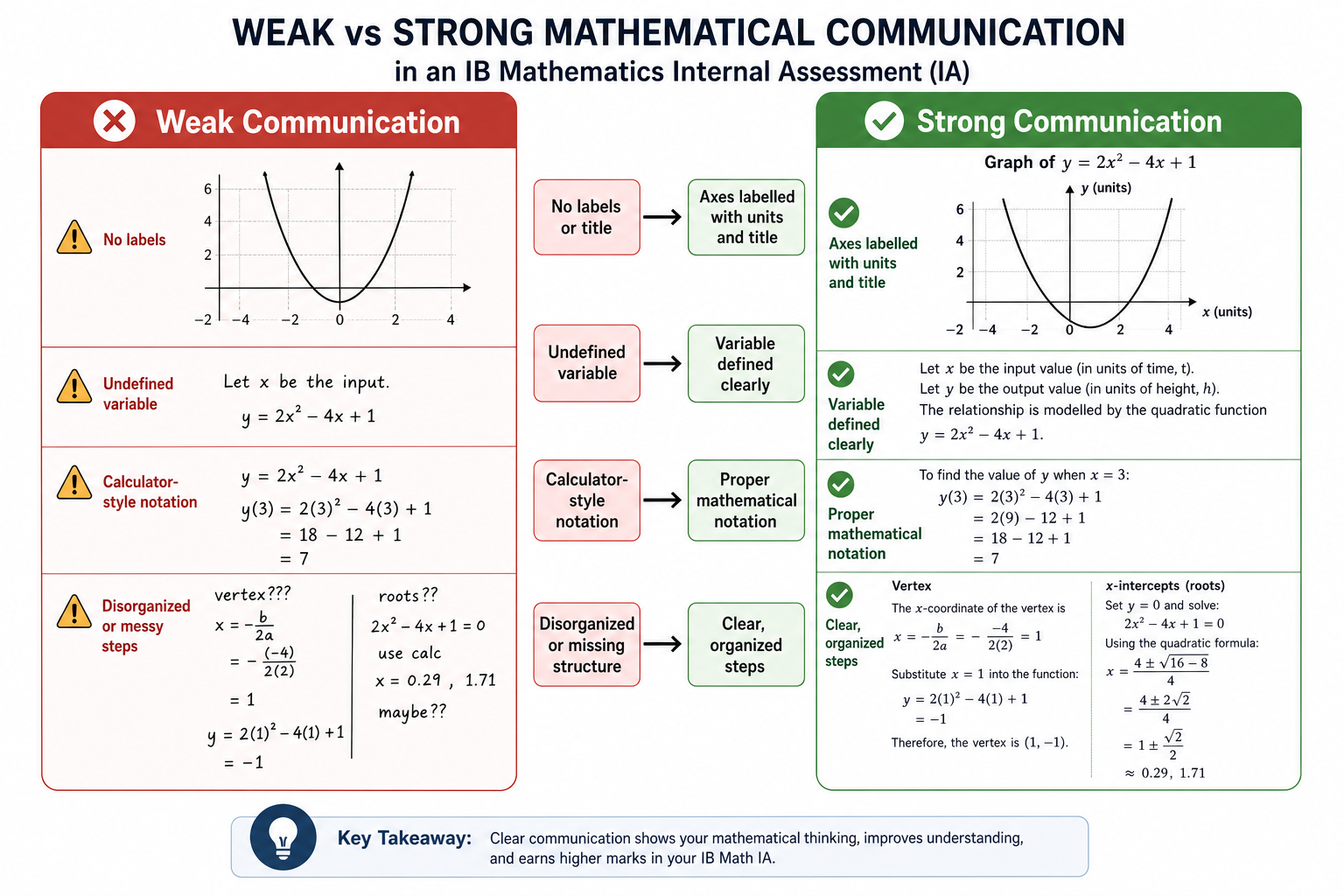
Poor mathematical communication is a silent mark-killer. Students lose points on Criterion B not because their mathematics is wrong, but because they haven’t communicated it clearly enough for an examiner to follow confidently. This is one of the most common IB Math IA errors at every level.
The Most Common Communication Failures
- Variables used without being defined — the reader doesn’t know what x or n represents
- Graphs without axis labels, units, or descriptive titles
- Calculator notation used instead of proper mathematical notation (e.g., writing x^2 instead of x²)
- Steps skipped in working — the reader can’t follow from one line to the next
- Inconsistent notation — the same quantity referred to by different symbols in different sections
- Equations presented as plain text rather than typeset properly
How to Fix It
Do a dedicated communication pass through your draft — separate from your content review. Read it specifically looking for undefined terms, unlabelled visuals, notation inconsistencies, and missing steps. Fix every instance you find. Then ask someone who hasn’t read the exploration to look at one section and tell you if they can follow the working. If they can’t, revise until they can.
For guidance on what properly structured mathematical writing looks like in the context of your full exploration, our post on IB Math IA structure and what examiners actually want covers this in detail.
Practical takeaway: Mathematical communication is a skill you improve through deliberate practice and careful revision — not something that appears automatically when you understand the maths. Budget time for a dedicated communication edit before submission.
Mistake 4 — Missing Reflection
Reflection is worth 3 marks on the IB Math IA rubric — the same as Personal Engagement. Yet it’s consistently one of the weakest-scoring criteria across submitted IAs. The reason is simple: most students treat reflection as a closing formality rather than a genuine analytical process, and this is a significant IB Math IA mistake.
What Superficial Reflection Looks Like
Superficial reflection sounds like: “Overall, this was an interesting exploration. In the future, I could collect more data or explore different methods.” This tells an examiner nothing meaningful. It doesn’t demonstrate mathematical thinking, it doesn’t identify specific limitations, and it doesn’t suggest extensions that are grounded in what you actually found.
What Strong Reflection Looks Like
Strong reflection is specific, critical, and mathematically grounded. It identifies the precise limitations of your approach — not vague gestures toward improvement. It connects those limitations to your results. And it suggests extensions that directly address what your exploration couldn’t do.
For example: “The sinusoidal model achieves a good fit for the central data range but consistently underestimates values at the extremes, suggesting the data has heavier tails than a pure sinusoidal function can capture. A Fourier series approximation with additional terms would likely produce a more accurate model for the full dataset.” That’s specific. That’s mathematical. That’s Criterion D top band.
📌 Important
Reflection must appear throughout your exploration — not just in your conclusion. Every time a result surprises you, every time you choose one method over another, every time a model doesn’t fit perfectly — those are moments for brief, in-context reflection. Saving all your reflection for the final paragraph is one of the clearest signals of a low Criterion D score.
Practical takeaway: Go through your draft and insert a brief reflective comment at every major transition point. At each stage, ask: what does this result mean, and what can’t my approach tell me? Those two questions are the foundation of strong Criterion D work.
Mistake 5 — Plagiarism and Template Misuse
This is the most serious of all IB Math IA mistakes — and the one with the most severe consequences. Academic misconduct in the IB can result in a null result for the entire subject, not just the IA component. It’s not a risk worth taking, and it’s more easily detected than many students assume.
What Counts as Plagiarism in the IB Math IA
Plagiarism includes submitting someone else’s work as your own, copying mathematical working from a source without attribution, and closely paraphrasing ideas or analyses from published IAs or online resources without acknowledgment. It also includes submitting an exploration based so heavily on a published template that the work is no longer genuinely your own — even if you’ve changed a few numbers or sentences.
The Problem With Online IA Templates
There are countless IA templates, sample explorations, and topic guides available online. Using them for inspiration or to understand the format is fine. Reproducing their structure, their working, or their analysis — even partially — is not. IB examiners are familiar with widely circulated templates, and schools submit IAs through academic integrity checks as standard practice.
⚠️ Watch Out
Using an AI tool to generate sections of your IA and submitting that content as your own work falls under the IB’s academic misconduct policy. The IB has explicit guidance on AI use in assessed work. Always write in your own words, use your own reasoning, and ensure every part of your submitted exploration genuinely reflects your own thinking and understanding.
How to Use Resources Ethically
Use guides, frameworks, and worked examples to understand what good work looks like — then put them away and write your own exploration from scratch. Cite every source you consult for data, theory, or formula. If you’re unsure whether something needs a citation, include one anyway. Academic integrity protects your score and your credibility.
Practical takeaway: Your exploration should be something only you could have written — because it reflects your topic, your data, your mathematical choices, and your reflection. If it could have been written by anyone, or lifted from anywhere, revise until it couldn’t.
Quick Self-Check Before You Continue
Before you move forward with your current draft — or hand it to your teacher — run through this checklist. It covers the five IB Math IA mistakes from this post and gives you a clear picture of where you stand right now.
- Does my topic generate enough mathematical depth for my course and level?
- Can I point to at least two specific moments in my exploration where my personal engagement is genuinely visible?
- Are all variables defined, all graphs labelled, and all notation correct and consistent throughout?
- Does reflection appear at multiple points in my exploration — not just in a closing paragraph?
- Is every part of my exploration written entirely in my own words, with all sources properly cited?
- Does my conclusion directly answer the aim I stated in my introduction?
If you answered no to more than one of these — or if you’re genuinely unsure — this is a good moment to consider getting structured feedback before you submit. Some of these issues are straightforward to fix with a focused revision. Others are the kind that benefit from an experienced eye that can see what you’ve missed.
📚 Recommended Resource
IA Boost Service — From Current Draft to Final Submission
If you’ve identified mistakes in your current draft but aren’t sure how to fix them — or if you want expert eyes on your exploration before you submit — our IA Boost Service gives you full guidance from your current draft through to final submission. You’ll receive detailed, criterion-by-criterion feedback targeted at pushing your score to 15+ out of 20. It’s structured support, not a shortcut — your work stays yours throughout.
$150
Learn about the IA Boost Service on SamzHub →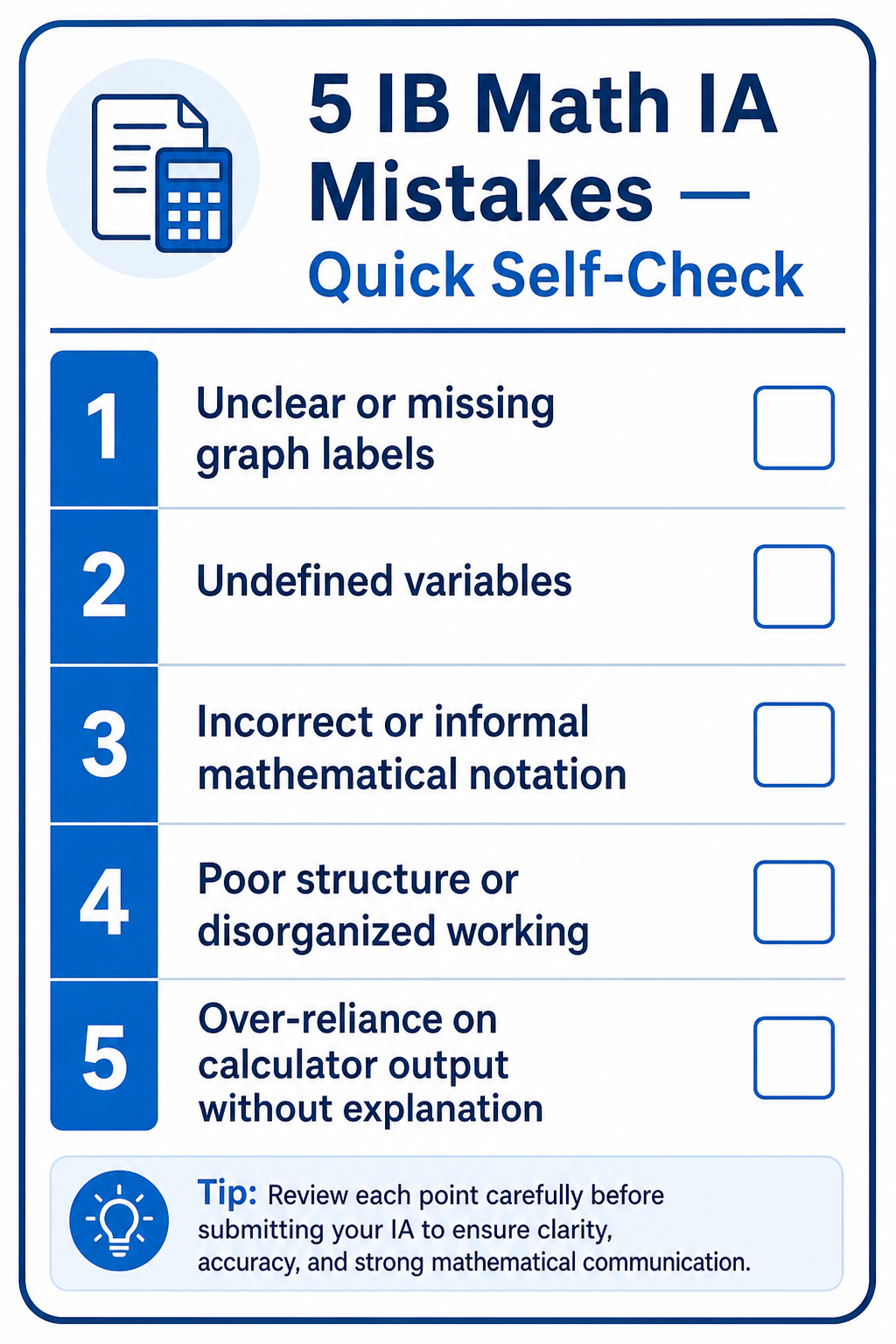
✅ Key Takeaways
- The five most damaging IB Math IA mistakes are: topic too simple, no personal engagement, poor mathematical communication, missing reflection, and plagiarism or template misuse.
- Most of these mistakes are fixable — but catching them early matters. The later you identify them, the more costly they are to address.
- Personal engagement must be visible in your mathematical choices and reasoning — not just in your introduction paragraph.
- Reflection must be specific, critical, and distributed throughout the exploration — not confined to a generic closing paragraph.
- Academic integrity is non-negotiable. Use resources ethically, write in your own words, and cite everything that isn’t your original work.
- Run the self-check in this post on your current draft before your next teacher review — it will show you exactly where to focus your revision energy.
Frequently Asked Questions
The IB Math IA mistakes covered in this post aren’t signs that a student lacks ability — they’re signs that a student didn’t know exactly what examiners were looking for at each stage of the process. Now you do. Use that knowledge to review your current draft with fresh, critical eyes. Fix what you can fix, get feedback on what you’re unsure about, and submit an exploration that genuinely reflects your best mathematical thinking. That’s what the IA is designed to reward — and you’re more than capable of delivering it.