The IB Math IA rubric is the single most important document you should read before you write a single word of your exploration — and most students have never looked at it properly.
📋 In This Guide
Understanding the IB Math IA rubric isn’t optional if you’re serious about your score. It’s the framework that every examiner uses to mark your exploration, and every decision you make — your topic, your structure, your mathematical choices, your reflections — either earns marks or loses them according to these five criteria.
The problem is that most students write their IA first and think about the rubric second. By then, it’s often too late to make the changes that would have pushed the score from a 14 to an 18.
This post gives you a thorough, examiner-focused breakdown of the IB Math IA rubric — what each criterion actually measures, what distinguishes a top-band response from a middle-band one, and what you need to do at every stage of your exploration to maximise your marks. This guide applies to all IB Math students: Analysis and Approaches (AA) and Applications and Interpretation (AI), at both SL and HL. The rubric is the same across all four courses.
If you haven’t chosen your topic yet, start with our guide on how to choose your IB Math IA topic — because your topic choice directly affects how well you can score on several of these criteria.
Overview of the 5 IB Math IA Criteria
The IB Math IA rubric is made up of five criteria, each worth a different number of marks. The total is 20 marks. Here’s how they break down:
- Criterion A — Presentation: 4 marks
- Criterion B — Mathematical Communication: 4 marks
- Criterion C — Personal Engagement: 3 marks
- Criterion D — Reflection: 3 marks
- Criterion E — Use of Mathematics: 6 marks
Criterion E carries the most weight at 6 marks — but this doesn’t mean you should neglect the others. Criteria A, B, C, and D together account for 14 marks. Students who focus only on the mathematics and ignore presentation, communication, and reflection consistently leave marks on the table.
📌 Important
The same rubric applies to AA SL, AA HL, AI SL, and AI HL. The expectations for Criterion E differ between SL and HL — and between AA and AI — but the criteria themselves and their mark allocations are identical across all four courses.
Practical takeaway: Think of your IA as five separate scoring opportunities. Every section of your exploration should be written with all five criteria in mind simultaneously — not one at a time.
Criterion A — Presentation (4 Marks)
Criterion A assesses whether your exploration is well-organised, clearly focused, and appropriate in length. It rewards explorations that are easy to follow from start to finish, with a logical structure and a consistent aim running throughout.
What Examiners Are Looking For
At the top band (3–4 marks), your exploration should have a clearly stated aim at the start, a coherent structure that builds logically, and a conclusion that directly addresses the aim you set out. Every section should feel purposeful — not like padding.
At the lower bands (0–2 marks), explorations tend to feel scattered. The aim is vague or changes direction midway. Sections don’t connect. The conclusion doesn’t relate to what was explored.
Length and Format
The IB recommends approximately 12–20 pages. Going significantly over this limit can work against you — it often signals a lack of focus rather than more depth. Appendices for raw data are acceptable and don’t count toward the page limit, but the core exploration must be self-contained.
💡 Pro Tip
Write your aim at the top of your introduction as a clear, specific sentence. Then, before you submit, re-read your conclusion and ask: does it directly answer what I aimed to find out? If not, revise one or both. Examiners check this connection explicitly when scoring Criterion A.
Practical takeaway: Structure is not decoration — it’s marks. Plan your exploration’s structure before you write a single body paragraph, and make sure your aim and conclusion are in direct conversation with each other.
Criterion B — Mathematical Communication (4 Marks)
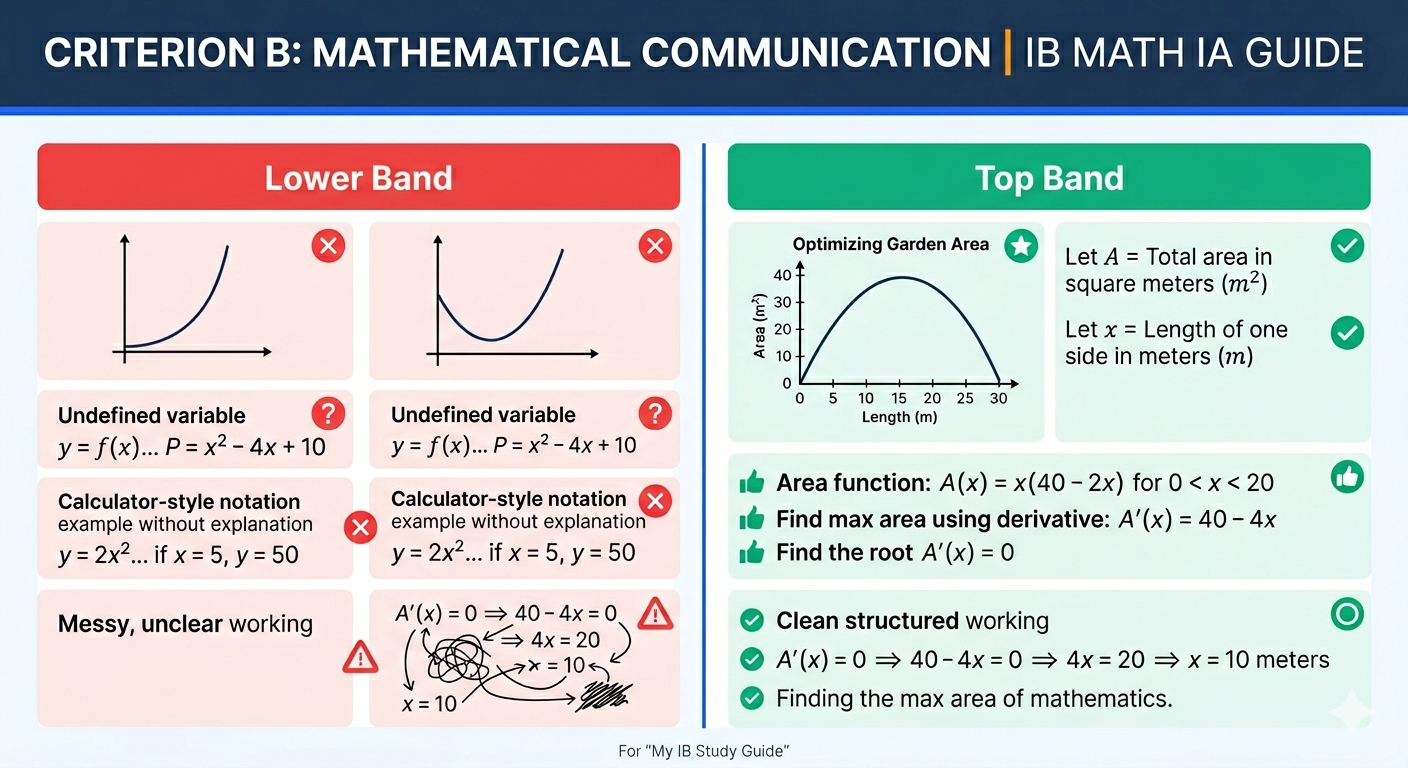
Criterion B assesses how well you use mathematical language, notation, and representation throughout your exploration. This isn’t about getting the right answers — it’s about communicating your mathematics clearly, correctly, and consistently.
What Examiners Are Looking For
At the top band, you define all variables, use correct notation throughout, label every graph and diagram clearly, and present your working in a way that’s easy for someone else to follow. Mathematical statements are precise. Notation is consistent from the first page to the last.
At lower bands, common problems include undefined variables, inconsistent notation, unlabelled axes, and missing units. These errors signal to examiners that the student understands the mathematics casually but can’t communicate it rigorously.
Key Habits to Build
- Define every variable the first time it appears
- Use proper mathematical notation — not calculator notation
- Label all graphs with axis titles, units, and a descriptive title
- Show all relevant working — don’t skip steps and expect the reader to follow
- Be consistent: if you call something f(x) on page 3, don’t switch to y on page 7
Practical takeaway: Read your exploration as if you’re seeing it for the first time. Every time you encounter a symbol, variable, or graph, ask: would someone who hasn’t been inside my head understand exactly what this means?
Criterion C — Personal Engagement (3 Marks)
Criterion C is the most misunderstood criterion on the IB Math IA rubric. Many students think it means writing “I chose this topic because I love football” in the introduction and moving on. It doesn’t. Personal engagement must show up in the mathematics itself — not just in the framing.
What Personal Engagement Actually Means
At the top band (3 marks), examiners look for evidence that you’ve made genuine, independent mathematical choices. This means exploring a direction you wondered about yourself, making a mathematical decision that wasn’t prescribed, asking a follow-up question mid-exploration, or interpreting results in a way that reflects your own thinking.
At lower bands, the exploration feels like a worked example that anyone could have produced. The student has completed the mathematics correctly but left no trace of their own curiosity or judgment anywhere in the work.
How to Build Genuine Personal Engagement
Personal engagement is most convincingly shown through the choices you make and the questions you ask — not through how much you write about yourself. Effective strategies include:
- Explaining — briefly — why you made a specific mathematical choice over an alternative
- Noting a result that surprised you and exploring why it occurred
- Extending your investigation in a direction you decided on yourself
- Connecting your findings to something personally meaningful in your introduction and conclusion
⚠️ Watch Out
Criterion C cannot be faked with a flowery introduction. If the body of your exploration reads like a textbook solution, no amount of personal framing will earn you top marks. Engagement must be visible in how you explore — not just in what you say about yourself.
Practical takeaway: At least twice in your exploration, pause and write one or two sentences explaining a decision you made, a result you didn’t expect, or a question that occurred to you. These moments are where Criterion C marks are won.
Criterion D — Reflection (3 Marks)
Criterion D rewards students who think critically about what their results mean — not just what they calculated. Reflection isn’t a paragraph at the end summarising what you did. It’s a thread of critical thinking that runs through the entire exploration.
What Strong Reflection Looks Like
At the top band (3 marks), reflection is meaningful and critical. You discuss the limitations of your model or approach, consider what your results actually imply in context, acknowledge assumptions you made and their impact, and suggest specific extensions that would address the weaknesses you’ve identified.
At lower bands, reflection is superficial. Students write things like “this was an interesting exploration” or “in future I could explore more data.” These statements don’t demonstrate mathematical thinking — they demonstrate that the student ran out of things to say.
Reflection Throughout vs. Reflection at the End
One of the most effective things you can do for Criterion D is to reflect throughout the exploration, not just in a closing paragraph. When a model doesn’t fit perfectly, say why. When you choose one method over another, acknowledge the trade-off. When results seem counterintuitive, engage with them directly.
💡 Pro Tip
Strong reflection is specific, not general. Instead of writing “the model has some limitations,” write “the exponential model overestimates growth after year 5 because it doesn’t account for carrying capacity — a logistic model would be more appropriate for long-term prediction.” That’s the level of specificity that earns top marks on Criterion D.
Practical takeaway: After writing each major section, ask yourself three questions: What do these results actually mean? What are the weaknesses in my approach? What would I do differently or additionally if I continued? Use those answers as the basis for your reflection.
Criterion E — Use of Mathematics (6 Marks)
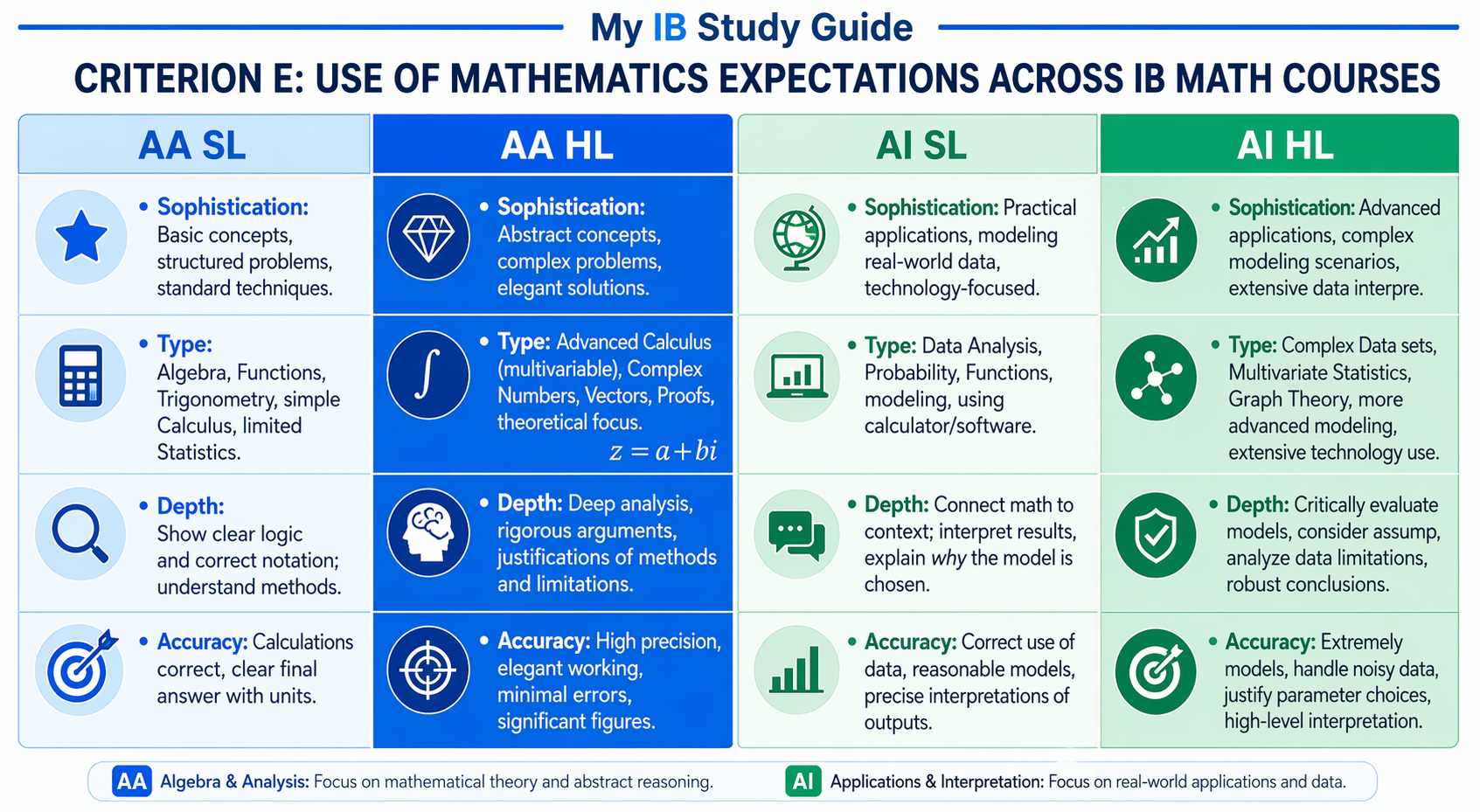
Criterion E is the highest-weighted criterion on the IB Math IA rubric, and it’s also the one where students most often underperform relative to their ability. It assesses not just whether your mathematics is correct, but whether it’s relevant, sufficiently sophisticated, and genuinely understood.
SL vs. HL Expectations
The IB makes a clear distinction here. For SL students, the mathematics should be at a level commensurate with the course — you don’t need HL content, but you do need to go beyond routine textbook procedures. For HL students, the expectation is explicitly for sophisticated mathematics — complex methods, precise reasoning, and a level of rigour that reflects the demands of the HL course.
For AI students at both levels, the focus is on appropriate and meaningful application — using statistical or modelling tools correctly and interpreting results in context, rather than simply running calculations.
What “Correct” and “Relevant” Mean Here
Mathematics can be technically correct but still score poorly on Criterion E if it’s not relevant to the aim, or if it’s presented without evidence of understanding. Copying a formula and substituting values without explaining what it represents or why it applies will not earn top marks — even if the answer is right.
📌 Important
The IB subject guide specifies that for top marks on Criterion E, mathematics must be “precise, relevant and consistent.” All three words matter. Precision means correct notation and working. Relevance means the maths directly serves your aim. Consistency means the same standard of rigour throughout — not just in one section.
Practical takeaway: For every piece of mathematics in your exploration, ask yourself: is this correct, is it relevant to my aim, and can I explain why I’m doing it? If the answer to any of those is “not really,” revise before you submit.
Realistic Score Expectations
Now that you understand every criterion on the IB Math IA rubric, it’s worth being honest about what different total scores typically look like — and what it takes to push from one band to the next.
Score Bands at a Glance
- 17–20 marks: Excellent exploration. Strong across all five criteria. Mathematics is sophisticated, communication is precise, reflection is critical and specific, personal engagement is genuinely visible.
- 13–16 marks: Solid exploration. Good mathematics and communication, but reflection may be superficial, personal engagement may be surface-level, or one criterion has a clear weakness.
- 9–12 marks: Adequate exploration. The mathematics works but the exploration lacks focus, reflection is minimal, and communication has notable errors.
- Below 9 marks: The exploration has significant weaknesses across multiple criteria — unclear aim, weak mathematics, little reflection, poor communication.
Where Most Students Lose Marks
In practice, the marks that most students lose unnecessarily come from Criterion C and Criterion D. The mathematics is often adequate, but reflection is generic and personal engagement is surface-level. These two criteria together represent 6 marks — the same as Criterion E alone.
If you’re targeting 18+, you need to be strong on all five criteria — not just the mathematics. Read our guide on what examiners actually want from your IB Math IA structure to see how the criteria translate into a well-built exploration from start to finish.
📚 Recommended Resource
Detailed IA Plans — Criterion-by-Criterion Guidance for Your Specific Topic
If you want to see exactly how the IB Math IA rubric applies to your specific topic — not just in general terms — our Detailed IA Plans give you a complete, criterion-by-criterion breakdown for one particular exploration. Each plan is sold to one student only worldwide, so your topic guidance stays exclusive to you. Clear, targeted advice for every criterion, designed to help you aim for top marks from the very first draft.
$45
Browse Detailed IA Plans on SamzHub →Practical takeaway: A score of 18+ is genuinely achievable for most students who understand the rubric and plan their exploration accordingly. The gap between a 14 and an 18 is rarely about mathematical ability — it’s almost always about how well the student understood what examiners were looking for.
✅ Key Takeaways
- The IB Math IA rubric has five criteria totalling 20 marks — understanding all five before you write is essential.
- Criterion E carries the most marks (6), but Criteria A, B, C, and D together account for 14 marks and are where most students lose points unnecessarily.
- Criterion C (Personal Engagement) must show up in your mathematical choices and reasoning — not just your introduction paragraph.
- Criterion D (Reflection) must be specific and critical — generic closing paragraphs will not earn top marks.
- For Criterion E, your mathematics must be correct, relevant to your aim, and consistent in rigour throughout — not just technically right.
- Targeting 18+ on the IB Math IA rubric is achievable when you plan each section with all five criteria in mind from the start.
Frequently Asked Questions
The IB Math IA rubric isn’t something to glance at once and forget. It’s the lens through which every decision in your exploration should be made — from your topic choice to your final conclusion. Students who internalise all five criteria before they start writing consistently outperform those who treat the rubric as an afterthought. Take the time to understand it properly now, use it as your planning guide throughout, and you’ll put yourself in the strongest possible position to score well. You’ve got this.