An IB Math IA summer plan is the single best thing you can do between DP1 and DP2 — because the students who use this window well arrive in September with a head start that’s almost impossible to close.
📋 In This Guide
Summer between DP1 and DP2 is one of the most valuable and most wasted stretches of time in the IB. For most students, the IA deadline feels distant enough that it’s easy to push it aside in favour of rest, travel, and everything else that summer brings. That’s completely understandable — and a reasonable amount of rest genuinely matters. But a focused IB Math IA summer plan doesn’t need to consume your entire holiday. It just needs to be intentional.
The students who arrive at the start of DP2 with a clear topic, a structured plan, or even a first draft already written are operating on a completely different timeline from those who haven’t touched their IA since the end of term. That head start compounds quickly once DP2 begins and the pressure of exams, Extended Essay deadlines, and coursework in every other subject closes in simultaneously.
This guide is written for all IB Math students — Analysis and Approaches (AA) and Applications and Interpretation (AI), at both SL and HL. Whether you’re starting your IA from scratch this summer or working to improve a draft you already have, this post gives you a realistic, actionable plan for making good use of the time available.
If you haven’t settled on a topic yet, start with our complete guide on how to choose your IB Math IA topic — it’s the right first step before anything else in this plan.
Two Types of Students Reading This
Before we get into the plan, it helps to be honest about where you’re starting from. Almost everyone reading a post about an IB Math IA summer plan falls into one of two groups — and the right approach differs significantly depending on which one you are.
Group A: You Haven’t Seriously Started Yet
You might have a rough topic idea, or you might have nothing at all. You know the IA exists, you know it’s important, and you’ve been meaning to think about it — but the end of DP1 arrived before you made real progress. Summer is your opportunity to change that before DP2 begins.
Group B: You Have a First Draft or a Partial Draft
You’ve done some work — maybe a full first draft, maybe a few sections. Your teacher may have given you initial feedback, or you may be waiting for the new school year to get that feedback. Either way, summer is your chance to revise with fresh eyes, address known weaknesses, and strengthen the sections that aren’t yet working.
📌 Important
Neither group is behind — yet. What matters is what you do with the time available. A student in Group A who spends four focused weeks this summer on their IA can arrive in September in a genuinely strong position. A student in Group B who uses summer to address structural and criterion-level weaknesses can dramatically improve a mediocre draft before their teacher sees the final version.
Identify your group and follow the relevant section below. The time guidance and September targets apply to both — just from different starting points.
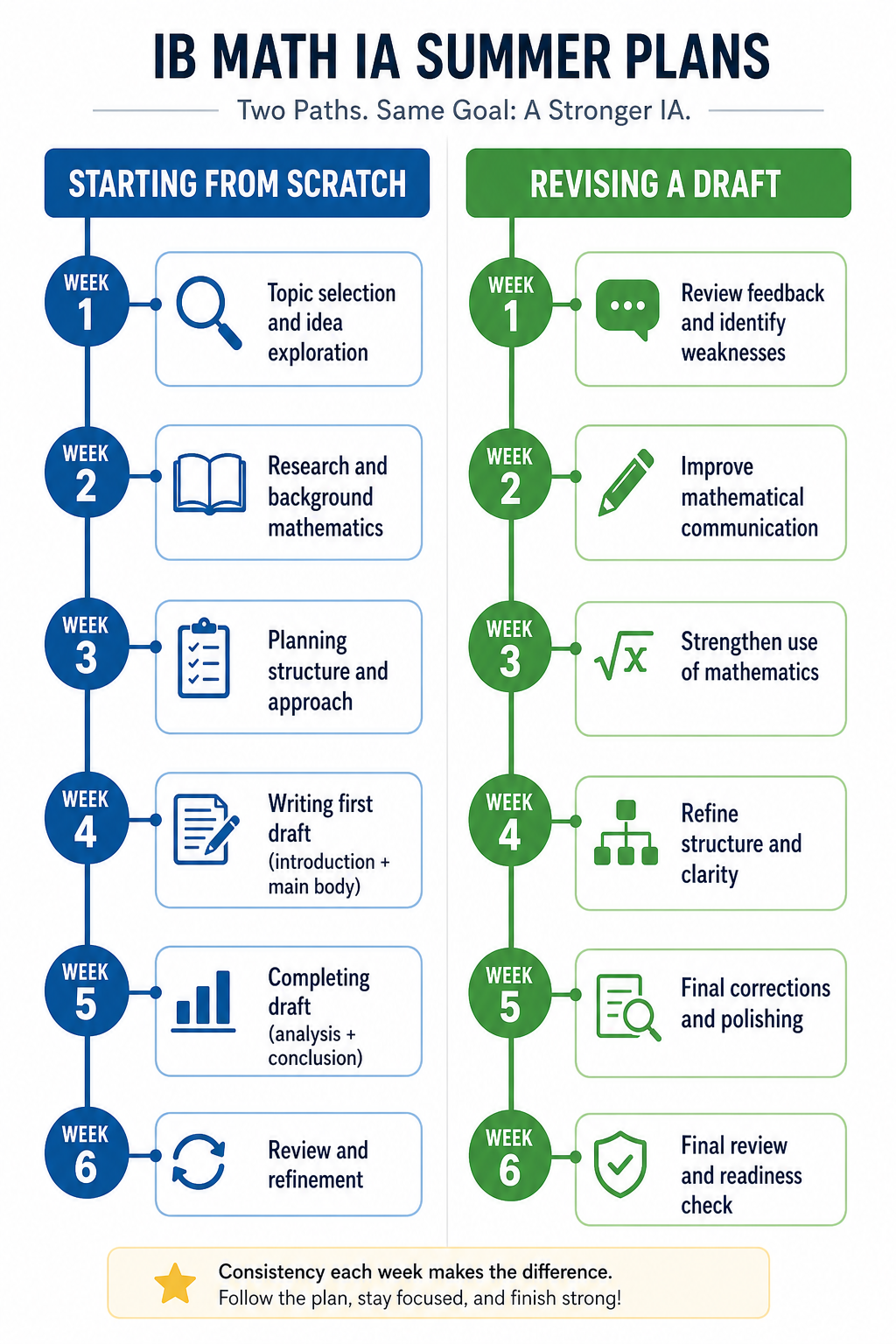
For Students Starting This Summer
If you’re beginning your IB Math IA this summer, the most important thing you can do in the first week is choose your topic properly — not quickly. A rushed topic decision creates problems that follow you all the way to submission. Use the structured selection process below.
Week 1–2: Choose and Confirm Your Topic
Start with your genuine interests — not with a list of “good IA topics” from the internet. Think about what you’re curious about outside of school, find the mathematical question inside that interest, and test it against the five IB criteria before you commit. Once you have a candidate topic, write a one-sentence aim and check that it’s specific, mathematical, and feasible.
At the end of this stage, you should have a clear topic and a defined aim. If your school allows it, send a brief email to your maths teacher to confirm the topic is viable before you invest significant time in it.
💡 Pro Tip
Don’t spend more than two weeks on topic selection. Perfectionism at this stage is the most common reason students arrive in September with nothing written. Choose a strong topic, commit to it, and start building — you can refine the angle as you go.
Week 3–4: Research, Background, and Mathematical Planning
Once your topic is confirmed, spend time understanding the mathematics you’ll be using. If your topic requires methods you haven’t fully covered in class yet, use this time to learn them. This is part of what makes a strong IA — independent learning in service of a genuine question.
At the end of this stage, you should have a clear plan for your main body: what mathematical methods you’ll use, in what order, and roughly what you expect each section to show. Think of it as a detailed outline, not a draft.
Week 5–6: Write Your First Draft
Write the full first draft of your exploration. Don’t aim for perfection — aim for completion. A finished draft with weaknesses is far more useful than a perfect introduction followed by nothing. Cover all five sections: introduction, background, main body, conclusion, and references.
- Write your introduction with a clearly stated aim and your personal connection to the topic
- Define all key terms and notation in your background section
- Present your mathematical investigation with working, graphs, and explanatory narration
- Write a conclusion that directly answers your aim and discusses specific limitations
- Add your references and check that all sources are cited correctly
Practical takeaway: Six focused weeks is enough to go from a blank page to a complete first draft. The key is following the stages in order and not skipping the planning phase to rush into writing.
For Students With a First Draft
If you already have a draft, summer is your opportunity to do something most students never do: revise with genuine distance from the work. When you’ve been writing something intensively, it’s hard to see it clearly. A few weeks away from it, followed by a structured revision process, can transform a middling draft into a strong one.
Step 1: Read Your Draft as an Examiner
Print your draft or open it fresh on screen. Read it from start to finish without editing as you go. As you read, mark every place where:
- The aim feels vague or the exploration loses focus
- A variable is used without being defined
- A graph is unlabelled or a diagram is unclear
- A calculation is shown with no explanation of what it means
- Your personal voice or independent thinking is absent
- Reflection is generic rather than specific and mathematical
- The conclusion doesn’t directly address the aim
Step 2: Address Each Issue Systematically
Work through your marked issues one criterion at a time rather than jumping between different types of problems. Fix all Criterion A issues first (structure, aim, conclusion), then Criterion B (communication and notation), then Criterion C (personal engagement), then Criterion D (reflection), then Criterion E (mathematical depth and relevance).
Step 3: Do a Final Length and Format Check
Make sure your exploration sits within the 12–20 page recommendation. Check that equations are properly typeset — not entered as plain text or calculator notation. Verify that your reference list is complete and consistently formatted. These details matter for Criterion A and Criterion B and are quick to fix if you address them systematically.
For a comprehensive section-by-section guide to what a well-structured IA looks like, read our post on IB Math IA structure and what examiners actually want.
⚠️ Watch Out
Don’t mistake surface-level editing for meaningful revision. Fixing typos and improving sentence flow won’t move your score significantly. The revisions that matter are structural and criterion-level — strengthening your aim, adding genuine reflection, improving mathematical communication, and deepening your engagement. Focus your summer revision energy there.
Practical takeaway: A structured revision process using the five criteria as your guide will do more for your score than any amount of general proofreading. Work criterion by criterion, be honest about where your draft is weak, and fix those areas deliberately.
How Much Time Do You Actually Need?
One of the most common reasons students avoid working on their IB Math IA over summer is a vague sense that it will consume the entire holiday. It doesn’t need to. The key is working in focused blocks rather than extended, unfocused sessions that feel exhausting and produce little.
Here’s a realistic time estimate based on where you’re starting:
- Topic selection and planning (Group A): 8–12 focused hours across 2 weeks
- Research and mathematical preparation (Group A): 10–15 hours across 2 weeks
- Writing a complete first draft (Group A): 15–20 hours across 2 weeks
- Full revision of an existing draft (Group B): 10–20 hours depending on how much revision is needed
- Format, communication, and reference check (both groups): 2–4 hours
For Group A students, that’s roughly 35–50 hours total across six weeks — or about six to eight hours per week. That’s one focused morning per week plus a few shorter sessions. It’s entirely compatible with a real summer holiday.
For Group B students, the total is lower — but only if you’re genuinely revising for criterion-level improvements rather than just polishing what’s already there.
💡 Pro Tip
Two hours of focused IA work — phone away, document open, a specific goal for the session — is worth more than five hours of distracted editing. Before each session, write down the one thing you’re going to accomplish. When you’ve done it, stop. Consistency over intensity is what builds a strong IA over a summer.
Practical takeaway: You don’t need to sacrifice your summer for your IA. You need to protect a realistic number of focused hours each week and use them deliberately. Plan those sessions in advance and treat them like commitments.
What to Have Ready by September
The goal of your IB Math IA summer plan isn’t perfection — it’s progress that puts you in a strong position when DP2 begins. Here’s what “ready by September” should look like for each group.
Group A — Starting From Scratch
By September, you should have a confirmed topic with a clearly defined aim, a complete first draft that covers all five sections, and a list of specific improvements you want to make before your teacher review. You don’t need a polished draft — you need a complete one that gives your teacher something substantial to respond to.
Group B — Revising a First Draft
By September, you should have a revised draft that has addressed the most significant criterion-level weaknesses in your original version, with stronger reflection, clearer mathematical communication, and more visible personal engagement. Ideally, this draft is close enough to final quality that your teacher’s feedback becomes refinement rather than major reconstruction.
📌 Important
Remember that your teacher can only provide feedback once in most IB schools. Use that feedback allocation wisely. Arriving in September with a draft that’s already been self-revised against the five criteria means your teacher’s feedback will be more targeted, more useful, and more likely to push you into a higher mark band.
If you’d like structured support in turning your topic idea into a personalised, criterion-aligned plan before you start writing, our Custom IA Plan is designed for exactly this moment.
📚 Recommended Resource
Custom IA Plan — Personalised for Your Topic
Submit your topic idea and receive a personalised IA plan built around your specific investigation. Each plan is unique to your topic and delivered within 3–5 business days — giving you a clear, criterion-aligned roadmap to follow across your summer writing sessions. It’s the fastest way to turn a topic idea into a structured, purposeful exploration plan that’s genuinely yours.
$59
Order a Custom IA Plan on SamzHub →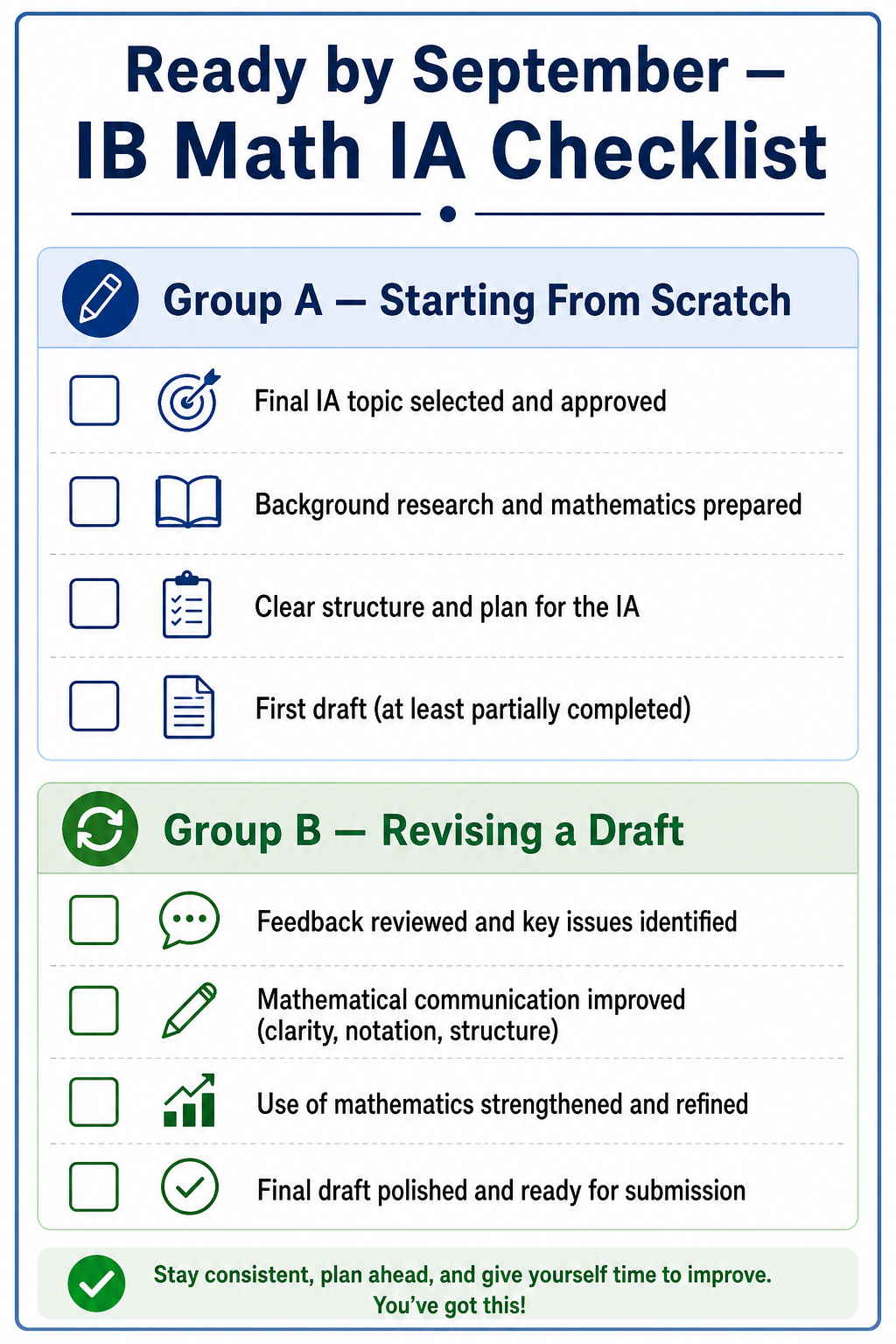
✅ Key Takeaways
- An IB Math IA summer plan doesn’t need to consume your holiday — it needs to be intentional, consistent, and criterion-focused.
- Group A students (starting from scratch) should aim for a confirmed topic and complete first draft by September — roughly six to eight focused hours per week across six weeks.
- Group B students (revising a draft) should use summer to address criterion-level weaknesses — especially reflection, personal engagement, and mathematical communication.
- Two hours of focused work per session is more valuable than five hours of distracted editing. Plan each session with a specific goal.
- Your teacher can only give feedback once — arrive in September with a draft that’s already been self-revised so their feedback pushes you higher rather than rebuilding from scratch.
- The students who use this summer window well arrive in DP2 with a genuine, compounding advantage over those who don’t.
Frequently Asked Questions
Summer is genuinely one of the best opportunities you’ll have to work on your IB Math IA without the pressure of exams, other deadlines, and the intensity of a full DP2 timetable bearing down on you. You don’t need to spend your entire holiday on it — but a focused, intentional IB Math IA summer plan will pay dividends throughout DP2 that go well beyond the IA itself. Start where you are, use the time you have, and arrive in September knowing you’ve given yourself a real advantage. That’s worth a few focused mornings.