Choosing between IB Math AA vs AI is one of the biggest decisions you’ll make as you move from MYP into the Diploma Programme — and getting it right can shape your university options, your daily study experience, and even your career path.
📋 In This Guide
If you’re an MYP 5 student preparing for the DP, you’ve probably heard classmates debating IB Math AA vs AI. Maybe your teachers have given you a brief overview, or maybe you’re still staring at two course descriptions wondering what the difference actually is. You’re not alone.
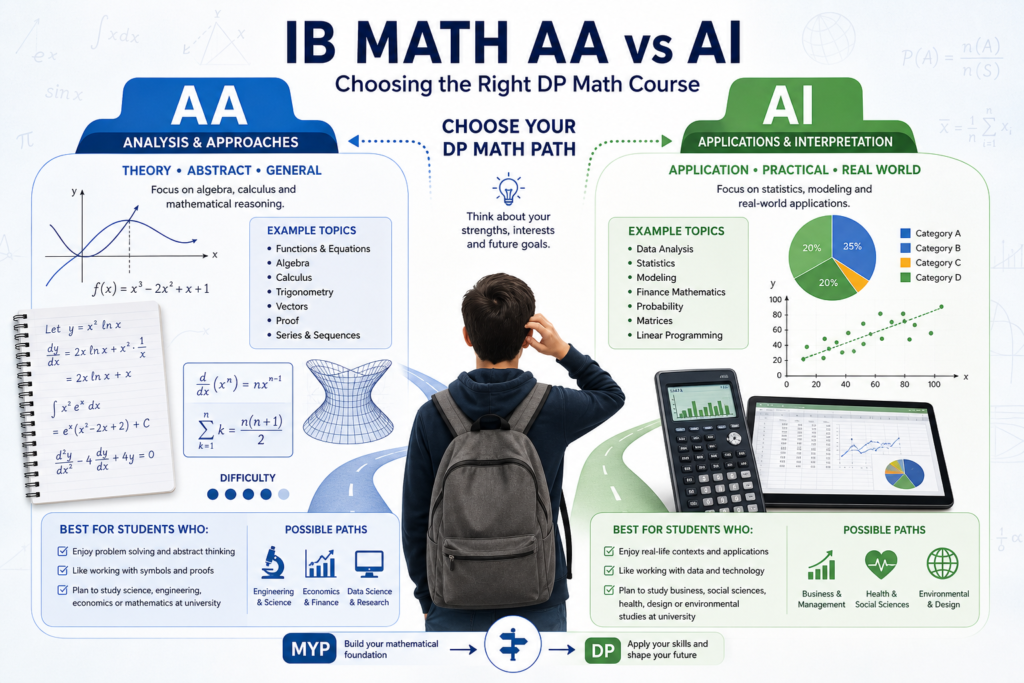
Analysis and Approaches (AA) and Applications and Interpretation (AI) are the two mathematics courses offered in the IB Diploma Programme, each with a Standard Level (SL) and Higher Level (HL) option. They share some topics, but they differ significantly in philosophy, assessment style, and where they lead after graduation.
This guide breaks down every angle of the IB Math AA or AI decision so you can choose with confidence — not guesswork. If you’re also deciding between SL and HL, check out our post on whether you should take IB Math SL or HL for a deeper dive into that question.
Let’s get into the details.
Quick Overview: IB Math AA vs AI
Before diving into the specifics, here’s the simplest way to understand the two courses:
Analysis and Approaches (AA)
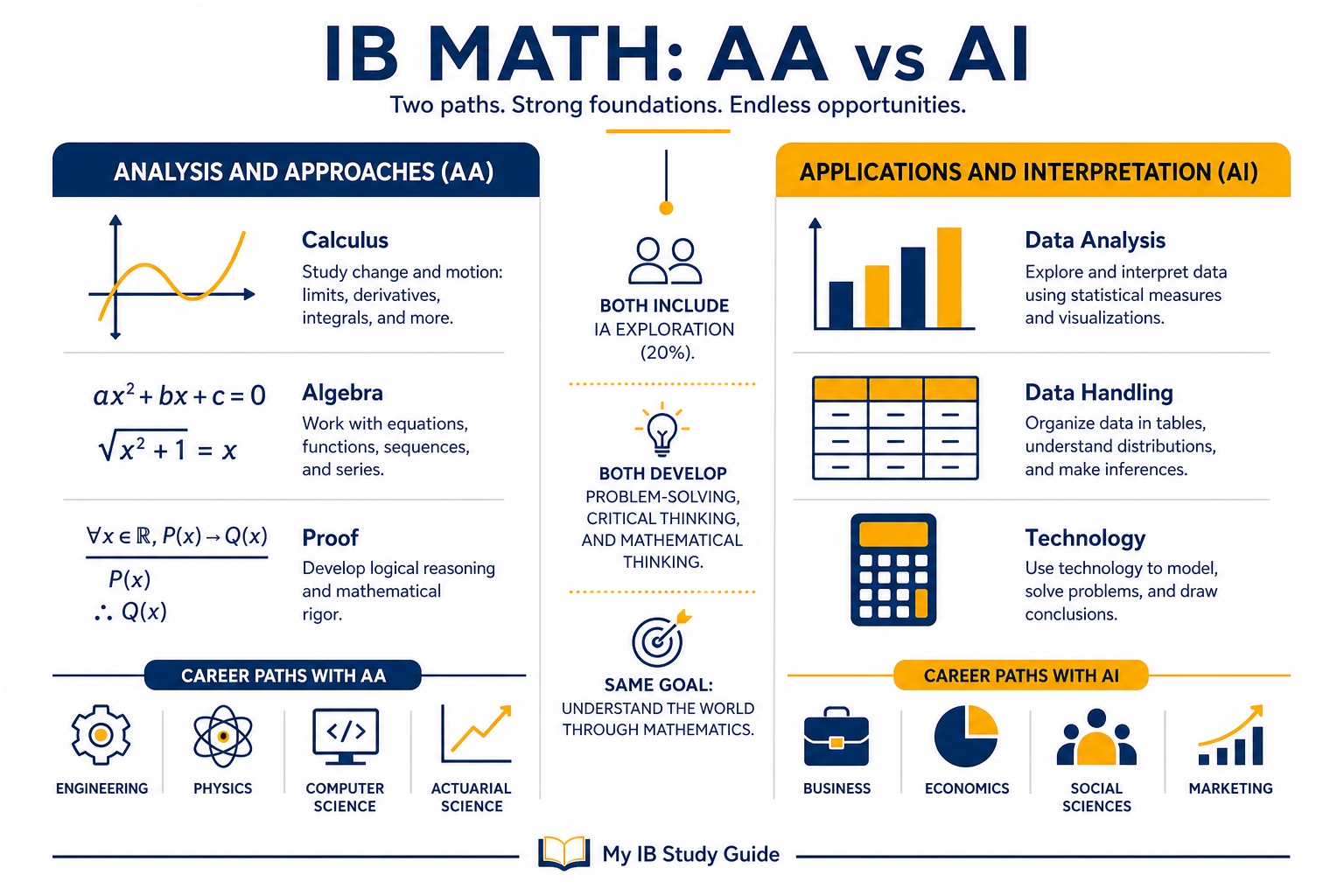
AA is built around mathematical theory, proof, and algebraic thinking. If you enjoy solving abstract problems, working through proofs, and understanding why formulas work, AA is designed for you. It’s the course that most closely resembles traditional pure mathematics.
Applications and Interpretation (AI)
AI is built around real-world applications, statistics, and technology. If you prefer using maths to model situations, interpret data, and solve practical problems, AI is your match. It leans heavily on your graphic display calculator (GDC) and statistical tools.
💡 Pro Tip
Neither course is “better” than the other. The right choice depends entirely on your strengths, interests, and future plans. Ignore peer pressure and focus on your own goals.
Side-by-Side IB Math Course Comparison
This IB Math course comparison table highlights the key differences at a glance. Use it as a quick reference when making your decision:
| Feature | Analysis and Approaches (AA) | Applications and Interpretation (AI) |
|---|---|---|
| Core Philosophy | Abstract, theoretical, proof-based | Applied, contextual, data-driven |
| Strongest Topics | Calculus, algebra, trigonometry | Statistics, modelling, discrete maths |
| Calculator Use | Paper 1 is non-calculator | Calculator allowed on all papers |
| Exam Papers (SL) | Paper 1 (no GDC) + Paper 2 (GDC) | Paper 1 (GDC) + Paper 2 (GDC) |
| Exam Papers (HL) | Paper 1 + Paper 2 + Paper 3 | Paper 1 + Paper 2 + Paper 3 |
| Internal Assessment | Mathematical exploration (20%) | Mathematical exploration (20%) |
| Best For | Engineering, physics, pure maths, economics | Business, social sciences, design, health sciences |
| Typical Student Enjoys | Solving abstract puzzles, proving results | Working with real data, using technology |
Who Should Choose AA?
Analysis and Approaches is the right fit if you identify with most of the following:
- You enjoy algebra and working with abstract equations
- You’re interested in understanding why mathematical results are true
- You’re considering a university degree in engineering, physics, computer science, mathematics, or economics
- You feel confident working without a calculator on timed problems
- You found MYP Criterion C (Communicating) and Criterion D (Applying mathematics in real-life contexts) engaging, but you were especially strong in pattern-based and algebraic tasks
- You want to keep doors open for STEM-heavy university programmes
If you’re strong in MYP algebra and functions, you likely have a solid foundation for AA. Make sure your core MYP math skills are in place before starting.
⚠️ Watch Out
Don’t choose AA just because someone told you it “looks better” to universities. Many programmes accept AI, and choosing a course you struggle with can hurt your overall score more than the course name helps.
Who Should Choose AI?
Applications and Interpretation suits you if the following statements resonate:
- You prefer using maths to solve real-world problems rather than abstract puzzles
- You enjoy working with data, statistics, and technology
- You’re considering a university degree in business, psychology, environmental science, design, or health sciences
- You feel more confident when you can use your GDC to support your work
- You were strong in MYP Criterion D (Applying mathematics in real-life contexts)
- You want a math course that connects directly to practical, everyday applications
📌 Important
AI is not the “easy” version of IB Math. AI HL, in particular, covers advanced statistics, Markov chains, and complex modelling that many students find genuinely challenging. Choose based on fit, not perceived difficulty.
SL vs HL Within Each Course
Once you’ve decided between AA and AI, you still need to choose between Standard Level and Higher Level. Here’s a quick breakdown of what each level adds:
AA SL vs AA HL
- AA SL covers core calculus, algebra, trigonometry, and statistics. It’s 150 teaching hours and has two exam papers.
- AA HL adds complex numbers, advanced calculus (including series and differential equations), proof by induction, and vectors in 3D. It’s 240 teaching hours with three exam papers.
- AA HL is typically required for university maths, physics, and engineering degrees.
AI SL vs AI HL
- AI SL covers statistical analysis, basic modelling, and financial maths. It’s 150 teaching hours with two exam papers.
- AI HL adds Markov chains, graph theory, advanced regression, and hypothesis testing in depth. It’s 240 teaching hours with three exam papers.
- AI HL is valued by social sciences, data science, and business programmes that want strong quantitative skills.
💡 Pro Tip
If you’re unsure about HL, start by confirming your university requirements. Some programmes specifically require AA HL, while others accept any math course at SL. Check early so you don’t have to switch mid-year.
📚 Recommended Resource
AA vs AI Decision Guide
Complete comparison of AA and AI with quiz, career paths, university requirements, and decision matrix — everything you need to make the right choice with confidence.
Free
Download the Free AA vs AI Decision Guide →University Requirements: Which IB Math Course Do You Need?
This is where the IB Math AA vs AI decision becomes very practical. University requirements vary by country, institution, and programme, but here are the general patterns:
Programmes That Typically Require AA
- Engineering (most require AA HL)
- Physics (AA HL strongly preferred)
- Mathematics and Computer Science (AA HL required)
- Economics at competitive universities (AA HL preferred, AA SL minimum)
Programmes That Typically Accept Either
- Business and Management
- Environmental Science
- Psychology
- Architecture (varies by school)
- Health Sciences and Nursing
Programmes Where AI May Be Preferred
- Social Sciences with quantitative methods
- Data Science (some programmes value AI HL’s statistics depth)
- Design and Technology
Always verify requirements directly with your target universities. The IBO’s official mathematics curriculum page provides detailed information about what each course covers, which can help you match course content to university expectations.
⚠️ Watch Out
University requirements can change. A programme that accepted AI SL last year might update its prerequisites. Always check the most current admissions pages for your specific target universities and programmes.
What If You’re Unsure?
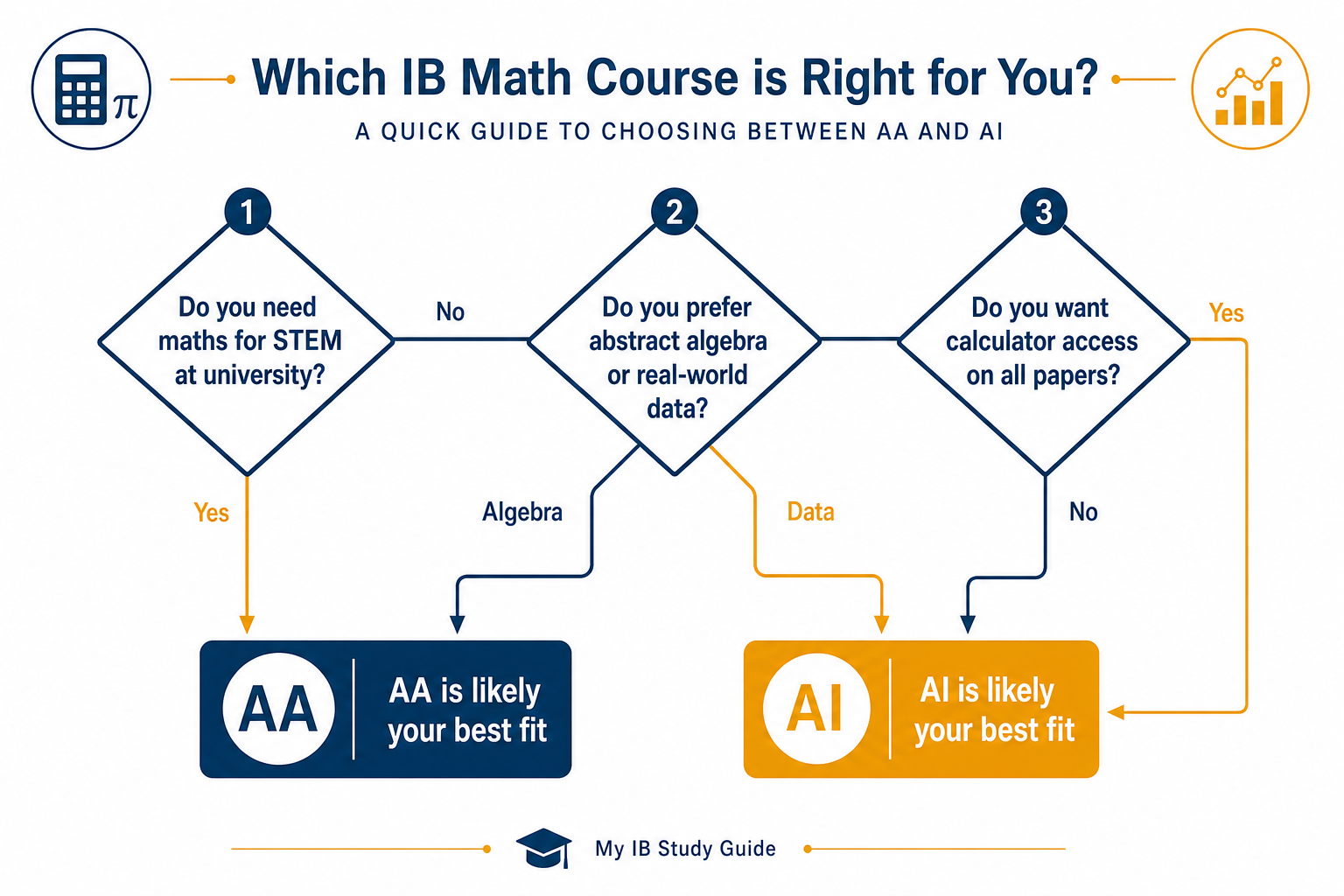
Many MYP 5 students feel stuck between the two courses — and that’s completely normal. Here’s a step-by-step approach to help you decide which IB Math course fits best:
- List your top 3 university programme interests. Research their maths requirements. If even one requires AA, lean toward AA unless you’re sure you won’t pursue it.
- Reflect on your MYP math experience. Did you prefer algebraic problem-solving (Criterion B — Investigating Patterns) or applying maths to real-world contexts (Criterion D)?
- Talk to your MYP math teacher. They’ve seen your work across all four criteria and can offer honest advice about your strengths.
- Try sample problems. Ask your school for past AA and AI exam questions. Spend 30 minutes on each and see which style feels more natural.
- Consider the non-calculator element. If the idea of Paper 1 without a GDC makes you anxious, that’s worth factoring in — but don’t let it be the only factor.
💡 Pro Tip
If you genuinely enjoy maths and want to study a STEM field but aren’t sure which course suits you, AA SL is often the safest middle-ground choice. It keeps most university doors open without the full demand of HL.
If you’d like a structured way to work through this decision, our free AA vs AI Decision Guide includes a self-assessment quiz and decision matrix that walks you through every factor.
✅ Key Takeaways
- IB Math AA vs AI isn’t about difficulty — it’s about fit. AA is theoretical and proof-based; AI is applied and data-driven.
- AA is generally required for engineering, physics, and pure mathematics degrees. AI is well-suited for business, social sciences, and health fields.
- AI is not the easy option. AI HL covers complex topics like Markov chains and advanced statistics.
- Always check your target university’s specific requirements before locking in your choice.
- If you’re unsure, try sample exam questions from both courses and talk to your MYP teacher for personalised advice.
Frequently Asked Questions
The IB Math AA vs AI decision doesn’t have to be stressful. With the right information about course content, university expectations, and your own strengths, you can make a confident, informed choice. Take your time, do your research, and remember — the best course is the one where you’ll genuinely engage, learn, and perform at your highest level.