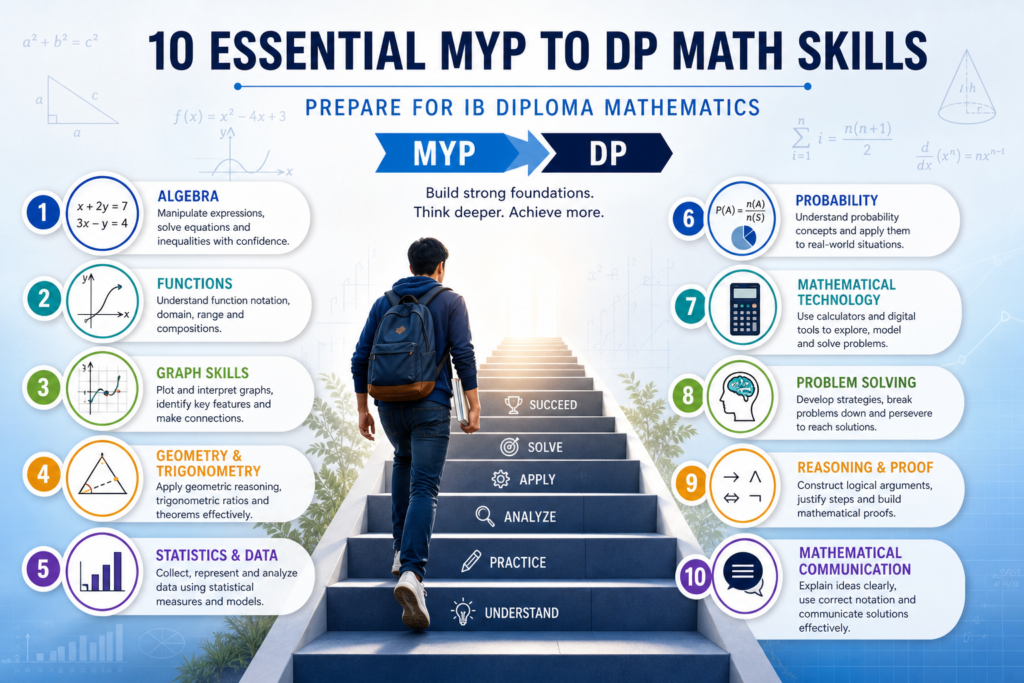
The MYP to DP math skills you bring into Year 1 of the Diploma Programme will determine whether you hit the ground running or spend your first term catching up on basics you should already know.
📋 In This Guide
- Why MYP Foundations Matter
- Skill 1: Algebraic Manipulation
- Skill 2: Solving Equations
- Skill 3: Working with Fractions
- Skill 4: Exponent Rules
- Skill 5: Basic Functions
- Skill 6: Graphing
- Skill 7: Geometry Fundamentals
- Skill 8: Trigonometry Basics
- Skill 9: Statistics Foundations
- Skill 10: Mathematical Reasoning
- Self-Assessment Quiz
- Key Takeaways
The jump from MYP Mathematics to DP Math — whether you choose Analysis and Approaches (AA) or Applications and Interpretation (AI) — is one of the steepest transitions in the entire IB programme. Your DP teacher won’t have time to re-teach foundational topics. They’ll assume your MYP to DP math skills are solid from day one.
The good news? The gap is completely bridgeable if you know exactly what to focus on. This guide identifies the 10 critical MYP math preparation for DP areas that every student needs to lock down before walking into that first DP lesson. Each skill includes what it looks like in MYP, why it matters in DP, and a quick self-check so you can spot your own gaps.
If you’re still deciding which DP math course to take, read our guide on AA vs AI: Which IB Math Course Should You Choose? first — then come back here to make sure your foundations are ready.
Why MYP Foundations Matter for DP Math
In MYP Mathematics, you work across four criteria — Knowing and Understanding, Investigating Patterns, Communicating, and Applying Mathematics in Real-Life Contexts. These build a broad base of mathematical thinking. But DP Math moves faster, goes deeper, and assumes fluency in skills that MYP introduces gradually.
Here’s the reality: skills before IB Math aren’t just “nice to have.” They’re the building blocks that every single DP topic sits on top of. If your algebra is shaky, calculus will feel impossible. If you can’t graph basic functions confidently, you’ll struggle with transformations, derivatives, and data modelling from week one.
⚠️ Watch Out
Many students feel comfortable in MYP math because they can use a calculator and reference sheets for most tasks. DP — especially AA Paper 1 — requires you to work without a calculator, relying on skills you’ve genuinely internalised.
Let’s walk through each of the 10 essential MYP to DP math skills you need to master.
Skill 1: Algebraic Manipulation
What it means: Expanding brackets, factorising expressions, simplifying algebraic fractions, and collecting like terms — fluently and accurately.
Why it matters in DP: Nearly every DP topic requires algebraic manipulation. From rearranging formulas in physics-style problems to simplifying derivatives in calculus, this is the single most important foundation skill.
Self-Check
Can you confidently:
- Expand and simplify (2x + 3)(x − 4)?
- Factorise x² + 5x + 6 without hesitation?
- Simplify an algebraic fraction like (x² − 9)/(x + 3)?
If you hesitated on any of these, prioritise this skill over the summer.
Skill 2: Solving Equations
What it means: Solving linear equations, quadratic equations (by factorising, completing the square, and using the quadratic formula), and simultaneous equations.
Why it matters in DP: Equation solving appears in virtually every DP topic. You’ll solve equations to find intercepts, optimise functions, and work through probability problems. Speed and accuracy here free up mental energy for harder concepts.
Self-Check
- Can you solve 3x² − 12 = 0 in under 30 seconds?
- Can you complete the square for x² + 6x + 2 = 0?
- Can you solve two simultaneous equations by substitution and elimination?
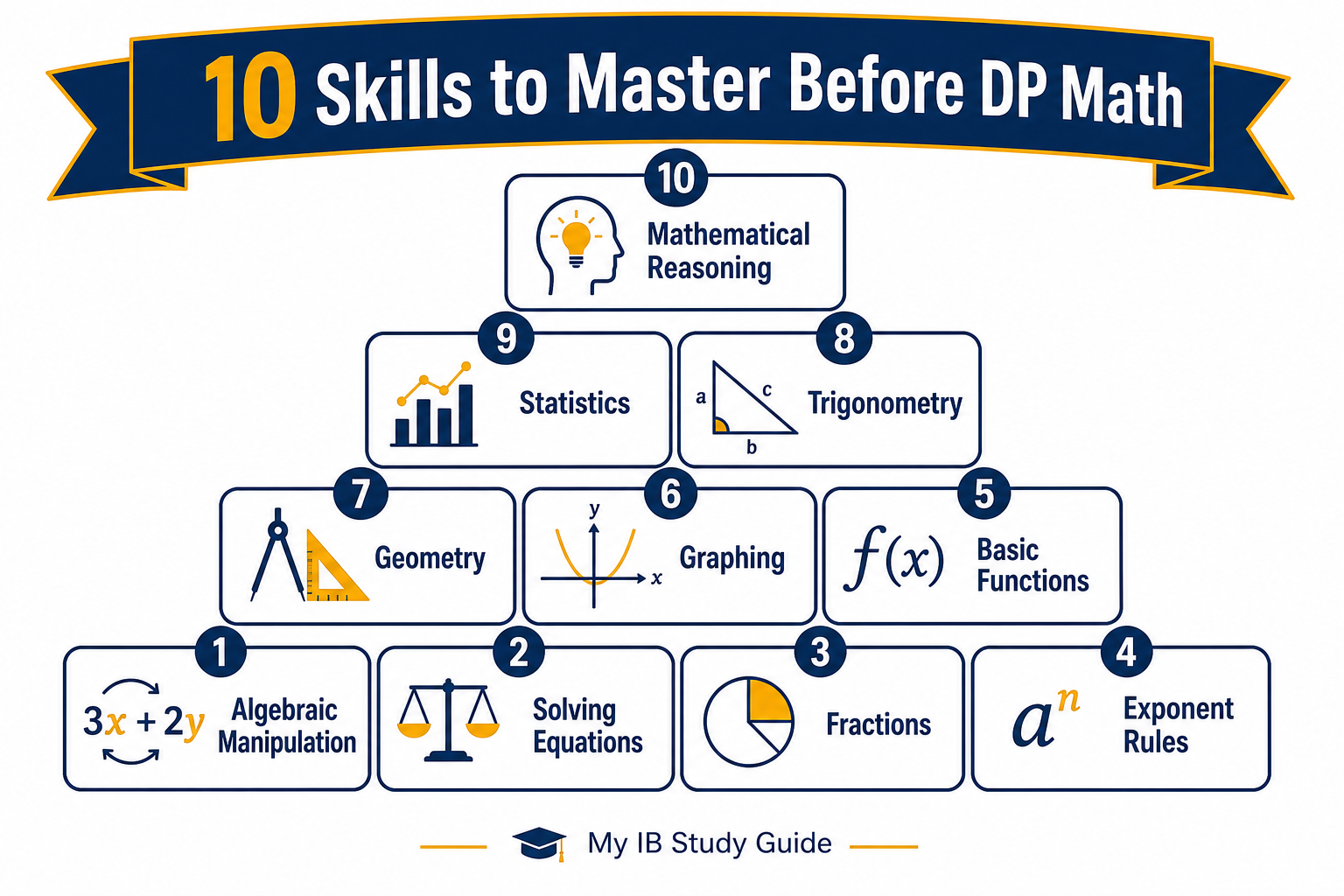
Skill 3: Working with Fractions
What it means: Adding, subtracting, multiplying, and dividing fractions — including algebraic fractions — without reaching for a calculator.
Why it matters in DP: Fractions appear constantly in calculus, probability, and trigonometry. If you rely on your GDC for basic fraction arithmetic, you’ll lose marks on non-calculator papers and slow down significantly on timed exams.
💡 Pro Tip
Practice fraction operations by hand for just 10 minutes a day over the summer. This small habit builds the fluency you’ll need for DP Paper 1 work.
Skill 4: Exponent Rules
What it means: Knowing and applying the laws of exponents — product rule, quotient rule, power rule, negative exponents, and fractional exponents.
Why it matters in DP: Exponent rules underpin logarithms, exponential functions, and differentiation of power functions. If you can’t confidently simplify x³ · x⁻¹ or convert √x to x^(1/2), you’ll struggle from the first calculus lesson.
Skill 5: Basic Functions
What it means: Understanding what a function is, using function notation f(x), evaluating functions for given inputs, and recognising basic function types (linear, quadratic, exponential).
Why it matters in DP: Functions are the central language of DP Mathematics in both AA and AI. Composite functions, inverse functions, and transformations all build directly on MYP-level function understanding.
Skill 6: Graphing
What it means: Sketching and interpreting graphs of linear, quadratic, and basic exponential functions. Identifying key features like intercepts, turning points, and asymptotes.
Why it matters in DP: Graphical interpretation is assessed in both AA and AI across multiple topics — from optimisation to statistical distributions. You need to sketch quickly and read graphs accurately under exam pressure.
- Can you sketch y = x² − 4x + 3 showing the vertex and roots?
- Can you identify the y-intercept and gradient of y = 3x − 7 instantly?
- Can you describe what happens to y = 2ˣ as x approaches negative infinity?
📚 Recommended Resource
MYP to DP Transition Pack
Bridges MYP and DP content with targeted practice exercises. Shows exactly how MYP topics connect to DP and prepares you for the step up — so you’re ready from lesson one.
$15
Get the MYP to DP Transition Pack on SamzHub →Skill 7: Geometry Fundamentals
What it means: Angle relationships, properties of triangles and circles, area and volume formulas, and coordinate geometry basics (distance, midpoint, gradient).
Why it matters in DP: Coordinate geometry appears heavily in AA. Circle geometry, vectors, and spatial reasoning in HL all depend on solid geometry foundations from MYP. Even AI students need geometry for modelling and applied problems.
Skill 8: Trigonometry Basics
What it means: Understanding sine, cosine, and tangent ratios in right-angled triangles. Being able to find missing sides and angles using SOH-CAH-TOA.
Why it matters in DP: DP trigonometry expands rapidly into the unit circle, radian measure, trigonometric identities, and graphing trig functions. If the basics aren’t automatic, the advanced content will overwhelm you. This is one of the most critical MYP to IB math transition areas.
📌 Important
In DP, you’ll also need the sine rule and cosine rule for non-right-angled triangles. Some MYP programmes introduce these; others don’t. Check whether you’ve covered them and practise if needed.
Skill 9: Statistics Foundations
What it means: Calculating mean, median, mode, and range. Understanding how to read and create frequency tables, histograms, and box plots. Basic probability concepts.
Why it matters in DP: Statistics is a core component of both AA and AI. AI students, in particular, will dive into regression, correlation, and hypothesis testing very early. Without solid descriptive statistics foundations, you’ll struggle to interpret data meaningfully.
Skill 10: Mathematical Reasoning
What it means: Explaining your thinking clearly, justifying answers, recognising patterns, and constructing logical arguments. In MYP terms, this connects strongly to Criterion B (Investigating Patterns) and Criterion C (Communicating).
Why it matters in DP: The DP Internal Assessment (IA) requires extended mathematical reasoning and communication. AA HL students encounter formal proof. Even at SL, exam questions increasingly ask you to “show that” or “justify” — not just calculate. Strong reasoning is what separates a 5 from a 7.
💡 Pro Tip
Start practising “show that” problems now. Instead of just writing the answer, write every logical step. This habit will pay dividends in both your DP exams and your IA. Learn more about what the first weeks of DP look like in our post on what to expect in your first month of IB Math AA.
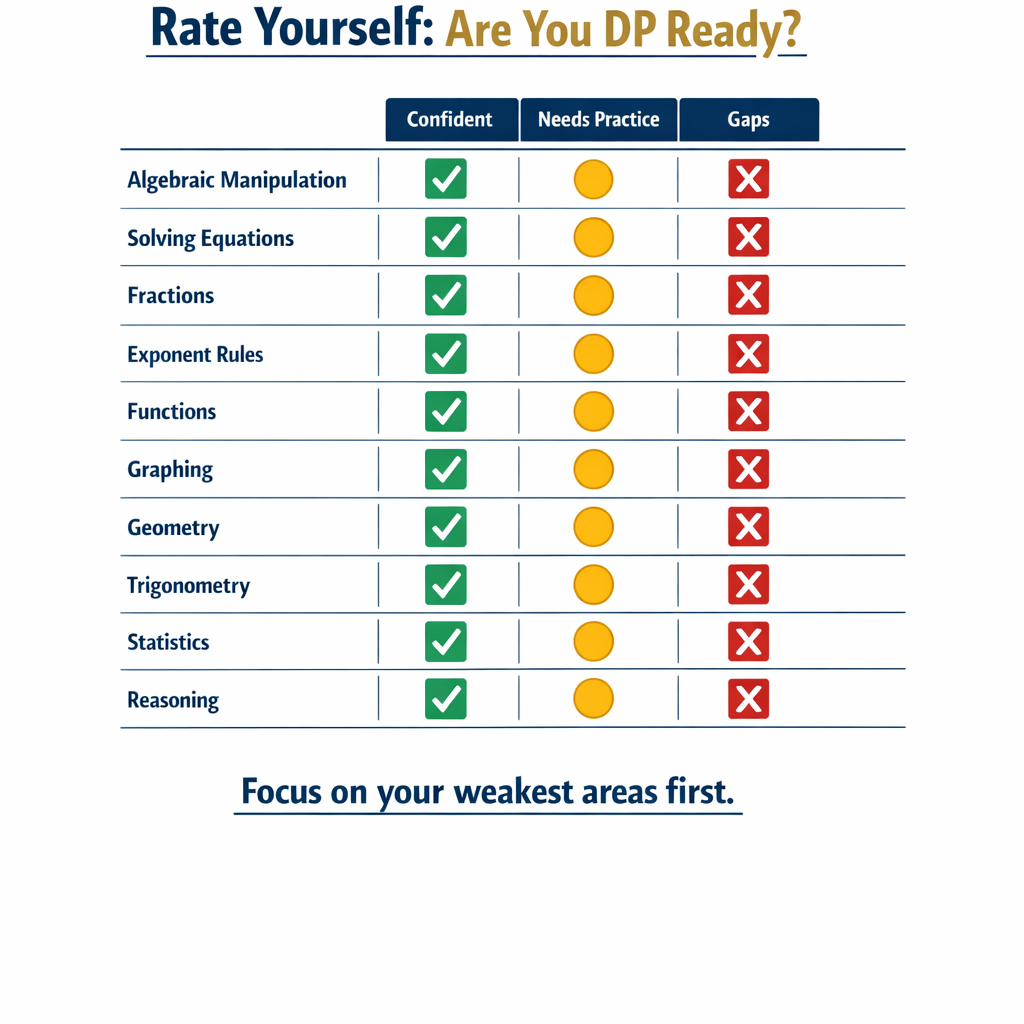
Self-Assessment Quiz: How Ready Are You?
Rate yourself honestly on each of the 10 myp to dp math skills using this quick self-test. For each skill, give yourself a score:
📌 Scoring Guide
3 points — I can do this confidently without a calculator or notes.
2 points — I can do this but sometimes make errors or need reminders.
1 point — I struggle with this or haven’t covered it properly.
- Algebraic Manipulation: ___/3
- Solving Equations: ___/3
- Working with Fractions: ___/3
- Exponent Rules: ___/3
- Basic Functions: ___/3
- Graphing: ___/3
- Geometry Fundamentals: ___/3
- Trigonometry Basics: ___/3
- Statistics Foundations: ___/3
- Mathematical Reasoning: ___/3
Your Results
- 25–30 points: You’re well-prepared for DP Math. Keep practising over the summer to stay sharp.
- 18–24 points: You have a decent foundation but clear gaps. Focus your revision on any skill scored 1 or 2.
- Below 18 points: Start working on these skills now. A structured transition resource can help you close gaps efficiently before term begins.
Be honest with yourself. Identifying weaknesses now is far better than discovering them during your first DP assessment. The IB’s official mathematics curriculum overview shows exactly what DP courses expect from day one — it’s worth a look.
✅ Key Takeaways
- The 10 MYP to DP math skills in this guide are the non-negotiable foundations for success in both AA and AI.
- Algebraic manipulation and equation solving are the two most critical skills — nearly every DP topic depends on them.
- Don’t confuse comfort with your GDC for genuine mathematical fluency. DP demands you work without a calculator on key papers.
- Use the self-assessment quiz honestly to identify exactly where you need to focus your summer revision.
- Closing gaps now prevents frustration later. A few weeks of targeted practice can make a huge difference.
Mastering these MYP to DP math skills before you start the Diploma Programme is one of the smartest investments you can make in your IB journey. The students who thrive in DP Math aren’t necessarily the most talented — they’re the ones who walked in with strong foundations and no hidden gaps. Start assessing yourself today, target your weak spots, and you’ll be ready for whatever DP throws at you.