
This IB math statistics practice question tackles one of the most important — and most frequently examined — topics in the AA SL course: the normal distribution. You will need to find a probability from given parameters and then work backwards using the inverse normal to find a missing value. Both skills appear on Paper 2 every year. Before you scroll down to the hints or the solution, take out your GDC and give this a real attempt. The only way to build fluency with the normal distribution is to practise it under exam conditions.
📋 Jump To
This Week’s IB Math Statistics Practice Question
📝 Question of the Week
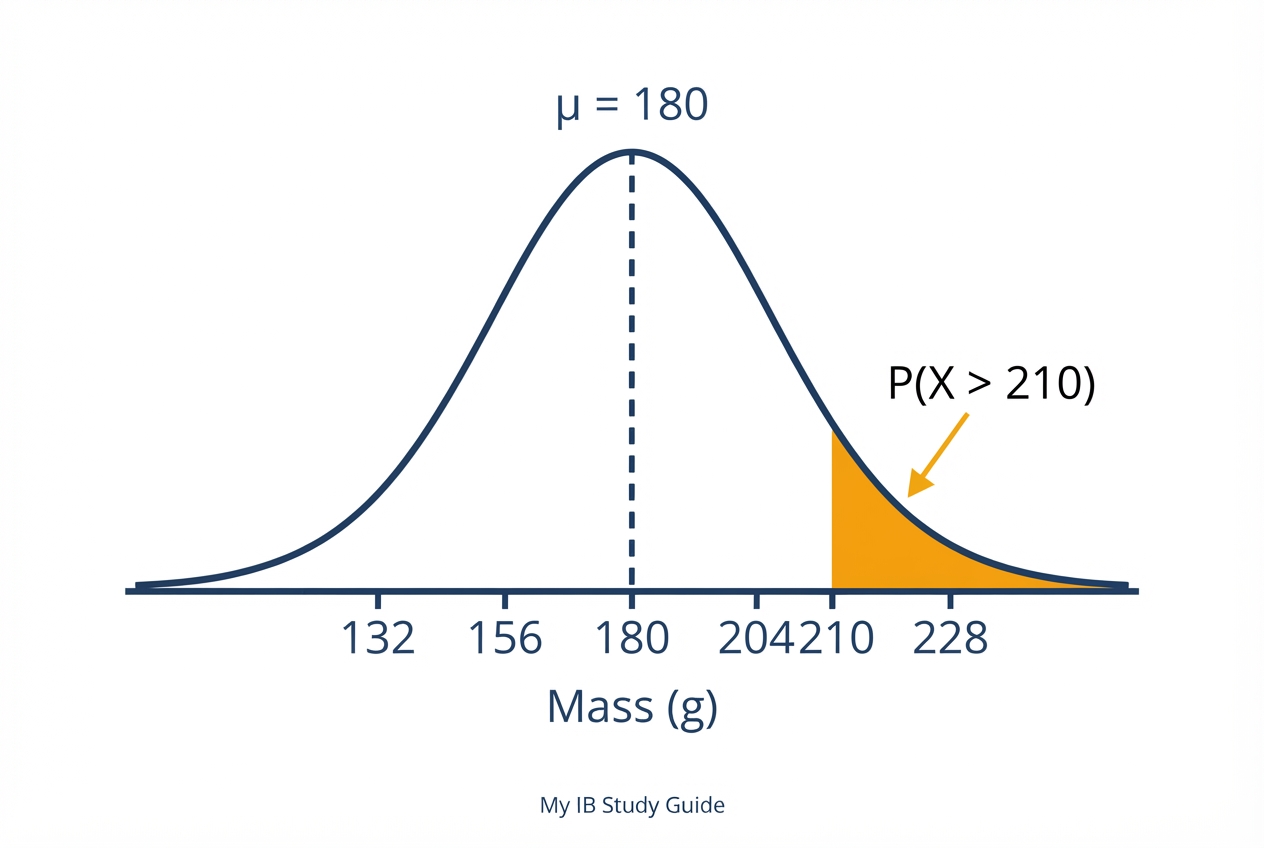
The masses of avocados sold at a market are normally distributed with a mean of \( 180 \) g and a standard deviation of \( 24 \) g.
(a) Find the probability that a randomly selected avocado has a mass of more than \( 210 \) g.
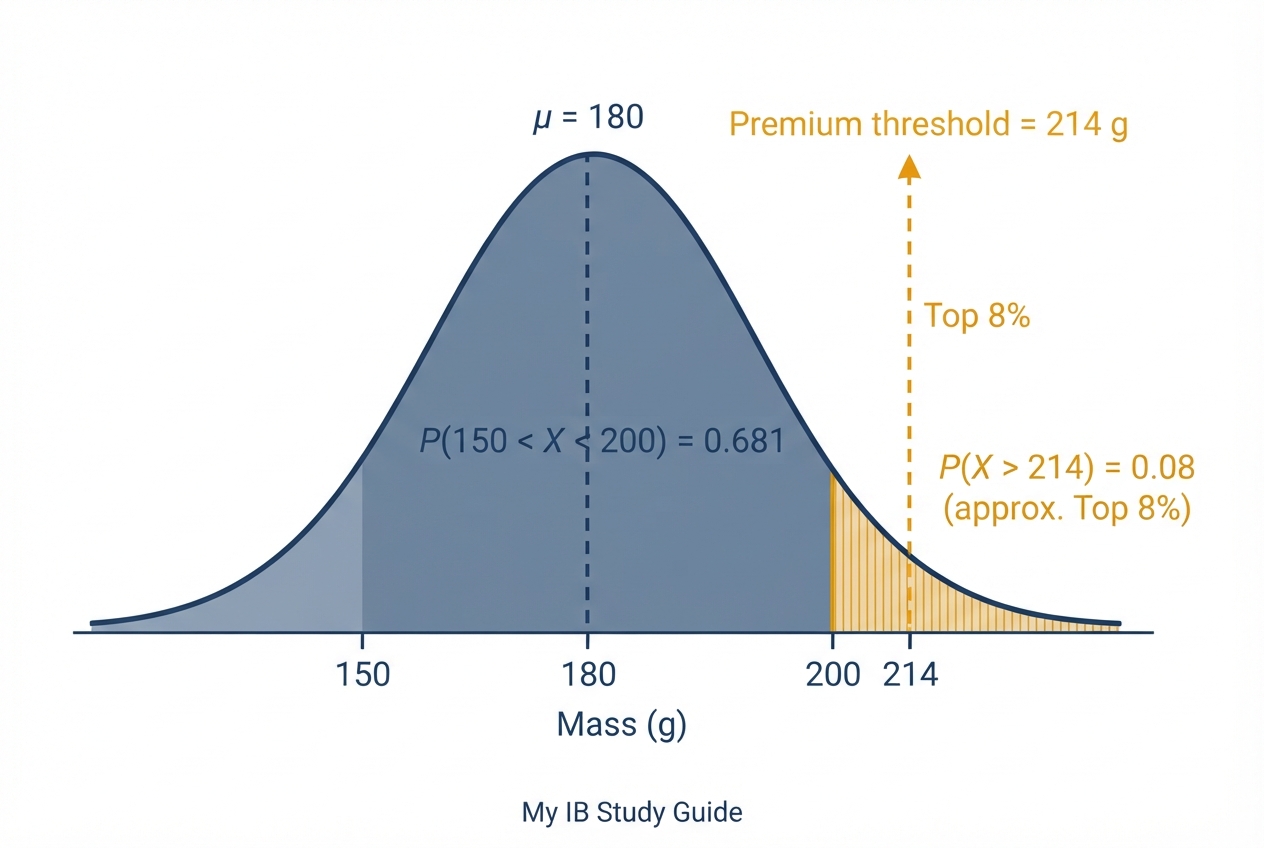
[2 marks](b) Find the probability that a randomly selected avocado has a mass between \( 150 \) g and \( 200 \) g.
[2 marks](c) Avocados with a mass in the top \( 8\% \) are classified as “premium” and sold at a higher price. Find the minimum mass of a premium avocado, giving your answer correct to the nearest gram.
[3 marks](d) In a batch of \( 500 \) avocados, find the expected number of premium avocados.
[2 marks]Total: [9 marks]
What You Need to Know
📖 Key Information
Topic: Statistics — Normal distribution and inverse normal (AA SL 4.9, AA HL 4.9)
Paper style: Paper 2 (calculator allowed)
Estimated time: 8–11 minutes
Key notation: If \( X \) is normally distributed with mean \( \mu \) and standard deviation \( \sigma \), write:
GDC steps for normal distribution (TI-84 / TI-Nspire):
- Normal CDF (probability): DISTR → normalcdf(lower, upper, \( \mu \), \( \sigma \)). Use \( -10^{99} \) as lower bound for “less than” and \( 10^{99} \) as upper bound for “greater than.”
- Inverse Normal (finding a value given probability): DISTR → invNorm(area to the left, \( \mu \), \( \sigma \)). If the question gives the right-tail area, subtract from 1 first if your calculator doesn’t support area to the right.
Note: Graphical display calculators support LEFT, CENTER, and RIGHT area.
Formula booklet: The normal distribution formula is provided — you do not need to memorise it. Focus on setting up the correct inputs for your GDC.
If you want to sharpen your GDC technique before attempting this question, our post on IB Math Paper 1 vs Paper 2: Different Strategies explains exactly when and how to use your calculator efficiently. You can also check the official syllabus details on the IB Mathematics curriculum page.
Hints
💡 Hint 1 — Getting Started
Start by writing the distribution clearly: \( X \sim N(180, 24^2) \). For parts (a) and (b), you are finding probabilities from given values — this means using the normal CDF function on your GDC. Sketch a rough bell curve and shade the region you want to find. This will help you avoid inputting the wrong bounds.
⏸ Try working with this hint before opening Hint 2.
💡 Hint 2 — Inverse Normal Setup
For part (c), the top \( 8\% \) means the right-tail area is \( 0.08 \). Your GDC’s inverse normal function requires the left-tail area (cumulative area from the left). So input \( 1 – 0.08 = 0.92 \) as the area, along with \( \mu = 180 \) and \( \sigma = 24 \).
⏸ Try completing parts (a), (b), and (c) before opening Hint 3.
💡 Hint 3 — Using Your Answer from Part (c)
For part (d), you have already found the probability that one avocado is premium — it is \( 0.08 \) (given directly in the question). The expected number in a batch of 500 is simply \( 500 \times 0.08 \). This is an application of the expected value formula for a binomial distribution: \( E(X) = np \).
⏸ Now try finishing the solution on your own.
Full Worked Solution
✍️ Step-by-Step Solution
Step 1: Define the Distribution
For this IB math statistics practice question, we begin by writing the distribution in correct notation. The mean is \( \mu = 180 \) g and the standard deviation is \( \sigma = 24 \) g, so:
Part (a): P(X > 210) — Normal CDF
We want the probability that an avocado has mass greater than 210 g. Using GDC: normalcdf(210, \( 10^{99} \), 180, 24):
Part (b): P(150 < X < 200) — Normal CDF with Two Bounds
We want the probability that mass falls between 150 g and 200 g. Using GDC: normalcdf(150, 200, 180, 24):
Part (c): Inverse Normal — Finding the Premium Threshold
Premium avocados are in the top 8%, so the right-tail area is 0.08. The left-tail area (cumulative from the left) is:
Using GDC: invNorm(0.92, 180, 24):
Part (d): Expected Number of Premium Avocados
The probability that one randomly selected avocado is premium is \( p = 0.08 \). In a batch of \( n = 500 \) avocados, the expected number is:
(a) \( P(X > 210) = 0.106 \) (3 s.f.)
(b) \( P(150 < X < 200) = 0.681 \) (3 s.f.)
(c) Minimum mass of a premium avocado \( = 214 \) g
(d) Expected number of premium avocados \( = 40 \)
(a) [M1] Correct use of normal CDF with correct bounds and parameters; [A1] Answer 0.106 — 2 marks
(b) [M1] Correct use of normal CDF with both bounds 150 and 200; [A1] Answer 0.681 — 2 marks
(c) [M1] Recognising inverse normal is required; [M1] Converting right-tail 0.08 to left-tail 0.92; [A1] Answer 214 g — 3 marks
(d) [M1] Multiplying 500 by their probability from part (c) context (0.08); [A1] Answer 40 — 2 marks
Total: 9 marks
Examiner Notes
🎓 What the Examiner Wants to See
- Write the distribution in correct notation. Begin with \( X \sim N(180, 24^2) \) — note that the second parameter is \( \sigma^2 \), not \( \sigma \). Writing \( N(180, 24) \) is a notation error and can cost a mark.
- Show GDC inputs explicitly. Write something like “normalcdf(210, 1E99, 180, 24)” or “invNorm(0.92, 180, 24)” in your working. Examiners award a method mark for correct GDC setup even if you make an arithmetic error.
- Give answers to 3 significant figures unless the question specifies otherwise. For part (c), the question asks for the nearest gram — follow the rounding instruction exactly.
- Do not confuse \( \sigma \) and \( \sigma^2 \) in your GDC. Your GDC always requires the standard deviation (\( \sigma = 24 \)), not the variance (\( \sigma^2 = 576 \)). Entering 576 instead of 24 produces a completely wrong answer.
- Part (d) is a follow-through mark. If your answer to part (c) gives a different probability, you can still earn both marks in part (d) by multiplying 500 by your probability consistently — the IB awards follow-through marks for correct method.
Common Mistakes
❌ Common Mistakes to Avoid
1. Entering variance instead of standard deviation in the GDC
This is the most common error on normal distribution questions. The notation \( N(180, 24^2) \) shows the variance as \( 576 \), but your GDC requires the standard deviation. Always enter \( \sigma = 24 \), not \( \sigma^2 = 576 \). Entering 576 gives a drastically incorrect probability and will cost you every mark in the affected part.
2. Using the wrong tail in the inverse normal
The question says “top 8%,” which means the right-tail area is 0.08. Most GDC functions require the left-tail (cumulative) area. Entering invNorm(0.08, 180, 24) instead of invNorm(0.92, 180, 24) gives a value of approximately 146 g — a mass below the mean, which makes no logical sense for the top 8%. Always sketch the distribution and shade the region first to avoid this trap.
3. Rounding intermediate answers and carrying that into part (d)
If you round your probability to 3 s.f. in part (a) and then use that rounded value in part (d), you may introduce a rounding error. For part (d), use \( p = 0.08 \) exactly as given in the question context, not a calculated value. The question states the top 8% directly — you do not need to recalculate the probability for part (d).
HL Extension: If you are studying AI HL, consider this: if \( n = 500 \) avocados are selected and \( Y \) is the number of premium avocados, then \( Y \sim B(500, 0.08) \). Use the Poisson approximation or a normal approximation to find \( P(Y \geq 50) \) as a further challenge.
📚 Want More Practice?
Statistics Workbook (Coming Soon)
Statistics practice covering descriptive stats, probability, distributions, and regression — with detailed solutions for every question. Master the normal distribution and every other stats topic before your exams.
$10.45
Get the Statistics Workbook on SamzHub →The normal distribution appears on almost every Paper 2 exam, so every time you work through an IB math statistics practice question like this one you are building a skill that will pay off directly on exam day. Keep practising your GDC inputs, trust your process, and come back next week for another challenge.