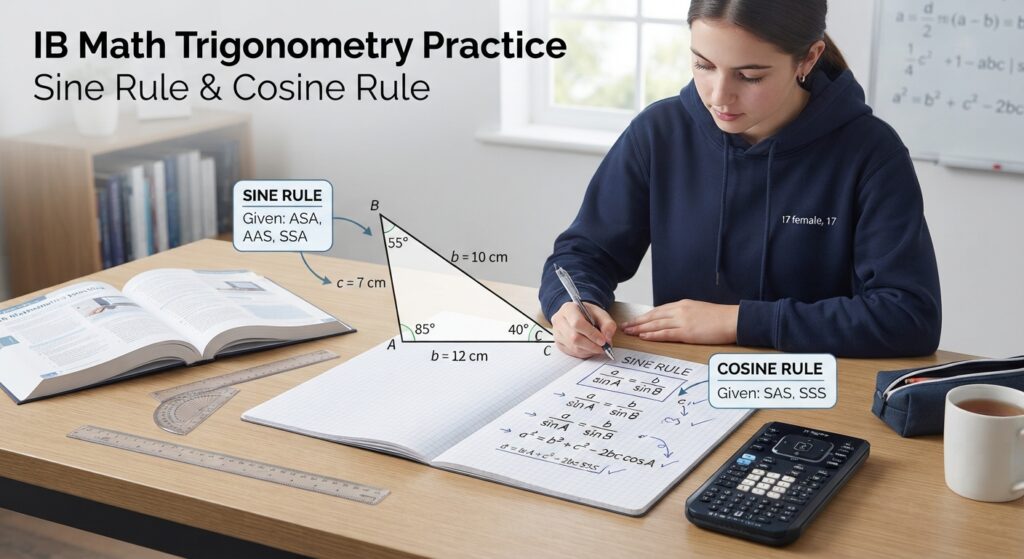
This IB math trigonometry practice question puts your sine rule and cosine rule skills to the test in a realistic non-right triangle context — the kind of problem that trips up students who try to apply the wrong rule without thinking first. Choosing the right formula is half the battle, and that decision-making skill is exactly what the IB examiners want to see. Before you look at any hints, draw the triangle yourself, label every piece of given information, and decide which rule to reach for first. That process alone is worth practising.
📋 Jump To
This Week’s IB Math Trigonometry Practice Question
📝 Question of the Week
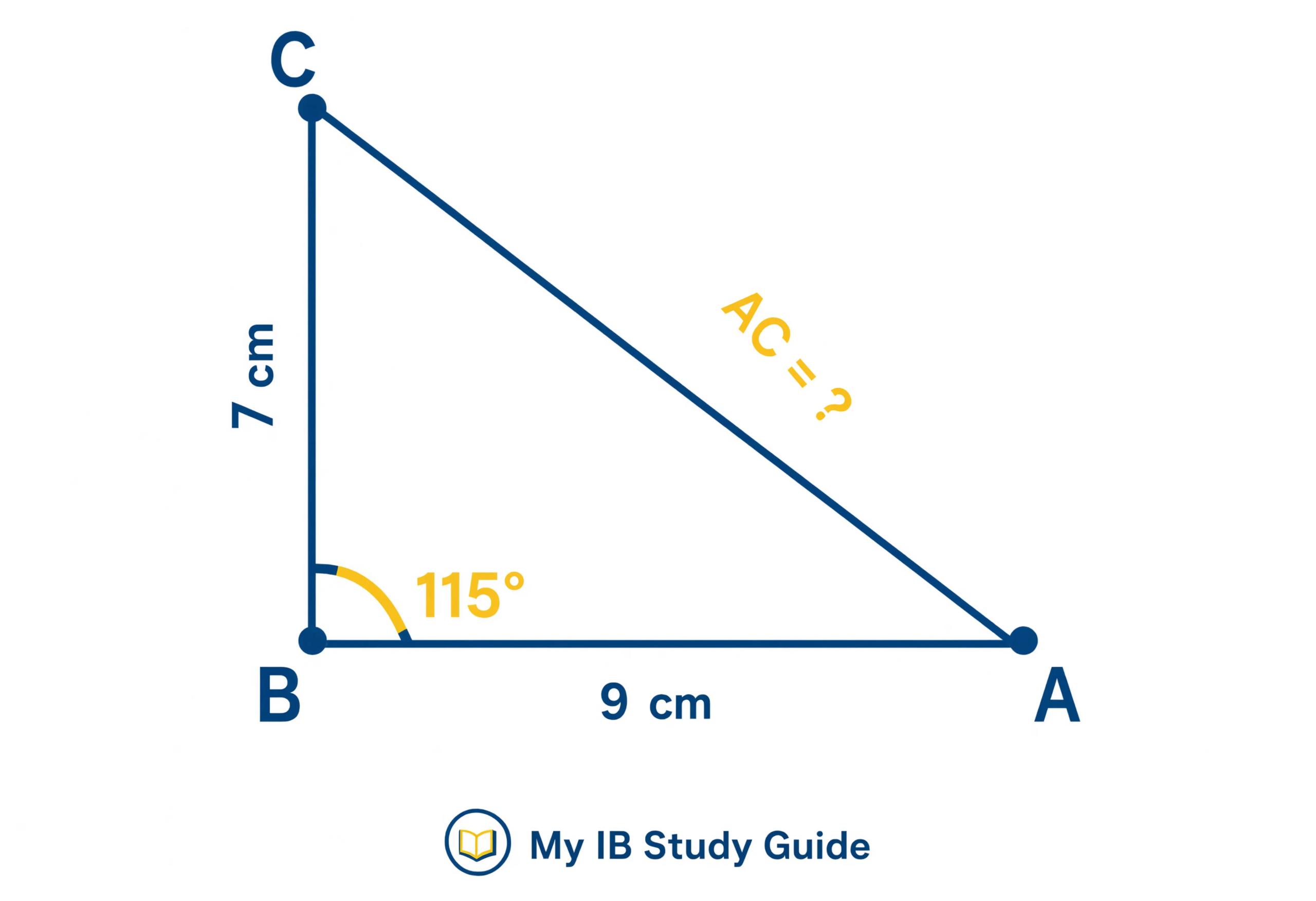
In triangle \( ABC \), the following information is known:
(a) Find the length of \( AC \), giving your answer correct to three significant figures.
[3 marks](b) Find the size of angle \( \hat{BAC} \), giving your answer correct to one decimal place.
[3 marks](c) Find the area of triangle \( ABC \), giving your answer correct to three significant figures.
[2 marks]Total: [8 marks]
What You Need to Know
📖 Key Information
Topic: Trigonometry — Sine rule and cosine rule (AA SL 3.6, AA HL 3.6)
Paper style: Paper 1 (no calculator) — exact values and careful arithmetic required
Estimated time: 9–12 minutes
Formulas from the data booklet:
Cosine rule:
Sine rule:
Area of a triangle:
When to use which rule:
- Cosine rule: Use when you know two sides and the included angle (SAS), or all three sides (SSS).
- Sine rule: Use when you know two angles and one side (AAS or ASA), or two sides and a non-included angle (SSA — watch for the ambiguous case).
In this question, parts (a) and (c) use SAS — so the cosine rule and area formula apply directly. Part (b) uses the sine rule once you have \( AC \).
If you want to build your rule-selection instincts further, our post on 10 calculator skills every IB Math student needs includes tips on checking your triangle answers efficiently. For the full syllabus context, visit the IB Mathematics curriculum page.
Hints
💡 Hint 1 — Getting Started
Look at what you are given: two sides (\( AB = 9 \) and \( BC = 7 \)) and the angle between them (\( \hat{ABC} = 115° \)). This is the SAS (side-angle-side) configuration. When you have SAS and need to find the opposite side, the cosine rule is your go-to formula. Write it out with the correct labelling before substituting any numbers.
⏸ Try working with this hint before opening Hint 2.
💡 Hint 2 — Setting Up the Cosine Rule
Label the sides opposite to their angles: side \( a = BC = 7 \) (opposite \( A \)), side \( b = AC \) (opposite \( B \) — this is what we want), and side \( c = AB = 9 \) (opposite \( C \)). The cosine rule for side \( AC \) is:
Remember that \( \cos(115°) \) is negative because \( 115° \) is in the second quadrant. This means the term \( -2 \cdot AB \cdot BC \cdot \cos(115°) \) actually adds to \( AB^2 + BC^2 \).
⏸ Try completing parts (a) and (c) before opening Hint 3.
💡 Hint 3 — Finding the Angle in Part (b)
Now that you have \( AC \), you know all three sides. You could use the cosine rule again to find angle \( \hat{BAC} \), but the sine rule is faster here. You already know side \( AC \) and angle \( \hat{ABC} = 115° \):
Since \( \hat{ABC} = 115° \) is obtuse and the triangle can only have one obtuse angle, angle \( \hat{BAC} \) must be acute — so there is no ambiguous case to worry about.
⏸ Now try finishing the solution on your own.
Full Worked Solution
✍️ Step-by-Step Solution
Part (a) Step 1: Identify the Configuration and Apply the Cosine Rule
For this IB math trigonometry practice question, we have two sides and the included angle (SAS): \( AB = 9 \) cm, \( BC = 7 \) cm, \( \hat{ABC} = 115° \). We apply the cosine rule to find \( AC \):
Part (a) Step 2: Substitute and Evaluate
Substitute the known values. Note that \( \cos(115°) = -\cos(65°) \approx -0.42262 \):
Part (b) Step 3: Apply the Sine Rule to Find Angle BAC
We now know side \( AC = 13.537\ldots \) cm (use the unrounded value) and the angle opposite it, \( \hat{ABC} = 115° \). We want angle \( \hat{BAC} \), which is opposite side \( BC = 7 \) cm. Apply the sine rule:
Since \( \hat{ABC} = 115° \) is already obtuse, angle \( \hat{BAC} \) must be acute — no ambiguous case arises.
Part (c) Step 4: Find the Area Using the SAS Formula
We use the two known sides \( AB = 9 \) cm and \( BC = 7 \) cm with their included angle \( \hat{ABC} = 115° \):
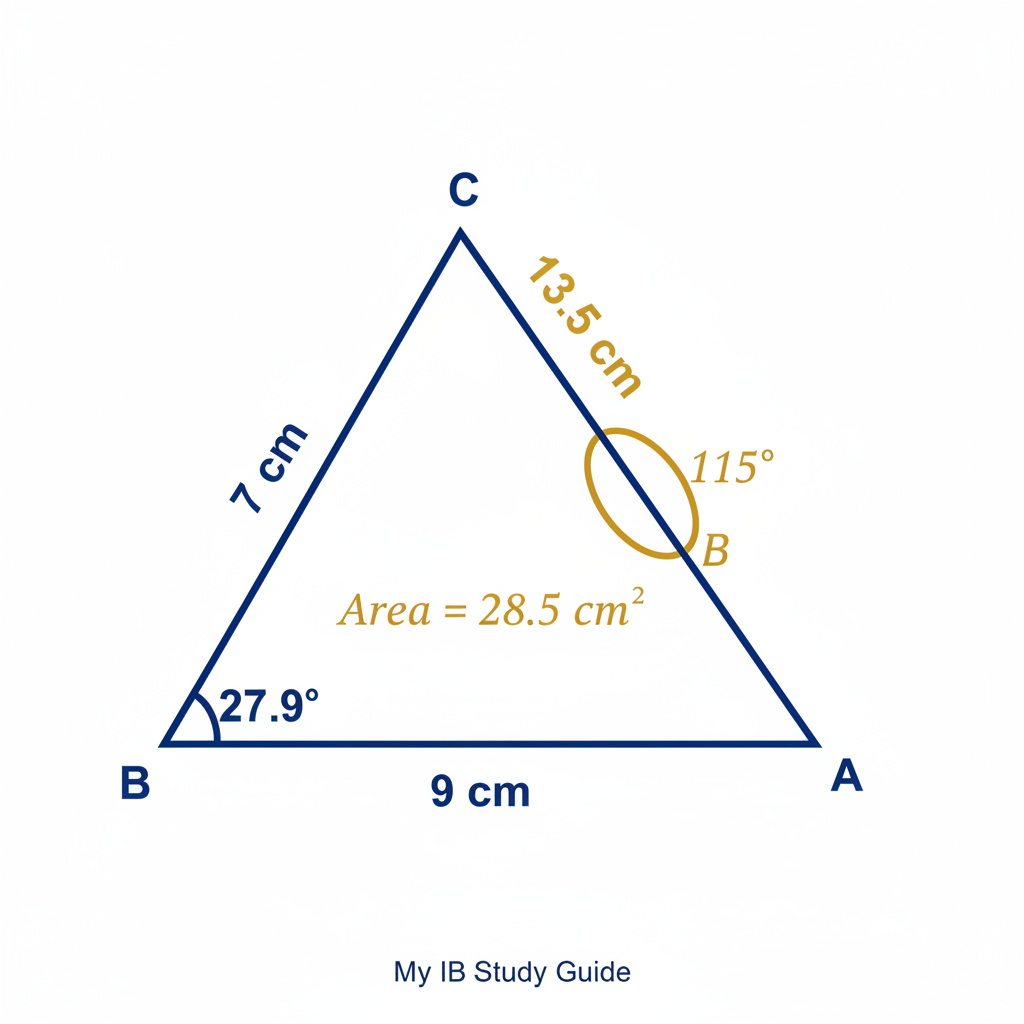
(a) \( AC = 13.5 \) cm (3 s.f.)
(b) \( \hat{BAC} = 27.9° \) (1 d.p.)
(c) Area \( = 28.5 \) cm² (3 s.f.)
(a) [M1] Correct use of cosine rule with correct substitution; [A1] Correct unsimplified expression; [A1] \( AC = 13.5 \) cm — 3 marks
(b) [M1] Correct use of sine rule with \( AC \) and \( \hat{ABC} \); [A1] Correct value of \( \sin(\hat{BAC}) \); [A1] \( \hat{BAC} = 27.9° \) — 3 marks
(c) [M1] Correct area formula with correct substitution; [A1] \( 28.5 \) cm² — 2 marks
Total: 8 marks
Examiner Notes
🎓 What the Examiner Wants to See
- State the rule you are using before substituting. Write “using the cosine rule” or “applying the sine rule” explicitly. This signals clear mathematical reasoning and makes your method mark secure even if an arithmetic slip follows.
- Show the formula before substitution. Write \( AC^2 = AB^2 + BC^2 – 2 \cdot AB \cdot BC \cdot \cos(\hat{ABC}) \) before filling in numbers. Jumping straight to numbers without the formula costs a method mark.
- Use unrounded intermediate values. Store \( AC = 13.537\ldots \) and use it in part (b). Rounding to 13.5 at the end of part (a) and then using 13.5 in part (b) introduces error and may cost the final accuracy mark.
- Address the ambiguous case explicitly if relevant. In this question the obtuse angle at \( B \) guarantees \( \hat{BAC} \) is acute, so there is no ambiguity — but mention this in your working if you want to demonstrate full understanding.
- Units matter. Always write cm and cm² for length and area answers. Omitting units on a final answer can cost an accuracy mark.
Common Mistakes
❌ Common Mistakes to Avoid
1. Treating the triangle as right-angled and using SOH CAH TOA
Because the problem gives two sides and an angle, some students instinctively reach for SOH CAH TOA. This only works in right-angled triangles. Triangle \( ABC \) has an angle of \( 115° \) — it is not right-angled. Applying SOH CAH TOA here produces a completely incorrect answer and earns no marks for method.
2. Treating cos(115°) as positive
\( \cos(115°) \) is negative (approximately \( -0.423 \)) because \( 115° \) lies in the second quadrant where cosine is negative. Students who write \( 130 – 126 \times 0.423 \) instead of \( 130 + 126 \times 0.423 \) end up with \( AC^2 \approx 76.7 \) and \( AC \approx 8.76 \) cm — a result that is actually smaller than both given sides, which should immediately signal an error.
3. Rounding AC too early and carrying the error forward
Rounding \( AC \) to 13.5 cm after part (a) and then using 13.5 in the sine rule in part (b) gives \( \hat{BAC} \approx 27.8° \) instead of \( 27.9° \). This small rounding difference costs the final A1 in part (b). Always keep at least four significant figures in intermediate calculations and only round at the very last step of each part.
HL Extension: If you are studying AA HL, find the size of angle \( \hat{BCA} \) and verify that the three angles sum to \( 180° \). You should get \( \hat{BCA} \approx 37.1° \), giving \( 115° + 27.9° + 37.1° = 180° \) — a useful self-check technique you should always apply in the exam.
📚 Want More Practice?
Geometry and Trigonometry Workbook (Coming Soon)
Trigonometry and geometry practice from basic ratios to advanced applications — covering sine rule, cosine rule, and area problems with full solutions and examiner notes for every question.
$10.45
Get the Geometry Workbook on SamzHub →Every time you work through an IB math trigonometry practice question like this one, you are sharpening the rule-selection instinct that separates confident students from hesitant ones in the exam hall. Keep practising, trust your labelling process, and come back next week for a brand new challenge.