
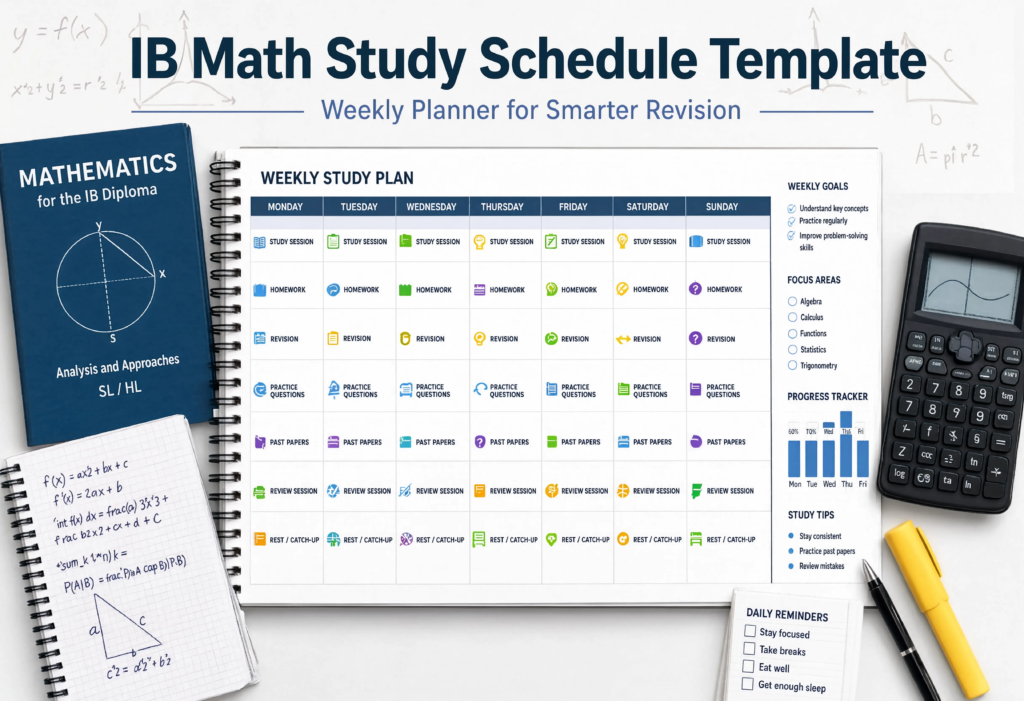
A well-designed IB math study schedule template is one of the most powerful tools you can use to stay consistent, reduce stress, and actually enjoy the process of mastering IB Mathematics.
📋 In This Guide
Let’s be honest — IB Math is one of those subjects that punishes cramming. Whether you’re taking Analysis and Approaches (AA) or Applications and Interpretation (AI) at Standard Level or Higher Level, the content builds on itself week after week. Without a clear IB math study schedule, it’s easy to fall behind and feel overwhelmed before exams even arrive.
The good news? You don’t need to study more — you need to study smarter and more consistently. An IB math study schedule template gives you a framework to follow so you never have to wonder, “What should I study today?” Instead, you’ll sit down, open your planner, and know exactly what to work on.
In this guide, we’ll walk you through how to build a realistic IB math study plan, how many hours to dedicate each week, what each session should look like, and how to adjust when exam season hits. If you’re looking for more ways to organize your IB life, check out our guide on how to balance IB Math with your other subjects.
Why You Need a Study Schedule
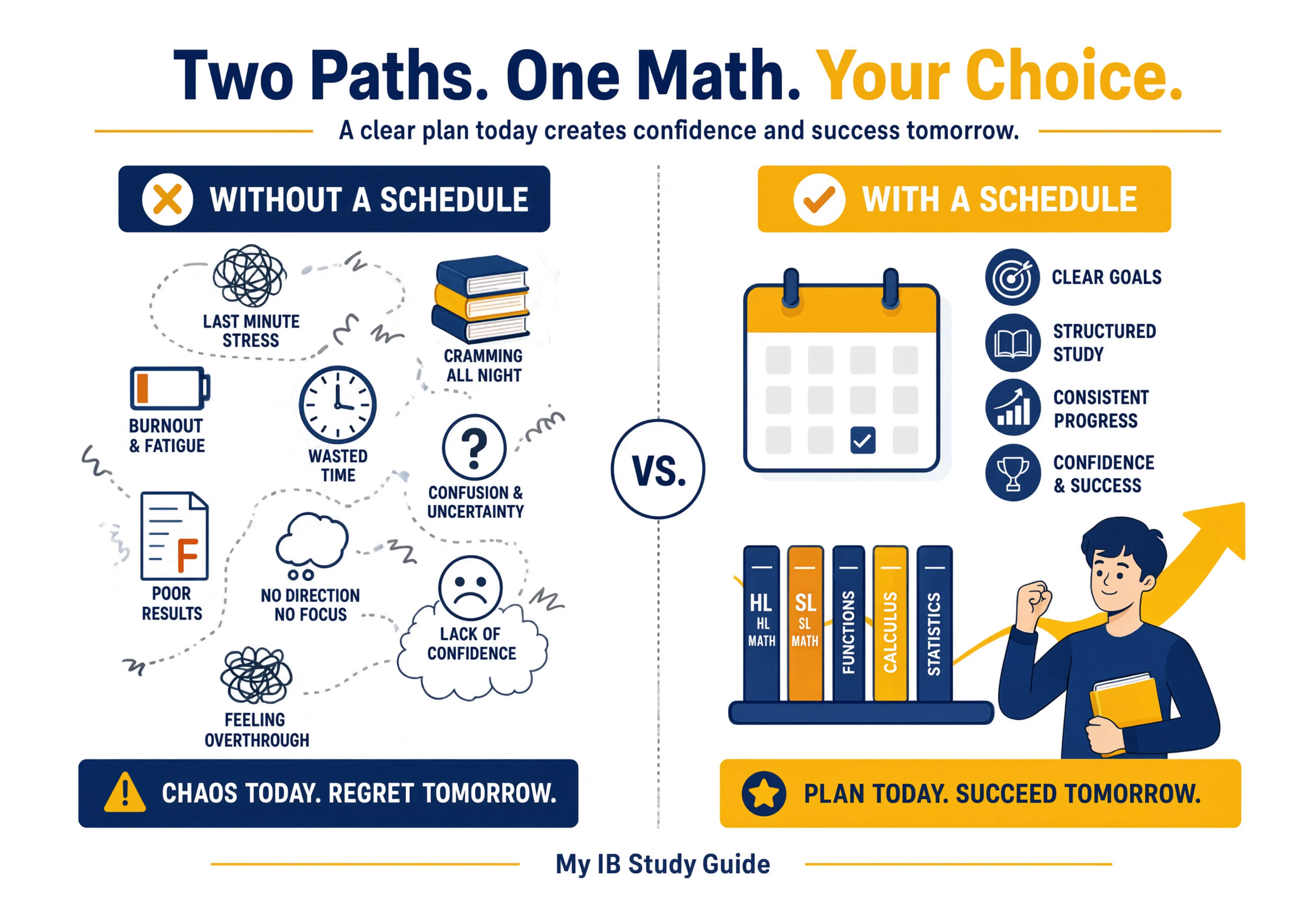
IB Math isn’t a subject you can learn the night before a test. Topics like calculus, probability, and functions require repeated practice over time. A study schedule forces you to spread that practice out, which is far more effective for long-term retention.
Here’s why structure matters so much in IB Math specifically:
- Each topic builds on the previous one — falling behind creates a snowball effect
- You need time for both concept learning and problem practice
- Your Internal Assessment (IA) requires separate, dedicated planning time
- Exam papers test multiple topics together, so you need cumulative review
- Consistency beats intensity — 30 minutes daily outperforms 4-hour weekend sessions
Without a plan, most students default to studying whatever feels urgent rather than what’s most important. A schedule puts you in control instead of letting deadlines control you.
How Many Hours Per Week
This is one of the most common questions, and the answer depends on your level and how far along you are in the course.
General Weekly Guidelines
- SL students (Year 1): 3–4 hours per week outside class
- SL students (Year 2): 4–6 hours per week, increasing before exams
- HL students (Year 1): 5–6 hours per week outside class
- HL students (Year 2): 6–8 hours per week, increasing before exams
💡 Pro Tip
These hours include homework, practice problems, and review — not just “extra studying.” If you’re already spending 3 hours on homework, you may only need 1–2 more hours of focused review per week in Year 1.
The key is consistency. Five sessions of 45 minutes will always beat one five-hour marathon. Your IB math study plan should reflect this by spreading sessions across the week.
📚 Recommended Resource
IB Math IA Timeline Template
Includes all 6 stages from topic selection to final submission, milestone tables with target date fields, 15 weekly planning grids, teacher sign-off columns, and a 6 common timeline mistakes guide — all designed specifically for IB Math students. Stop guessing what to do and start following a proven structure.
grab it for $7.99 below!
Get the Study Schedule Template on SamzHub →The Ideal Weekly IB Math Study Schedule Template Structure
A great weekly structure balances three types of study: learning new content, practicing problems, and reviewing past topics. Here’s a framework you can adapt to your own timetable.
Sample Weekly Layout (HL Student)
- Monday: Review class notes + complete assigned homework (45 min)
- Tuesday: Practice problems on the current topic — aim for variety (45 min)
- Wednesday: Rest day or light review of formulas (15 min)
- Thursday: Review class notes + complete assigned homework (45 min)
- Friday: Cumulative review — revisit one past topic with practice problems (45 min)
- Saturday: Longer focused session — past paper practice or IA work (60–90 min)
- Sunday: Rest or light formula review (15 min)
SL students can reduce Saturday sessions and drop one weekday session. The important thing is that your IB revision schedule includes at least one cumulative review session per week — this is what prevents you from forgetting earlier topics.
📌 Important
Your schedule should be realistic. If you know you have sports practice on Tuesdays, don’t schedule a 90-minute study block that day. A schedule you actually follow is infinitely better than a perfect one you ignore.
What to Include in Each Study Session
Not all study time is created equal. A 45-minute session with clear structure will accomplish more than two hours of unfocused work. Here’s what an effective session looks like:
- Warm-up (5 min): Review your formula sheet or flashcards for the current unit
- Focused practice (25–30 min): Work through problems — start with textbook exercises, then move to exam-style questions
- Review and reflect (10 min): Check your answers, identify mistakes, and write down what you need to revisit
If you’re doing a cumulative review session, replace the focused practice with problems from a past topic. Keep a running list of topics you’ve reviewed so you cycle through everything over time.
💡 Pro Tip
Keep a “mistake log” — a simple notebook or document where you write down problems you got wrong and why. Reviewing this log before exams is one of the most efficient revision strategies you can use. Learn more about building an effective revision approach in our post on how to build an IB Math revision plan that actually works.
Adjusting for Exam Season
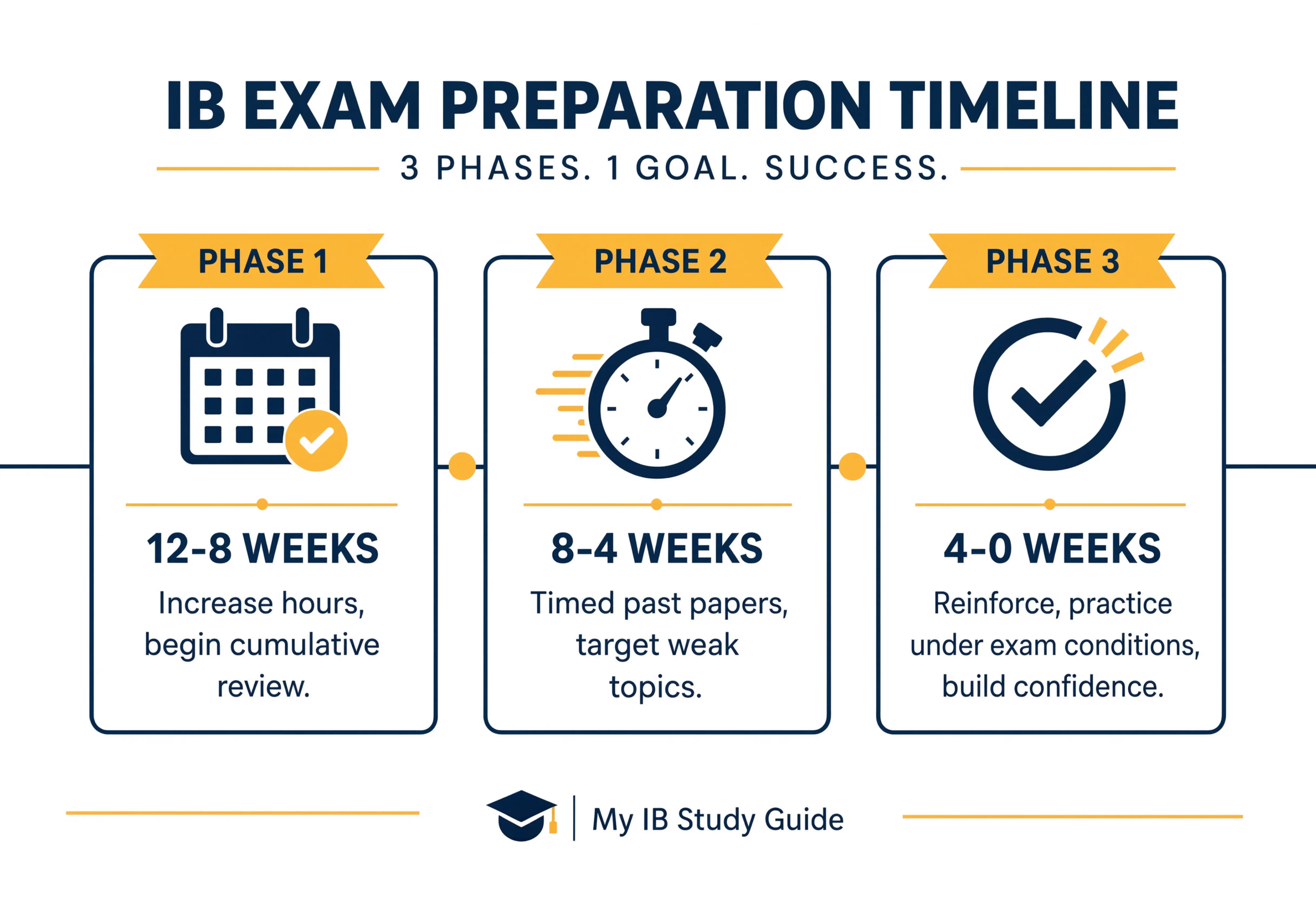
Your IB study schedule should evolve as exams approach. What works in October won’t work in April. Here’s how to shift your focus:
8–12 Weeks Before Exams
Begin increasing your weekly hours by 1–2. Shift the balance from learning new content to reviewing and practising past paper questions. Make sure your IB revision schedule now includes at least two cumulative review sessions per week.
4–8 Weeks Before Exams
Start doing full past papers under timed conditions. Identify your weakest topics and dedicate extra sessions to those areas. This is where a topic tracker becomes essential — you need to see exactly which areas need more work.
Final 2–4 Weeks
⚠️ Watch Out
Don’t try to learn new material in the final two weeks. This time is for reinforcing what you know, practising under exam conditions, and building confidence. If a topic feels completely unfamiliar at this stage, focus on understanding the basics rather than trying to master it.
During exam season, also review the official IB Mathematics curriculum page to make sure you haven’t missed any syllabus areas.
Common Scheduling Mistakes
Even with a great IB math study schedule template, you can undermine your progress by falling into these traps:
- Over-scheduling: Planning 2 hours every day sounds ambitious, but you’ll burn out. Start with less and add more when needed.
- Only studying new content: If you never review past topics, you’ll forget them by exam time. Always include cumulative review.
- Skipping rest days: Your brain consolidates learning during rest. Schedule at least one full rest day per week.
- Not tracking what you’ve covered: Without a topic tracker, you’ll keep reviewing topics you’re already strong in and avoid the ones you’re not.
- Ignoring your IA timeline: Your Internal Assessment needs its own dedicated time blocks — don’t let it compete with exam revision.
The best IB math study plan is one you can actually sustain for months, not one that looks impressive on paper but collapses after two weeks. For more tips on building sustainable habits, read our guide on how to create a weekly study routine that sticks.
✅ Key Takeaways
- An IB math study schedule template removes daily decision fatigue and keeps you consistent throughout the year.
- SL students should aim for 3–6 hours per week outside class; HL students should aim for 5–8 hours, depending on the year.
- Every session should include a warm-up, focused practice, and reflection — not just passive reading.
- Your schedule must include cumulative review sessions to prevent forgetting earlier topics.
- Adjust your plan as exam season approaches — shift from learning to reviewing and practising under timed conditions.
Frequently Asked Questions
Building a study schedule isn’t the most exciting part of IB Math — but it might be the most impactful. With the right IB math study schedule template, you’ll spend less time stressing about what to study and more time actually making progress. Start simple, stay consistent, and adjust as you go. Your future self will thank you.