Deciding between an IB Math IA calculus or statistics exploration — or perhaps a modeling approach — is one of the first and most consequential choices you’ll make in the IA process. Pick the right mathematical area, and everything from research to writing flows naturally. Pick the wrong one, and you’ll be fighting your topic for weeks.
📋 In This Guide
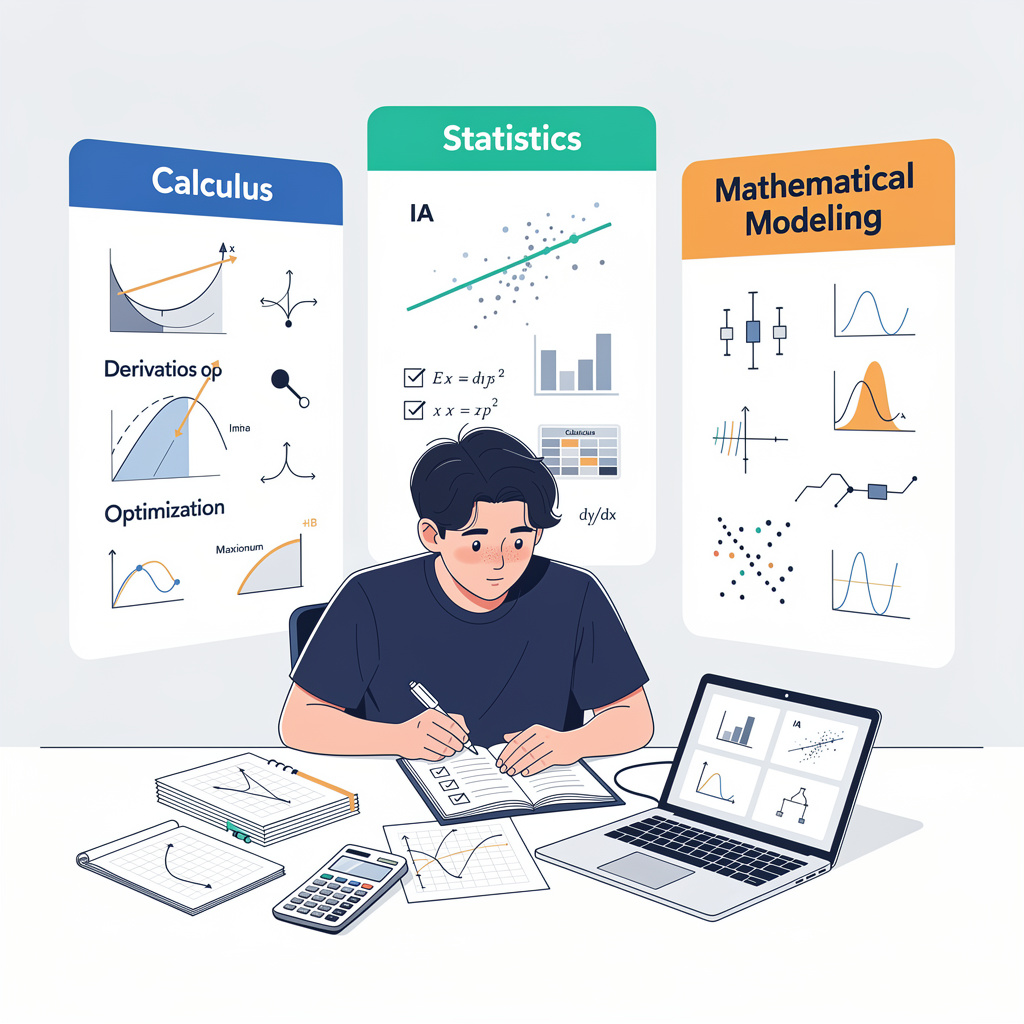
When you start brainstorming your Internal Assessment, the mathematical direction you choose shapes everything — your research question, the tools you’ll use, the data you’ll need, and ultimately how enjoyable (or painful) the process will be. Most IAs fall into three broad categories: calculus-based, statistics-based, or modeling-based, though geometry and functions explorations also exist.
The question of IB Math IA calculus or statistics comes up constantly in classroom discussions, and for good reason. Each type has distinct advantages and challenges depending on your course — Analysis and Approaches (AA) or Applications and Interpretation (AI) — your level (SL or HL), and your personal strengths. If you’re still in the early brainstorming stage, our complete guide on choosing your IB Math IA topic is a great starting point.
This guide breaks down each IA type honestly — what it involves, who it suits, and where students commonly struggle — so you can make a confident decision before investing weeks of work.
The Three Main IA Types (and Two More)
There’s no official IB classification of IA “types,” but experienced teachers and examiners consistently see explorations cluster around five mathematical areas. Understanding each one helps you match your best ib math ia topic area to your actual skills.
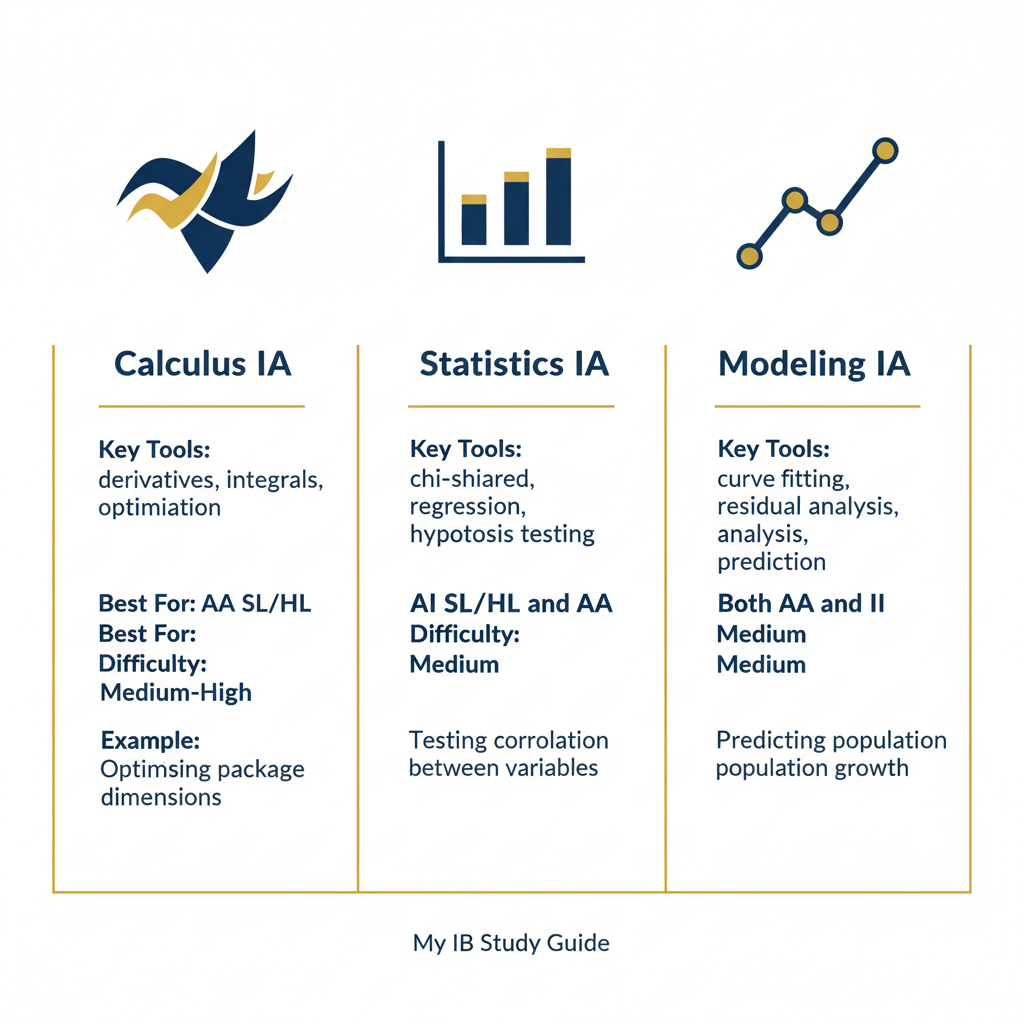
- Calculus — Differentiation, integration, optimisation, rates of change, differential equations (HL)
- Statistics — Hypothesis testing, regression, correlation, probability distributions, chi-squared tests
- Modeling — Fitting mathematical models to real-world data, comparing model accuracy, predictive analysis
- Geometry & Trigonometry — Spatial reasoning, vectors, non-Euclidean geometry (HL), fractal geometry
- Functions & Number Theory — Exploring properties of functions, sequences, series, or number patterns
The first three are by far the most common. Geometry and functions IAs can be excellent, but they require strong mathematical maturity and are more common at HL. For most students, the core decision comes down to IB Math IA calculus or statistics — with modeling as a strong third option that often blends elements of both.
💡 Pro Tip
Your IA type doesn’t have to match your favourite classroom unit. Some students who struggle with calculus in exams produce outstanding calculus IAs because they chose a topic they genuinely cared about. Personal engagement matters more than past test scores.
Calculus IAs
Calculus-based explorations are popular among AA students, especially at HL, because the course emphasises these tools heavily. But they’re also accessible to AA SL students who are comfortable with differentiation and integration.
What a Calculus IA Looks Like
Typical calculus IAs involve optimising a real-world quantity, exploring rates of change, calculating areas or volumes, or investigating how a function behaves. The mathematical depth often comes from applying calculus to a context rather than proving theorems.
Example directions:
- Optimising the dimensions of packaging to minimise material cost
- Modelling the rate of coffee cooling using Newton’s Law of Cooling and integration
- Investigating the relationship between velocity and displacement using real motion data
- Exploring related rates in a practical engineering context
Who It Suits
Choose a calculus IA if you enjoy working with derivatives and integrals, you’re comfortable with algebraic manipulation, and you want a more “pure math” feel to your exploration. AA HL students have the widest range of tools here, including differential equations and Maclaurin series.
Common Pitfalls
The biggest risk with calculus IAs is being too theoretical. If you simply differentiate a function and find a maximum without any real-world application or interpretation, you’ll struggle with Criterion C (Personal Engagement) and Criterion D (Reflection). Always connect the calculus to something meaningful.
Statistics IAs
Statistics IAs are the most popular choice across both AA and AI courses. They’re especially well-suited to AI students, since the Applications and Interpretation course places heavy emphasis on data analysis, but AA students can write excellent statistics IAs too.
What a Statistics IA Looks Like
These explorations typically involve collecting or sourcing data, running statistical tests, and drawing conclusions. The mathematical rigour comes from choosing appropriate tests, checking conditions, and interpreting results correctly.
Example directions:
- Using chi-squared tests to investigate whether music genre preference is independent of age group
- Performing linear regression to explore the relationship between study hours and exam performance
- Comparing two populations using t-tests on self-collected survey data
- Investigating whether a dataset follows a normal distribution using goodness-of-fit tests
Who It Suits
Choose statistics if you enjoy working with real data, asking questions about patterns in the world, and interpreting results in context. If you’re an AI student, statistics is often the most natural fit because it aligns directly with your course content. The IB’s Mathematics curriculum overview emphasises that AI students should demonstrate comfort with statistical tools.
Common Pitfalls
The most frequent mistake in statistics IAs is running a test without understanding the underlying conditions. Performing a chi-squared test on data that doesn’t meet the expected frequency requirements, or claiming a correlation proves causation, will cost you marks in Criterion B (Mathematical Communication) and Criterion E (Use of Mathematics).
⚠️ Watch Out
If you choose a statistics IA, make sure your data is rich enough. A survey with only 15 responses won’t support meaningful analysis. Aim for at least 50–100 data points if you’re using primary data, or use a reliable secondary dataset with sufficient size.
📚 Recommended Resource
IA Mini Packs by Math Area
We offer separate IA Mini Packs for Calculus, Statistics, Modeling, Geometry, and Functions. Each pack includes 3 detailed frameworks to help you develop your exploration in the right mathematical area — with structure guidance, personalisation prompts, and Criterion A support.
$5.99–$10.99
Browse IA Mini Packs by Math Area on SamzHub →Modeling IAs
Modeling explorations sit at the intersection of pure math and applied data analysis, making them a great ib math ia type for students who want the best of both worlds. They work well for both AA and AI students.
What a Modeling IA Looks Like
In a modeling IA, you take real-world data and fit one or more mathematical models to it — then evaluate which model best describes the situation and why. The mathematics comes from comparing functions, analysing residuals, and discussing limitations.
Example directions:
- Comparing linear, quadratic, and exponential models for COVID-19 case growth in a specific region
- Using sinusoidal functions to model tidal patterns and testing accuracy against real data
- Modeling population growth with logistic vs exponential functions
- Fitting polynomial regression to sports performance data and predicting future results
Who It Suits
Modeling IAs are ideal if you want to blend calculus or functions knowledge with real data. They’re especially strong for students who enjoy graphical analysis, technology tools like GeoGebra or Desmos, and comparing different mathematical approaches. IB ia modeling explorations also tend to score well on Criterion D (Reflection) because there’s always plenty to discuss about accuracy, limitations, and extensions.
Common Pitfalls
The main risk is letting the technology do all the work. If you simply plug data into a regression calculator and report the output, you haven’t demonstrated mathematical understanding. You need to explain why a particular model fits, discuss the mathematics behind it, and critically evaluate the results. For guidance on reflecting effectively throughout your exploration, read our post on showing personal engagement in your IA coming out next week.
Quick Decision Framework for Your IB Math IA Calculus or Statistics Choice
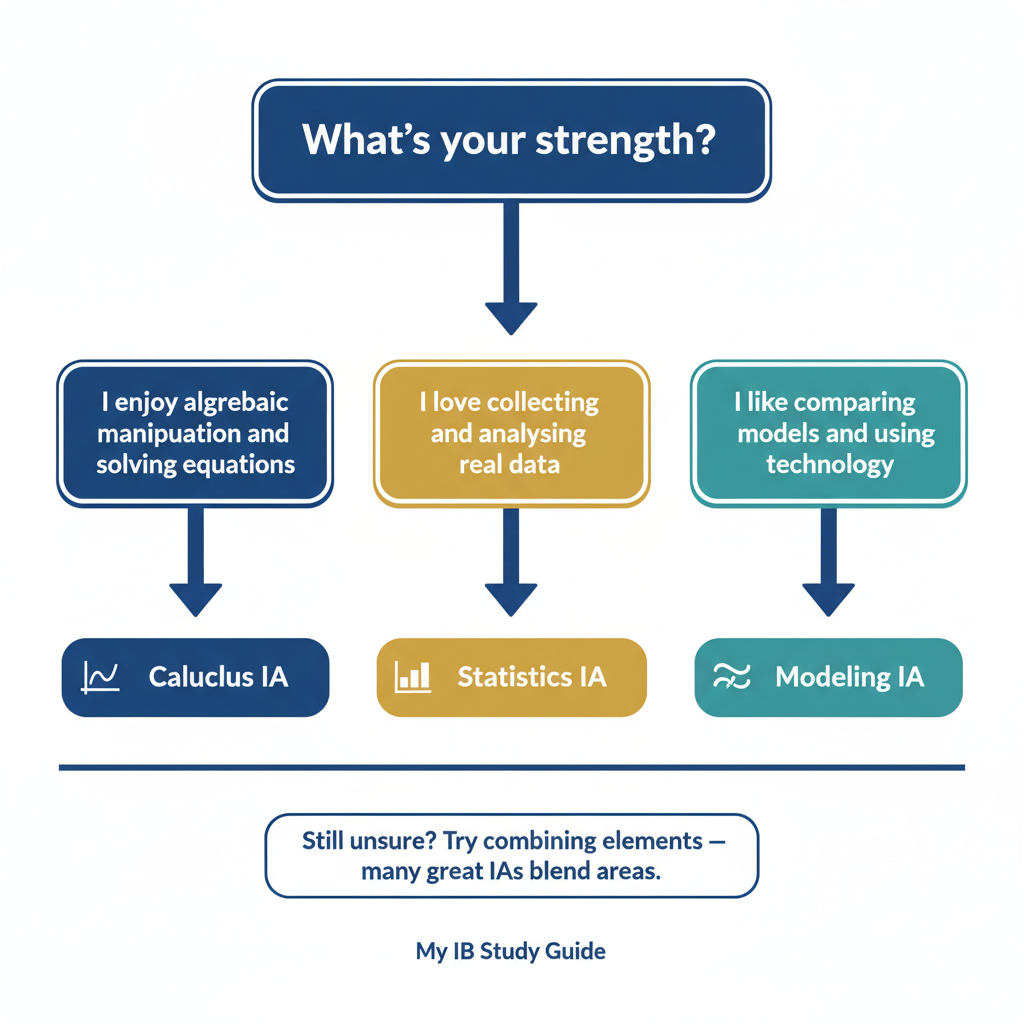
If you’re still torn, use this practical framework. Answer each question honestly — don’t pick what sounds impressive, pick what genuinely matches your strengths.
- What do you enjoy more in class? If derivatives and integrals excite you → lean calculus. If data tables and hypothesis tests feel natural → lean statistics. If graphing functions and comparing fits is your thing → lean modeling.
- What course are you in? AA students have deeper calculus tools available. AI students have richer statistical methods. Both can do modeling. Choose an area where your course gives you strong mathematical tools to showcase.
- Do you have access to good data? Statistics and modeling IAs require reliable data. If you can collect or source quality data, these paths become much stronger. If data access is limited, calculus IAs may be more practical.
- What interests you outside of math? Your best ib math ia topic area is usually one that connects to a genuine interest — sports, music, environment, economics, health. Think about which math type applies most naturally to that interest.
- What level are you? HL students have more tools in every area (differential equations, advanced distributions, etc.). SL students can still produce excellent IAs in any area but should choose topics that match SL-level tools.
📌 Important
There is no “correct” IA type. Examiners don’t prefer calculus over statistics or vice versa. They prefer IAs where the student clearly understands the mathematics, applies it to something meaningful, and reflects thoughtfully on the results. A well-executed statistics IA will outscore a poorly executed calculus IA every time.
For a detailed breakdown of how each criterion is scored — and what examiners prioritise regardless of IA type — see our full rubric breakdown for scoring 18+.
✅ Key Takeaways
- Most IAs fall into five types: calculus, statistics, modeling, geometry, or functions — with the first three being the most common.
- The decision between IB Math IA calculus or statistics depends on your course (AA vs AI), your level, and your personal strengths.
- Calculus IAs suit students who enjoy algebraic reasoning and optimisation — strongest for AA students.
- Statistics IAs suit students who love real-world data and hypothesis testing — especially strong for AI students.
- Modeling IAs blend both approaches and work well for either course.
- No IA type is inherently easier or higher-scoring. What matters is how well you execute it.
Frequently Asked Questions
Choosing between an IB Math IA calculus or statistics or modeling approach doesn’t have to be stressful. Start with what genuinely interests you, match it to the mathematical tools your course provides, and use the decision framework in this guide to confirm your direction. Remember — the best IA type is the one where you can demonstrate understanding, personal engagement, and thoughtful reflection. Whichever path you choose, commit to it and make it yours.